




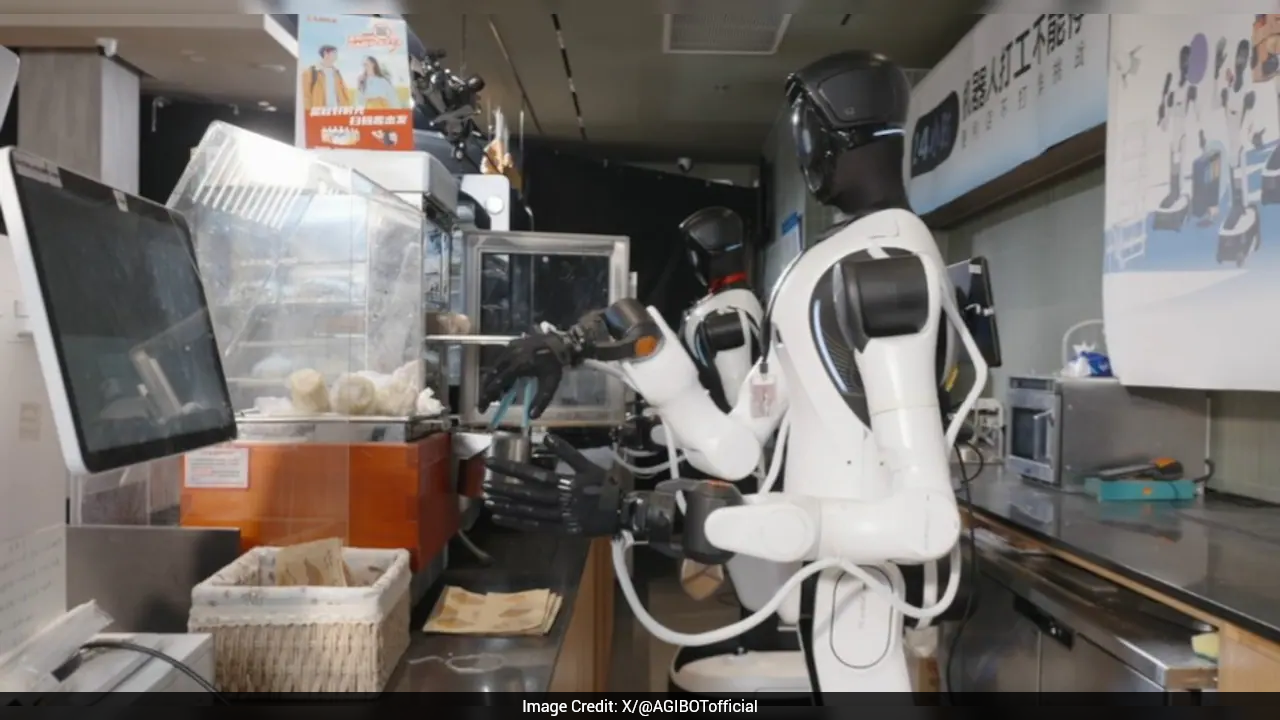
Amid fears that humans might be replaced by robots in workplaces, a new experiment has highlighted that even machines are sometimes not good enough to keep their jobs. Agibot, a Chinese robot manufacturer, recently launched a livestream challenge involving six of its humanoid machines that were pressed into working a 24-hour shift at a convenience store in Shanghai's Xuhui district.
The challenge, called "Robots Never Clock Out" was designed to test whether the humanoid machines could handle the demands of everyday retail work across different periods of the day and night.
In the 24 hours, six robots collectively completed 1,730 tasks, which included 683 customer greetings, 369 item retrievals and deliveries, and 147 coffees. The remaining tasks comprised 126 hot-food orders, 277 shelf inspections and restocking jobs, and 128 table-cleaning tasks.
The challenge was devised to cover four different periods in the day, which included the lunchtime rush, evening crowd, overnight operations and the morning breakfast rush. The idea was to analyse how the machines were performing under different working conditions, rather than relying on a short controlled scenario.
While four robots emerged with adequate performance, the two robots assigned to cleaning and arranging the shelves failed to keep up. According to a report in ITHome, the cleaning bot encountered a full trash can on its route. Instead of picking it, the robot deviated from its designated route, moved outside the store and failed to return to its position.
Meanwhile, the robot tasked with patrolling the shelves 'lacked initiative' when inspecting and replenishing products and could not keep up with the store's turnover pace.
Robots Never Clock Out | AGIBOT G2's 24-Hour Convenience Store Challenge Six AGIBOT G2 take on a 24-hour shift as convenience store trainees. From rush-hour crowds to late-night solo duty and the morning breakfast sprint, can they keep up with nonstop customers and unexpected requests? https://t.co/eg1fUhcr3T
— AGIBOT (@AGIBOTofficial) November 2, 2026
Also Read | Man, 97, Dies At His Own Birthday Party Dancing To 'Staying' Alive'
Human Touch Needed
While humanoid robots might be smart, they still need humans, as AI agents are still not very efficient with hardware. Last month, a US startup called Dimensional posted a job listing hiring human handlers to walk its robot dogs through San Francisco's streets.
Dimensional founder, Stash Pomichter, explained that the dog walkers were being hired to improve the machines' ability to navigate urban environments autonomously. He added that the robo dogs still needed humans, as AI agents couldn't control hardware properly.
"What we determined from our dog-walking experiment was that agents are still very bad at controlling hardware," Pomichter stated.
The company bought 100 robot dogs and 50 humanoid robots from manufacturers in China, Germany, and the US. The $2,000 robot dogs seen on the streets of San Francisco were purchased from Chinese firm Unitree.
Track Latest News Live on NDTV.com and get news updates from India and around the world

