





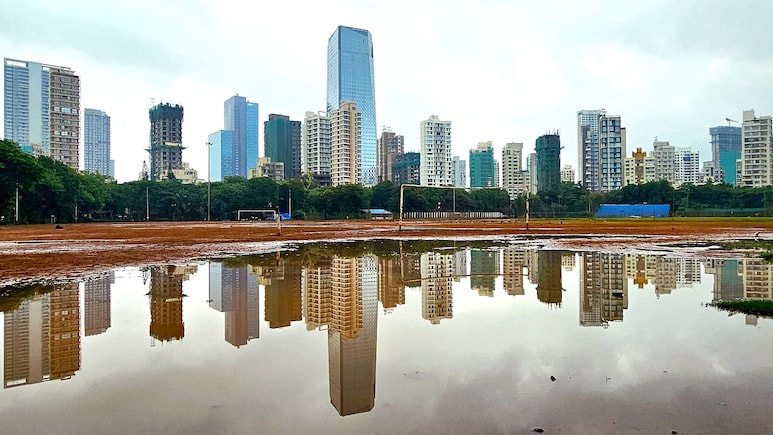
Mumbai is once again staring at a familiar summer concern: Will the city have enough water before the monsoon arrives?
As Mumbai enters the monsoon season, civic officials are keeping a close watch on rainfall over the city's lake catchment areas after the India Meteorological Department (IMD) revised its monsoon forecast downward, predicting rainfall at around 90 per cent of the long-period average this year. The revised forecast has prompted the BMC to review its water management strategy, with senior officials assessing how to ensure an uninterrupted water supply through the summer of 2027.
Where does Mumbai's water come from?
Mumbai is heavily dependent on rainfall. The city receives its drinking water from seven lakes - Upper Vaitarna, Modak Sagar, Tansa, Middle Vaitarna, Bhatsa, Vihar and Tulsi. These reservoirs are replenished primarily during the June-to-September monsoon period and collectively supply nearly 3,950 million litres of water every day to the city.
Unlike many other metropolitan regions, Mumbai currently does not have a major alternative source of potable water, making a healthy monsoon particularly important.
What is the current situation?
According to BMC data, the seven lakes currently hold about 15 per cent of their total storage capacity. Based on the city's average consumption patterns, the existing reserves are estimated to sustain Mumbai's water needs for approximately one-and-a-half months if significant inflows do not occur.
A 10 per cent water cut has been in effect since May 15 as a precautionary measure due to lower reservoir levels before the onset of the monsoon.
Why are officials concerned?
Experts have long pointed out that Mumbai's water challenges are not solely about the amount of water available. The city receives thousands of millions of litres of water every day, yet access remains uneven across neighbourhoods. While planned and formal areas generally receive regular supply, many informal settlements often depend on limited pipelines, community taps or private tankers. In this sense, the problem is frequently one of distribution and infrastructure rather than absolute scarcity.
Mumbai's dependence on monsoon rainfall also exposes a structural vulnerability. Unlike many global cities, Mumbai relies almost entirely on rain-fed reservoirs located outside city limits. Groundwater extraction is limited because of salinity intrusion from the sea, leaving the city with few alternative sources when rainfall underperforms.
At present, there is no immediate risk of taps running dry across the city. The BMC has access to reserve stocks from Bhatsa and Upper Vaitarna and continues to monitor daily consumption levels. Officials have repeatedly urged residents not to panic while emphasising the need for conservation until reservoirs receive substantial inflows from monsoon rains.
The current concern is not about an immediate shortage, but about ensuring adequate reserves for the entire year ahead.
Civic officials say the first two months of the monsoon are particularly important because this is when most inflows into the reservoirs usually occur. Even if overall seasonal rainfall is slightly below average, strong rainfall over the lake catchment areas during June and July could significantly improve the situation. However, if rainfall remains deficient in these regions, reservoir levels may not rise as expected, potentially creating challenges later in the year.
Adding to the concern is the possibility of warmer-than-normal conditions associated with El Nino-like weather patterns, which could increase evaporation from water bodies.
What steps is BMC taking?
The coming weeks will therefore be crucial. If the monsoon arrives on time and rainfall in the catchment areas is close to normal, Mumbai's reservoirs could recover quickly, as they have in previous years. But if rains are significantly delayed or below average, the city may have to contend with prolonged water cuts and tighter restrictions.
The civic body has directed officials to closely monitor rainfall trends and reservoir levels over the coming weeks. It is also planning stricter monitoring of water tanker operations and filling points across the city to ensure fair distribution and prevent unreasonable price increases if demand rises.
At present, officials have not indicated any decision to increase the existing water cut. Future measures will depend on the rainfall received over the next two to three months.
What should Mumbaikars know?
For now, Mumbai is not in a full-blown water crisis. But dwindling lake levels, a drying Upper Vaitarna reservoir and uncertainty over the monsoon have created a situation that civic authorities can no longer afford to treat as routine. The city's annual pre-monsoon water scare is also a reminder of a larger question: Whether a metropolis of over 20 million people can continue to depend almost entirely on a few rain-fed lakes for its drinking water needs.
Authorities emphasise that there is no cause for panic at this stage. The city is entering the monsoon season, and reservoir levels can change significantly depending on rainfall over the catchment areas in June and July.
For now, civic officials are encouraging residents to use water responsibly while the administration continues to monitor the situation closely. The coming weeks will determine whether Mumbai's reservoirs receive the replenishment needed to comfortably meet the city's water demands through the next year.
Track Latest News Live on NDTV.com and get news updates from India and around the world

