The dinosaurs lived in the Triassic period, 252 to 201 million years ago, according to the Natural History Museum. And they went extinct in the Jurassic Period, 201 to 145 million years ago. The reason? It has been a topic of debate for around two centuries.
The mass extinction event not only eliminated dinosaurs from the face of the Earth, but studies suggest that it affected 70%-80% of species, including marine life, non-dinosaur reptiles, and large amphibians (four-legged animals). But it did not dry up oceans and rivers, or else we would not know about the Finke River in Australia. It is believed to be 300-400 million years old. Yes! It is older than dinosaurs.
After studying its weathering profiles, geological records, and radionuclide sediments, scientists date this river system in either the Devonian (419 million to 359 million) period or Carboniferous (359 million to 299 million) era.
About The World's Oldest River
The Finke River, also called Larapinta in the Indigenous Arrente language, is located in central Australia, flowing through the Northern Territory and the state of South Australia. Originating in Australia's MacDonnell Ranges, not only is it the oldest riverbed in the world, but it is also one of the four crucial waterbodies of Lake Eyre Basin.
Its complex network of channels and streams spans over 640 km and can extend up to 750 km when it is flooded and reaches Lake Eyre. Despite being the oldest river in the world, the Finke River does not flow throughout the year.
The arid conditions in the region allow it to flow intermittently. For most of the year, people only witness it as a string of isolated water holes.
The Finke River System
In an interview with Live Science, Victor Baker, a geomorphologist at the University of Arizona, United States, explained the world's oldest river system. He said that the river has a cross-axial drainage system (a river system that cuts across geological structures rather than following them).
He explained that instead of flowing parallel to resistant rock structures in the region, such as quartzite, the Finke River cuts across the mineral formations while passing through the MacDonnell Ranges in central Australia.
"There is some suggestion that there was a preexisting drainage that was flowing as this range was building up," Baker told the publication. "It's called antecedence - basically, the river is there before the mountains form, and as the crust is being thrust up, the river is cutting down."
The Finke River Adventures
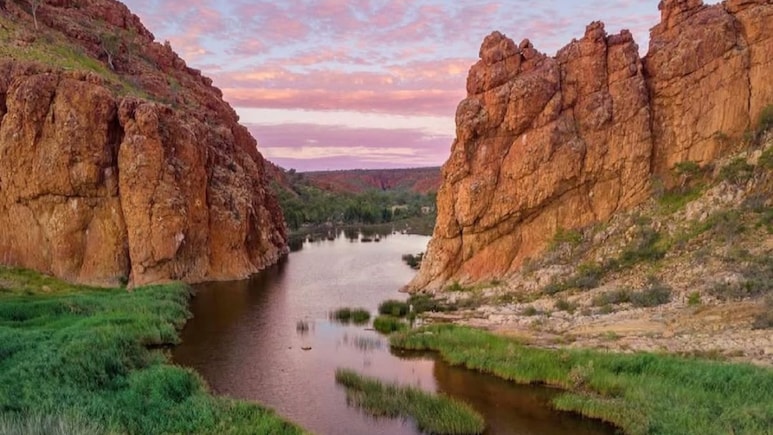
We have delved into the history, geography, and science behind the river system of the Finke River. Now comes the fun part. Along the banks of the Finke River, adventure enthusiasts often opt for camping along the Larapinta Trail, which can be accessed on foot. Imagine the blood-red sandstone cliffs sheltering the waterholes and palms. Why should vehicles be allowed in this picnic and picture-perfect region?
The trail begins near the junction of Davenport and Ormiston. Abundant tea-tree bushes, bullrushes, and dense stands of reeds are found here. The river and creek regions are rich in flora and fauna.
Since no vehicles are allowed, locals and tourists have to pay camping and walking fees, and one can even book a multi-day tour online in advance. The prices for entering the Finke River Trailhead, sections 10 and 11 of the Larapinta Trail range from AUD 10 (Rs 605) - AUD 60 (Rs 3,630) for adults and from AUD 5 (Rs 302) to AUD 30 (Rs 1,815) for children.
Depending on the length of your expedition and the number of people in a group, the camping fee can vary. If you want to explore the Finke Gorge, you can rent special jeeps (high-clearance four-wheel drive vehicles). Tourists and locals enjoy walking, hiking, camping under the stars, and birding in the region.
Also Read | Coca-Cola's 140-Year-Old Secret Recipe Revealed? YouTuber Claims He Cracked The Code
Track Latest News Live on NDTV.com and get news updates from India and around the world
