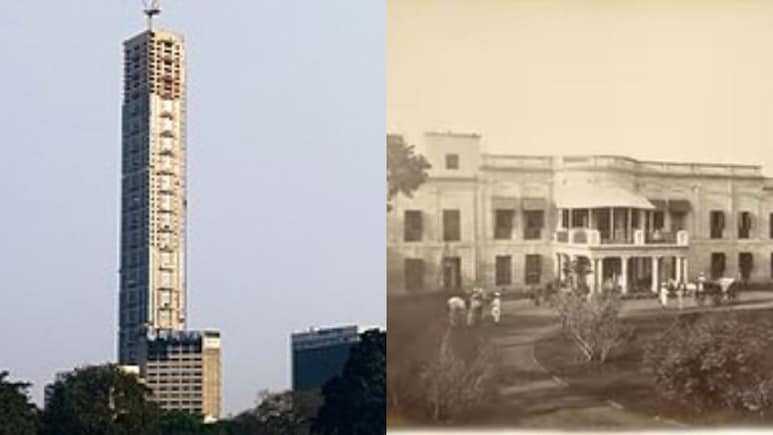
It is hard to miss the gleaming glass tower rising beside the green expanse of the Maidan. As commuters cross Chowringhee Road, the towering presence of The 42 has become a defining part of Kolkata's skyline. Yet few pause to consider what once stood here or the legacy tied to the land beneath the skyscraper - land that once belonged to the royal family of Darbhanga.
About The 42
The 42 is a residential skyscraper located on Chowringhee Road in Kolkata, West Bengal. It stands between the Tata Centre and the residential complex Jeevan Sudha in the city's central business district.
The project was first proposed in 2008, though construction was delayed by nearly two years. Completed in 2019, the building briefly held the title of the tallest building in India. It currently remains the tallest completed building in the country outside Mumbai and reportedly ranks as the 14th tallest building in India overall.
Rising to a height of 268 metres (879 feet) and comprising 65 floors, The 42 is among Kolkata's most prominent residential landmarks.
Land That Once Belonged To Royalty
A video that recently went viral on social media revisited the history of The 42. In the clip, a man claims that before the skyscraper was built, the site was occupied by the Darbhanga House, which translates to the Darbhanga royal palace, which is true. According to him, the palace served as a residential building for the Darbhanga royal family and was constructed during the reign of Maharaja Lakshmeshwar Singh. The last claim, however, could not be independently verified.
Maharaja Lakshmeshwar Singh is widely remembered for his contributions to education and infrastructure, including the commissioning of buildings for Calcutta University.
Watch the video here:
The Darbhanga Legacy
The Darbhanga royal family was one of the wealthiest princely estates in India for several decades. The family owned properties across the country, many of which were known as Darbhanga House. Darbhanga Ghat in Varanasi remains a visible reminder of the family's former prominence.
Following the death of Maharaja Kameshwar Singh in 1962, the Darbhanga estate was valued at approximately Rs 2,000 crore. In the years that followed, much of this wealth was reportedly lost due to alleged mismanagement by the estate's trustees. There is no confirmed estimate of the family's current holdings.
A report by the India Today suggests that assets worth Rs 2,000 crore in 1962 would be valued at nearly Rs 4 lakh crore today. These holdings included stakes in large companies, vast landholdings, properties in India and abroad, jewellery, and stock market investments. Less than two per cent of this wealth is believed to remain.
Contributions To The Nation
The Darbhanga royals are particularly remembered for their contribution during the 1962 India-China War, when the family donated around 600 kg of gold, three aircraft, and 90 acres of land to the government. Darbhanga Airport now stands on land donated by the estate.
The family also played a key role in the development of education and industry. Institutions such as Lalit Narayan Mithila University, Darbhanga Medical College, and several leading universities across India received financial support from the estate. On the industrial front, the family backed sugar mills, paper mills, jute mills and early aviation ventures.
The Royal Family's Later Years
Maharaja Kameshwar Singh had no children. His younger brother, Raja Bahadur Vishweshwar Singh, had died earlier, leaving behind three sons - Jeeveshwar Singh, who was an adult and married, and Yajneshwar Singh and Subheshwar Singh, who were minors at the time.
Under the Maharaja's will, provisions were made for his two wives during their lifetimes. The elder queen died in 1976.
After the government acquired Darbhanga House in Delhi, Maharani Kamsundari Devi lived in a neighbouring outhouse on the same premises, as per a report by India Today. During her visits to Darbhanga, she initially stayed at Nargona Palace. Around 1980, Kalyani House was built for her within the Nargona campus, where she lived thereafter.
A Legacy Beneath The Skyline
More recently, the death of Maharani Kamsundari Devi on January 12, 2026, briefly brought renewed attention to the Darbhanga legacy. Tensions during her cremation were resolved following the intervention of Bihar government officials.
As The 42 continues to dominate Kolkata's skyline, it stands not only as a symbol of modern luxury but also as a reminder of a once-powerful royal estate.
Also Read: Inside Remo D'Souza's Mumbai Bungalow: Mother Mary Statue, 'World's Smallest Shivling', And Luxurious TV Room
Track Latest News Live on NDTV.com and get news updates from India and around the world
