
- Eunhee Park was shocked by food waste in South Korea, contrasting with North Korea's constant hunger
- North Koreans lack open internet access, limiting exposure to global news and alternative perspectives
- North Korea has only one state-controlled TV system with locked frequencies preventing foreign channels
Imagine growing up in a country where switching TV channels isn't really an option, searching the internet is impossible, criticising the country's leader could land you in prison, and quitting your job isn't your choice to make.
For North Korean defector and author Eunhee Park, these weren't dystopian ideas, but they were everyday reality.
After escaping to South Korea, she encountered freedoms that many people take for granted. In a recent post, Park reflected on the five biggest culture shocks that completely changed the way she saw the world.
Here's what surprised her the most.
1. People Can Criticise The President
The first and biggest shock wasn't technology or modern conveniences—it was freedom of speech.
Park was stunned to see people openly criticising the president and even in casual conversations on the street. Having grown up in North Korea, where even minor criticism of the leadership can have severe consequences, the openness felt surreal.
She recalled a haunting incident from 2011 after the death of Kim Jong Il. A man in her neighbourhood casually remarked while drinking that the leader had died because "it was simply his time to die." According to Park, he disappeared the very next day after someone reported him to the authorities.
She also explained that North Koreans are taught from childhood to report anyone who speaks negatively about the Kim family or the government. Even calling Kim Jong Un without an honorific can reportedly be considered a political offence, and citizens are not legally allowed to share the same name as the leader.
Seeing public demonstrations demanding a president's impeachment in South Korea, she said it felt "like arriving on another planet."
2. There Are Hundreds of TV Channels
Another eye-opening experience was something as ordinary as changing television channels.
According to Park, North Korea effectively operates a single government-controlled television system. Every television station is state-owned, and broadcasts are designed to promote the ruling Kim family, the Workers' Party, military achievements, propaganda dramas and songs, along with anti-American and anti-South Korean messaging.
She added that government technicians regularly visit homes to permanently lock television frequencies, preventing people from accessing South Korean, Japanese or other foreign broadcasts.
After spending her entire life with television under state control, the simple act of picking up a remote and choosing from hundreds of programmes felt unimaginable.
According to Park, workplaces in North Korea are assigned by the state, and leaving without permission can result in punishment. Photo: Eunhee Park/ Instagram
3. You Can Search Anything On The Internet
One of the greatest surprises after arriving in South Korea was discovering that information was available almost instantly.
Park said North Korea does not have open internet access like the rest of the world. She added the regime restricts outside information because exposure to global news could challenge what citizens are taught from childhood.
Growing up, Park said she was told that North Korea was the world's most prosperous country, that South Koreans were starving, and that the Kim family provided citizens with a happy life.
She believes that if ordinary North Koreans had unrestricted access to platforms like YouTube, international news and social media, they could discover different perspectives within minutes.
The biggest emotional shock, however, came when she learned that while many ordinary North Koreans struggled with hunger, the ruling Kim family reportedly enjoyed extraordinary luxury. She recalled learning that a private jet had been flown to Italy to import fresh gelato—a revelation that left her angry because, in her words, many of her people were starving while the country's elite lived lavishly.
4. So Much Food Is Thrown Away
Perhaps the most emotional adjustment involved food.
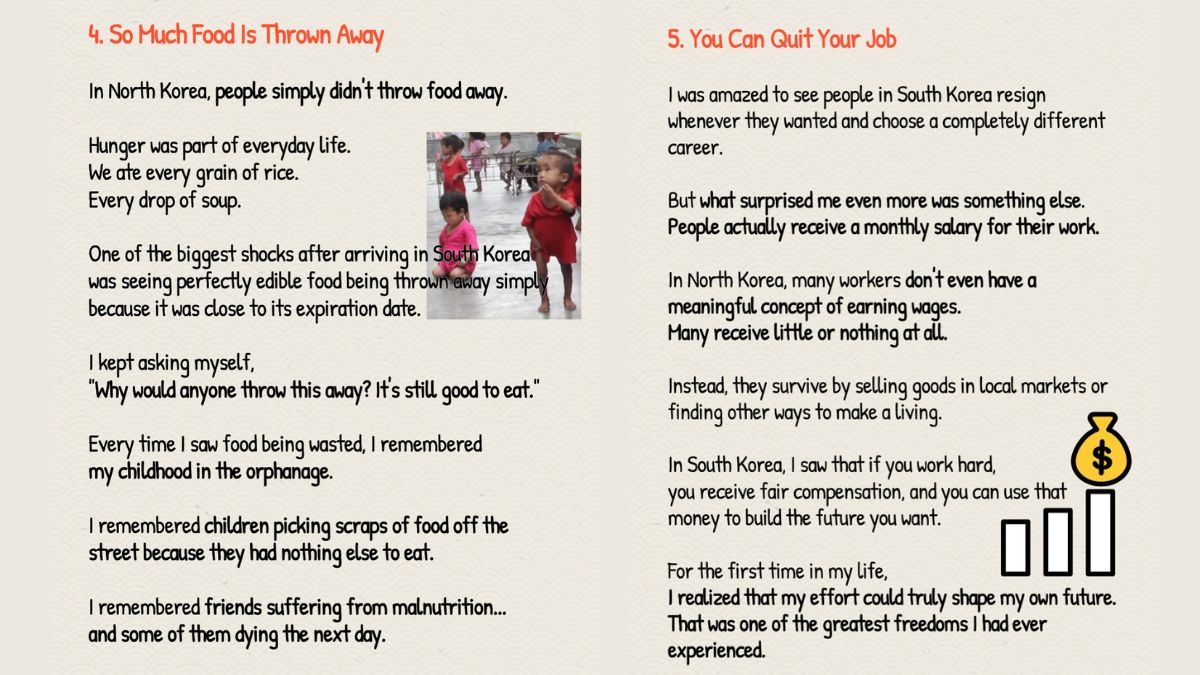
Park said that in North Korea, wasting food simply wasn't an option. Hunger was a constant part of life, and every grain of rice and every drop of soup mattered.
After arriving in South Korea, she was shocked to see perfectly edible food being discarded simply because it was approaching its expiration date.
Each time she saw food thrown away, she says she was reminded of her childhood in an orphanage, children picking scraps off the streets because they had nothing else to eat, and friends who suffered from malnutrition, some of whom died the following day.
Even today, she says she finds it difficult to throw food away. She contrasts the two halves of the Korean Peninsula, writing that while food is often discarded in the South because there is an abundance of it, many people in the North still don't know where their next meal will come from.
"For people in free countries, food is often a matter of choice," she said. "For many North Koreans, food is the hope of surviving one more day."
5. You Can Quit Your Job
The final culture shock was discovering that people could simply resign from their jobs.
According to Park, workplaces in North Korea are assigned by the state, and leaving without permission can result in punishment or being labelled as someone who refuses to live a "socialist life."
In South Korea, she was amazed that people could leave one career and pursue another whenever they chose.
She was equally surprised to learn that workers received regular monthly salaries. She explains that many North Korean workers receive little or no meaningful wages and instead survive by selling goods in local markets or finding other ways to earn a living.
For the first time, Park realised that working hard could directly influence her own future.
"That was one of the greatest freedoms I had ever experienced."
Also Read | Mercury Retrograde: Why It Gets Blamed For Breakups, Delays And Bad Days
Track Latest News Live on NDTV.com and get news updates from India and around the world
