Holi is often described as the festival of colours, but much like vibrant gulal, the festivities take on different hues in different regions. In the Braj region alone, people celebrate the festival in seven ways - Ladoo Mar Holi, Lathmar Holi, Chhadi Mar Holi, Phoolon Ki Holi, Widow's Holi, Rangbhari Holi, and Harunga Holi.
West Bengal and Odisha celebrate Dol Jatra or Dol Purnima. For Manipur, it is Yaosang; for Kerala, it is Manjal Kuli; for Punjab, it is Hola Mohalla; for Uttarakhand, it is Baithki Holi; for Rajasthan, it is Royal Holi hosted by royal families; and for Varanasi, it is Masan Holi.
-

-
 NDTV World Summit LIVE: Global Leaders To Discuss 'World Between Orders'
 -
 World-Class Chefs, Food And Music: The Fun Side Of NDTV World Summit 2026
 -
 AI, Consciousness And Dharma: Why Ancient Indian Wisdom Matters Now
 -
 NDTV World Summit: What To Expect From PM Modi's Keynote Address
 -
 NDTV World Summit 2026: What To Watch Out For | PM Modi, Jaishankar, AI And Global Power Shifts
 -
 A World Between Orders: What To Expect At NDTV World Summit 2026
 -
 Who Is Rajiv Mehta? Lilavati Hospital Trustee To Speak At NDTV World Summit 2026
 -
 Alain Ebobisse, Africa50 CEO, To Attend NDTV World Summit 2026. All About Him
 -
 Kriti Sanon At NDTV World Summit: A Look At Her Career And Business Ventures
 -
 Ex-CIA Director To Decode 'War In Times Of AI' At NDTV World Summit
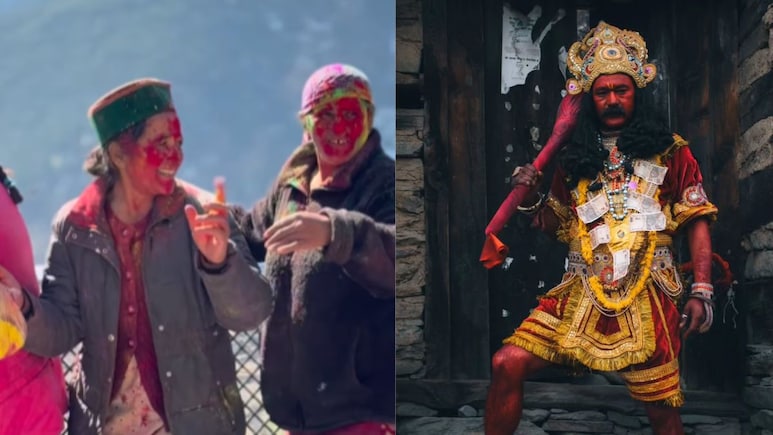
One of the most scenic Holi celebrations you can witness in India is in the Kinnaur district, Himachal Pradesh. The celebrations in Sangla Valley have already begun and are trending on social media.
Satyajit Dahiya, a solo traveller, celebrated Holi in Sangla. Describing his experience, he wrote, "Celebrated Holi this year in the peaceful valleys of Sangla, Kinnaur, Himachal Pradesh - where colours are not just on faces, but in the mountains, rivers and the sky itself. No loud parties. No chaos. Just local traditions, pure smiles, folk music and the calm flow of the Baspa River."
How Kinnaur In Himachal Pradesh Celebrates Holi
There are different elements attached to Holi celebrations in Kinnaur, bordering the Shimla district and Lahaul Spiti. A travel blogger, Map My Bharat, shared a video of how people participate in the processions, dance, and relish community meals.
He explained, "The celebrations begin at Beri Nag Temple, where devotees representing Shiv and Vishnu appear in sage-like forms. A striking highlight is women carrying a sickle in one hand and a mirror in the other, symbolising strength and self-awareness."
People believe that Lord Hanuman participates in the celebration, and he punishes anyone who breaks ritual discipline during the procession.
"From the temple, the entire village moves towards Kala Kendra, surrounded by snow-capped Himalayan peaks. Here, the iconic Kinnauri Naati dance takes over," he added.
Naati is a traditional folk dance of Himachal Pradesh, quite popular in Mandi, Kullu, Kinnaur, Chamba, and Shimla. Dancers bend their knees and perform steps slowly to the beats of the dhol-damau instrument.
"Community feasting is a core part of the celebration, along with local Kinnauri cuisine and traditional drinks. It is not uncommon for over a thousand people to share meals," he further shared.
"The ritual concludes back at the Beri Nag Temple with the burning of Holika, symbolising the victory of good over evil. From the vibrant Kinnauri caps to the echoing drumbeats in the mountains, Sangla's Holi shows how one festival can transform into something deeply regional, spiritual, and unforgettable," the travel blogger concluded.
Kinnaur's Holi Is The Festival Of Masks
In the local dialect, people call it Fagli (Phagli) or Faguli. The celebration is believed to be 800 years old, making it one of the oldest traditions that people continue to follow in the Himalayan region. The celebration of Holi in the Sangla region is considered a blend of Hindu and Buddhist influences, marking the end of winter and the transition to spring.
Abhinav Chandel, a travel influencer, shared, "I once again learned why this is called the Happiest Holi of India, because everyone is so welcoming, everyone is so full of joy, ensuring we are comfortable and well fed, everyone sharing their happiness with people who've come from outside in their village and then those beautiful Himalayan peaks in front of us, shining brightly while we paint each other with many colours, dancing to the tunes of folk songs and realising that it isn't difficult to smile with all our heart in these mountains!"
It is often referred to as the Festival of Masks because people, dressed elaborately, enact characters from Hindu epics and local folklore. This community's culture of storytelling is not only rich but takes the art to a whole new level.
Describing his experience of witnessing Sangla Holi, Laksh Puri, a travel influencer, wrote, "Every time I go there, I feel a different kind of energy - something divine, something ancient. When the Ramayan characters come alive during the festival, it doesn't feel like a performance... it feels like witnessing gods in physical form. That aura, that power, that devotion - it gives goosebumps."
Holi in Kinnaur is indeed a one-of-a-kind celebration that attracts people from across India.
Also Read | With Aalta, How Vijay Deverakonda Broke A Wedding Tradition Meant For Brides
Track Latest News Live on NDTV.com and get news updates from India and around the world
