
A LinkedIn post by Gurugram-based entrepreneur Nistha Tripathi has sparked a larger conversation around India's work culture, burnout, and the pressure employees feel to constantly prove their dedication by staying available beyond office hours.
Tripathi, who co-founded education consulting company 24NorthStar, wrote about what she described as the guilt attached to leaving work on time in many Indian workplaces, even after employees have completed their responsibilities for the day.
What The Post Said
"In India, you feel guilty for leaving work at 6 pm. Even if you've finished your work. Even if you worked your back off the whole week, even if you came in at 7 am," she wrote on her LinkedIn.
She added that employees are often met with comments such as "half day today?" for logging off on time, reflecting a workplace culture where long hours are seen as commitment and efficiency is sometimes treated with suspicion.
Contrasting this with her experience working with European teams, Tripathi said employees there typically log off at 5 pm without apology or justification. "No explanation. No guilt. Just... 'See you tomorrow.' And the surprising part? Things still got done. Deadlines were met. No one flinched," she wrote.
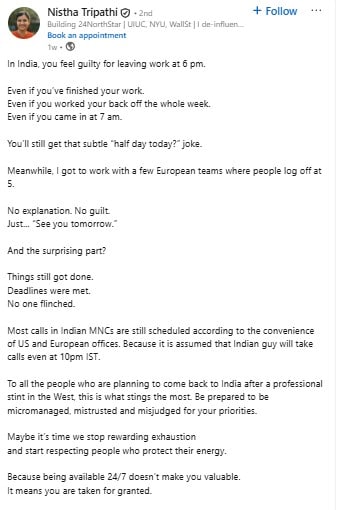
The entrepreneur also pointed to the way Indian employees working in multinational companies are frequently expected to adjust to global schedules, especially those of US and European offices. "Most calls in Indian MNCs are still scheduled according to the convenience of US and European offices. Because it is assumed that Indian guy will take calls even at 10 pm IST," she wrote.
For professionals returning to India after working abroad, Tripathi said this shift can feel particularly jarring. "Be prepared to be micromanaged, mistrusted and misjudged for your priorities," she added.
Her post ended with a sharp critique of hustle culture and the glorification of overwork. "Maybe it's time we stop rewarding exhaustion and start respecting people who protect their energy. Because being available 24/7 doesn't make you valuable. It means you are taken for granted."
How The People Reacted Online
The post quickly drew strong reactions online, with many professionals saying her observations reflected the reality of Indian corporate life. Several commenters argued that Indian offices continue to reward visibility and "seat-time" over actual productivity and outcomes.
One user wrote, "The problem in Indian MNCs is we have normalized presenteeism and branded it as dedication. Commitment is still measured by visibility and not value. Indian employees are expected to absorb everyone else's time zones, stretch endlessly and still provide evidence of dedication."
Another commenter, Anshul Falor, said the issue was not about hours but about what companies choose to reward. "This isn't about hours, it's about outcomes vs optics. In many places, visibility still gets rewarded over productivity. The shift we need is simple: respect delivery, not desk time," he wrote.
Several users also highlighted how subtle workplace comments can contribute to unhealthy work expectations. Entrepreneur Sadiq Diwan commented, "The 'half day today?' joke is the ultimate culture killer. It reframes efficiency as laziness and rewards the 'seat-time' marathon instead of actual output."
Others shared personal experiences of working overseas and struggling to readjust after returning to India. Marketing professional Shruti A. wrote that in the US, staying beyond office hours was treated as an exception rather than a norm. "Indian work culture doesn't reward ingenuity or efficient work; it rewards sacrificing your personal life, brown-nosing, and burnout," she commented.
Similarly, programme manager Satheesh Venkatesh said, "US and Europeans protect their boundaries without apology, and productivity doesn't suffer; it thrives. Back in India, logging off at a reasonable hour somehow signals lack of commitment."
Not Everyone Agreed
At the same time, not everyone agreed with Tripathi's comparison between Indian and Western work culture. Some commenters argued that cultural context matters and that Indian workplaces operate differently. One user pointed out that many Indian professionals start work later in the day and therefore do not necessarily view 9 pm calls as unusually late. Others noted that India's social and work rhythms differ from Europe because of lifestyle and climate differences.
Another commenter argued that long working hours are common in countries experiencing rapid economic growth. Comparing India's current stage of growth to the industrial expansion seen in Western countries decades ago, the user suggested that work-life balance often improves only after economies mature further.
Some professionals also defended their own experiences in Indian companies. Software engineer Harsh Vardhan Jain wrote that he and many of his peers had positive work-life balance experiences in large firms, adding that employees in the US also sometimes adjust their schedules to accommodate meetings across time zones.
Track Latest News Live on NDTV.com and get news updates from India and around the world
