
Today, AI is everywhere, from the filters we use on Instagram to the tools that can transform an ordinary photograph in seconds. But as AI-powered editing becomes increasingly accessible, the line between enhancing an image and misusing someone's likeness is getting harder to draw.
In Bhopal, a school has reportedly made jackets compulsory for female teachers amid concerns that students could be taking their photographs and editing them in vulgar ways using AI. While the school has not officially confirmed the reason behind the change, teachers suspect it is linked to the misuse of their images.
"I am lucky that I teach students till Pre KG, cause my friends who teach middle schoolers have it way worse," a teacher from Bhopal shared, describing how students allegedly edit photographs of female teachers and circulate them in groups.
The incident raises an uncomfortable question: why should women have to change what they wear because someone else might misuse their photographs? And the problem extends well beyond classrooms.
From Yami Gautam asking the media not to alter her public appearance photographs to Rashmika Mandanna becoming the target of a viral deepfake, AI image manipulation is sparking a wider debate about consent, privacy and authenticity.
Yami Gautam's Request Puts Consent Back In The Spotlight
The debate has now reached celebrity dressing rooms, red carpets and newsrooms, too. Earlier this month, actor Yami Gautam asked the media to stop using AI to alter or enhance photographs taken at her public appearances, insisting that her images be used in their original form.
"A sincere request to the media. Please refrain from using AI to alter or enhance my photographs from public appearances," she wrote, adding that manipulating someone's image or likeness without their knowledge and consent should not be done.
Her appeal highlights an important distinction. AI can be used to improve the lighting or sharpness of a photograph, but it can also change a person's features, clothing or appearance without their permission. And when the person in the photograph has no say in how the image is altered, the question is no longer just about editing. It is about consent.
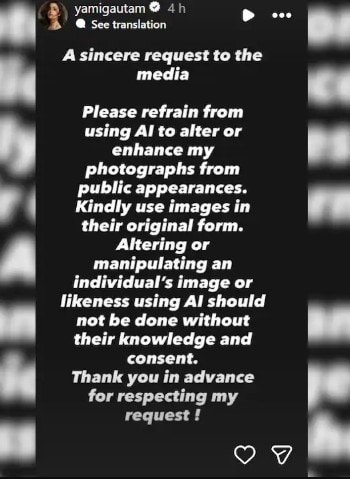
Yami Gautam asked the media to stop using AI to alter or enhance her photographs from public appearances. Photo: Instagram
For photographers, the technology can be a useful addition to their workflow. For the people being photographed, however, it can mean losing control over how they are represented.
Gaurav, founder of Fourfold Pictures, who are known for wedding photography, believes the difference lies in the intention behind the edit.
"Basic enhancement improves what is already captured in the photograph, such as exposure, contrast, colour balance and sharpness. AI manipulation goes a step further when it generates, replaces or substantially alters elements within the frame," he explains.
The key question, he adds, is whether the edit preserves the original intent and context of the photograph or changes what the image communicates.
From Rashmika Mandanna's Deepfake To AI-Generated Abuse
The consequences of AI manipulation become more serious when it is used to create misleading or sexually explicit content involving real people.
In November 2023, a manipulated video of Rashmika Mandanna went viral, making it appear as though the actor was entering a lift in a revealing outfit. The original footage featured British-Indian influencer Zara Patel, whose face had been replaced with Mandanna's using AI face-swapping technology.
The incident sparked widespread outrage and brought the dangers of deepfakes into the national conversation. Mandanna spoke about how frightening the experience was, while Amitabh Bachchan called for legal action.
The case also prompted a wider discussion about digital consent, the speed at which manipulated content spreads and the difficulty of correcting false information once it has gone viral.
In October 2024, the Indian Cybercrime Coordination Centre (I4C), under the Ministry of Home Affairs, appointed Mandanna as National Ambassador for Promoting Cyber Safety. The role involved raising awareness about cybercrime and online safety.
The problem is not confined to celebrities. A manipulated image can affect an ordinary person's reputation, relationships, education or professional life. Unlike a conventional edited photograph, a convincing deepfake may be created and circulated without the subject ever knowing their image was used.
Hakimuddin Wadlawala, founder of Aquila I, an AI-native cyber defence platform, points out that these risks extend into the workplace, where manipulated photographs can be used to impersonate executives, fabricate employee identities or support fraudulent requests.
"Enhancing image quality is different from generating identities or altering the context of an image," he says.
His concern is that convincing visual material can make deception more effective, particularly when people assume that a photograph is proof of someone's identity or an event.
AI Has Made Photo Editing Easier, But At What Cost?
Of course, AI-powered photo editing is not inherently harmful. It has made several tasks quicker, more accessible and less technically demanding.
Features such as background removal, noise reduction, sharpening, colour correction and object removal are now available through widely used editing software. Tools in Adobe Lightroom and Photoshop can automate repetitive tasks that once required considerable manual effort.
For photographers working on tight deadlines, this can mean spending less time on technical adjustments and more time on the creative process.
Nikhar Arora, CEO of Mentoria and BOTS.AI and director of HR at Anexi, says AI-powered editing software can go beyond applying filters. It can analyse an image, adjust lighting and help reconstruct elements of a scene, making sophisticated editing accessible to more people.
Dr Kanishk Agrawal, founder and CEO of Path in AI Technologies, similarly notes that tasks such as restoring old photographs, changing backgrounds, removing objects and improving lighting can now be completed in seconds.
But speed and accessibility come with their own challenges. When editing becomes almost effortless, the temptation to keep adjusting an image until it looks perfect can become difficult to resist.
Gaurav says he has noticed growing expectations for photographs to look polished, visually striking and almost flawless, a shift that social media has helped accelerate.
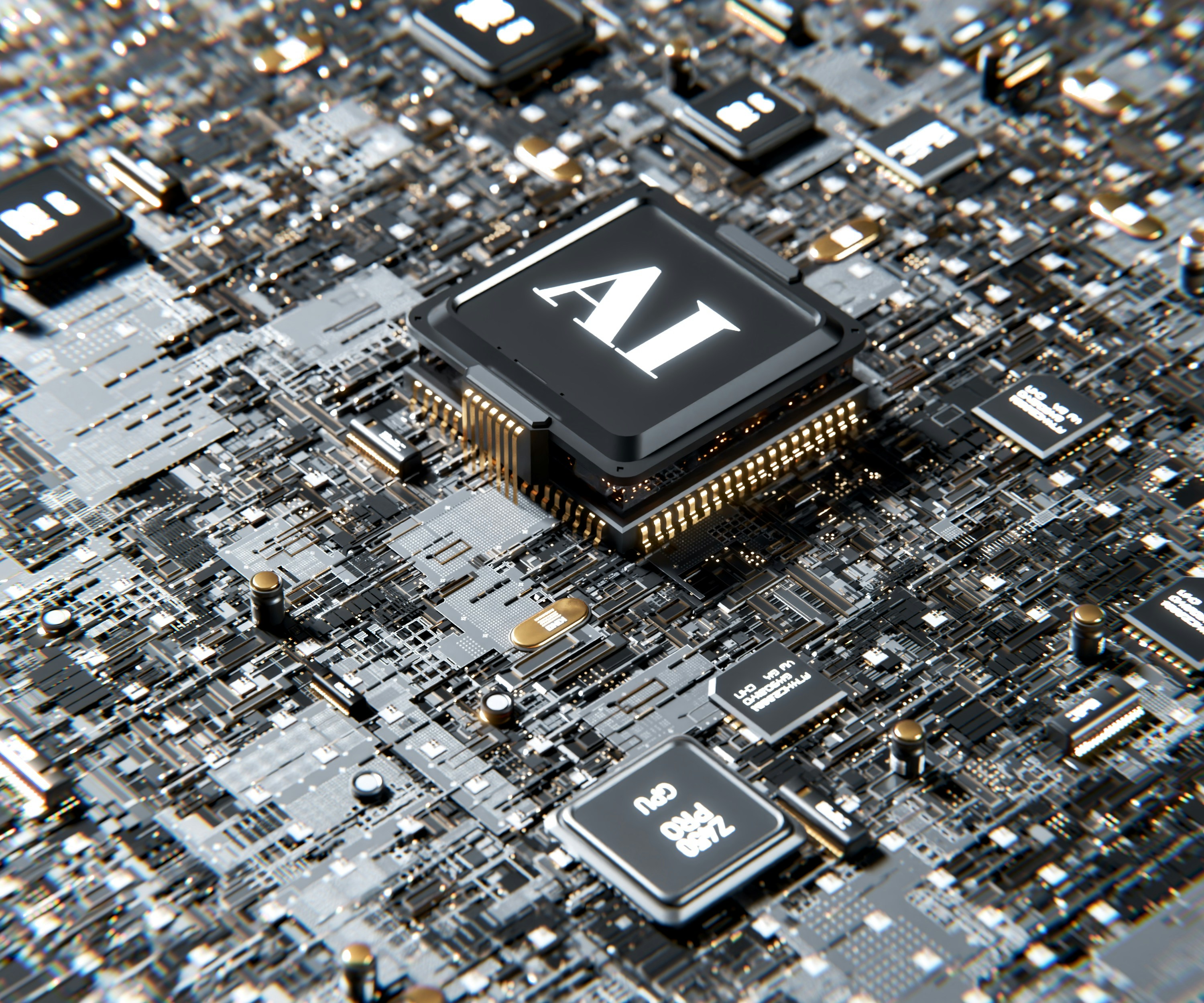
When editing becomes almost effortless, the temptation to keep adjusting an image until it looks perfect can become difficult to resist.
Photo: Unsplash
There is a creative concern here, too. If everyone has access to similar AI tools and enhancements, photographs risk becoming increasingly uniform, with the same polished skin, dramatic lighting and carefully constructed backgrounds.
As one of the experts consulted for this feature puts it, photography is not simply about producing a technically perfect image. It is about observation, perspective, composition and the story a photographer wants to tell. AI can improve an image, but it cannot automatically understand why that image was captured in the first place.
When An Enhanced Photograph Becomes A Misleading One
The distinction between enhancement and manipulation matters most when photographs are expected to document reality.
A little colour correction may make a photograph look closer to what the photographer saw. Removing a distracting object might be acceptable in a clearly identified artistic composition. But adding people to a protest, changing a person's face or inventing details in a documentary photograph can alter the meaning of the image entirely.
Nikhar Arora warns that AI-enhanced images can mislead viewers precisely because they are based on something real. "An existing photograph can be modified to make an event appear more violent, change the appearance of a person or introduce details that were never present, he adds"
AI can also invent details when asked to enhance a blurry image. The resulting picture may look convincing, even when the details it appears to reveal are inaccurate.
Wadlawala agrees that the distinction between basic enhancement and manipulation is becoming harder to establish. Generative AI can produce images that look almost flawless, making visual judgement alone an unreliable way of determining whether a photograph has been altered.
Gaurav believes the context of the photograph should determine where the line is drawn.
"In photojournalism, the stakes are much higher because photographs serve as visual records of real events," he says.
Can You Tell If A Photograph Has Been Edited Using AI?
A few years ago, obvious visual errors could make manipulated images easier to spot. Today, the results are considerably more convincing, and there is no single visual clue that can reliably identify every AI-edited photograph.
Unusual textures, inconsistent lighting and distorted details can be warning signs, but they are not definitive proof. Equally, a photograph that looks entirely natural may have undergone substantial manipulation.
Agrawal suggests checking an image's metadata and editing history, where available. Digital Content Credentials and other image-provenance systems can also help establish where an image came from and how it was modified.
A few years ago, obvious visual errors could make manipulated images easier to spot. Photo: Unsplash
However, these methods have limitations. Metadata can be removed, not every image carries provenance information, and no single verification method is completely reliable.
Wadlawala believes organisations will increasingly need tools that verify the origin and authenticity of visual content rather than relying solely on whether an image looks genuine.
For the average social media user, the first step is more straightforward: check the original source, look for the earliest available version of the image and avoid sharing sensational photographs without verification.
The responsibility does not rest entirely with viewers, though. Photographers, publishers, social media platforms and technology companies also have a role in making manipulated content easier to identify.
The Environmental Cost Of An AI Edit
There is another side to AI-powered photo editing that rarely makes it into the conversation: the resources required to run these tools.
Every time someone uses an AI service, computing infrastructure is involved. Depending on the tool and the task, this can require electricity and cooling, with water consumption associated with some data centres and electricity generation.
There is no universal figure for the water used to edit a single photograph. A simple adjustment to brightness is not equivalent to generating an entirely new image, and the environmental impact depends on the model, the hardware, the data centre and the complexity of the task.
Arora cites an estimate from research associated with the United Nations University that puts water use at approximately 29 millilitres per AI-generated image. He also refers to an estimate of 29 million litres for one billion images.
Agrawal explains that the environmental impact goes beyond the edit itself. Data centres require electricity and cooling, while the hardware supporting AI systems also has a material footprint.
"The negative effects of AI-generated images on the environment involves more than the process of photo editing itself," he says.
The challenge is to understand the cumulative impact of millions of such operations rather than assume that every individual edit has the same environmental cost.
What Responsible AI Editing Should Look Like
So, should photographers stop using AI altogether? The experts do not think so. The issue is not necessarily the tool itself, but how it is used and whether its impact on the final image is understood.
Gaurav believes photographers should be open to new technology while remaining mindful of the difference between improving an image and creating a different reality. Significant changes should be disclosed when they could influence how audiences interpret a photograph.
A few years ago, obvious visual errors could make manipulated images easier to spot. Photo: Unsplash
Wadlawala stresses the importance of consent, privacy and verification, particularly when images are used in professional or business settings. Organisations should not rely on visual evidence alone to confirm identities or approve sensitive requests.
Agrawal also emphasises the need for creators to retain original images, disclose significant alterations and avoid manipulating documentary or informational photographs in ways that distort facts.
These principles become especially important in creative education. Young people need to understand not just how to operate editing tools, but also what happens when those tools are used to alter someone else's identity or create misleading content.
That conversation needs to extend to schools, too. Protecting teachers and students from image-based abuse is essential, but so is addressing the behaviour that enables it rather than placing the burden of prevention on the people being photographed.
Track Latest News Live on NDTV.com and get news updates from India and around the world
