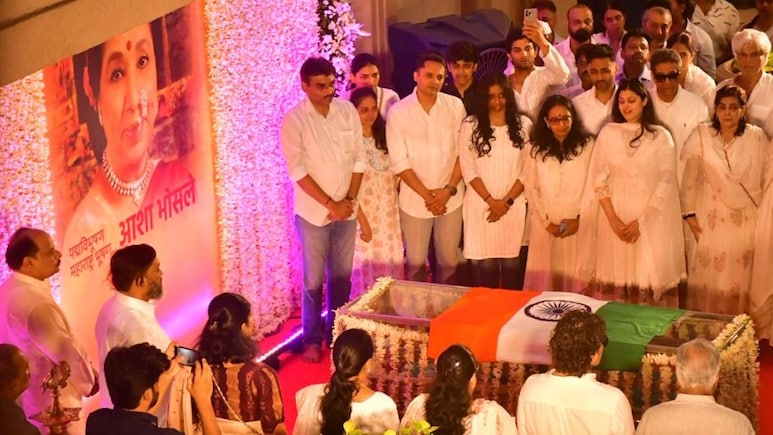
Asha Bhosle, the Padma Vibhushan and Dadasaheb Phalke Award honouree, died on April 12, and her body will be cremated with full state honours today at 4 pm in Mumbai. She sang over 12,000 songs in more than 20 Indian languages, and documenting her contribution to Indian cinema would require tracing her eight-decade-long career.
The late singer started a wave of dynamism in Indian music. From peppy, Western-influenced tunes and cabaret numbers to traditional bhajans and melodious ghazals, Asha Bhosle's voice brought versatility to Indian music. With playfulness, she often recorded songs in a single take.
A state funeral, which honours an individual with military and ceremonial rites, highlighting their contributions to a nation, is only fitting for her. But the criteria for who gets a state funeral have evolved over the years, and there are a few eligibility conditions that one must fulfil.
What Is A State Funeral
Often, when dignitaries, military personnel, and distinguished individuals die, they are cremated with full state honours. Unlike ordinary funerals, these are elaborate affairs, including a gun salute, the draping of the coffin with the national flag, and formal ceremonial honours.
A state funeral is not just about honouring the departed but also represents the collective mourning of the nation. While a state funeral is often reserved for the Prime Minister, President, former Presidents, and Governors, the central government can accord it to other dignitaries, depending on their contributions to the country.
Who Gets A State Funeral
The concept of state funerals dates back to 1948, when it was first held for Mahatma Gandhi. Since then, notable individuals have received this honour, including former Prime Ministers, Presidents, Governors, and individuals who have contributed to Indian politics, arts, science, cinema, and social service, among other fields.
The eligibility criteria include
- Heads of state, current and former Prime Ministers and Presidents, are entitled to a state funeral, which includes a 21-gun salute for Presidents and a three-volley salute for other dignitaries. Flags are flown at half-mast nationwide.
- Government officials, including sitting and former Cabinet Ministers, Union Ministers, and State Governors, may be accorded state funerals. The Chief Minister and senior Cabinet members consult before making a decision regarding the funeral, and in some cases, a public holiday may be declared.
- Distinguished citizens of the country who have made significant contributions in the fields of literature, arts, science, and social service can be considered for a state funeral, subject to the discretion of the government. In the past, Lata Mangeshkar, Ratan Tata, and Mother Teresa have received state funerals.
Rules And Features Of A State Funeral
A state funeral is not ordinary, but it is organised with certain rules,
- The funeral is organised by the Ministry of Defence after it receives confirmation from the Ministry of Home Affairs
- The national flag is draped on the coffin with the saffron colour facing the head
- All gazetted officers of the government are expected to attend, subject to availability
- Service personnel wear official dress for state functions
- The flag must not be lowered into the grave or burned on the pyre
The formalities of a state funeral include,
- A gun salute is organised, during which several guns are fired in honour of the individual
- The coffin is draped with the national flag
- A period of mourning is declared, during which flags are hoisted at half-mast, and public entertainment is suspended
21-Gun Salute
The tradition of the gun salute dates back to the 16th century, when warships would fire cannons harmlessly out to sea to signal their peaceful intent until their ammunition was depleted.
Since cannons required time to reload, firing them rendered the ships temporarily defenceless. This act, therefore, demonstrated trust between the parties involved.
At the time, seven guns were recognised as the British national naval salute. When a ship fired seven guns, the forts ashore would respond by firing three shots for every one shot fired by the ship. This resulted in a total of 21 guns.
Odd numbers were chosen because even numbers of shots were traditionally associated with death. The 21-gun salute was inherited from the British Empire, which reserved it as the highest honour for the most important rulers.
After India's independence in 1947, the 31-gun salute was retained to honour the Governor-General of India (1947-1950). Out of 565 princely states, 118 were classified as "salute states" and were honoured with gun salutes ranging from 9 to 21 guns. This "salute states" system continued until 1971.
Today, it is primarily reserved for the presidents and prime ministers of India, top leaders, and individuals who have contributed to the nation. An individual being cremated with full state honours reflects the nation's respect for them and their contributions to society.
Also Read | 80 Years, 20 Languages, 12,000 Songs: Asha Bhosle Was India's Love Language
Track Latest News Live on NDTV.com and get news updates from India and around the world
