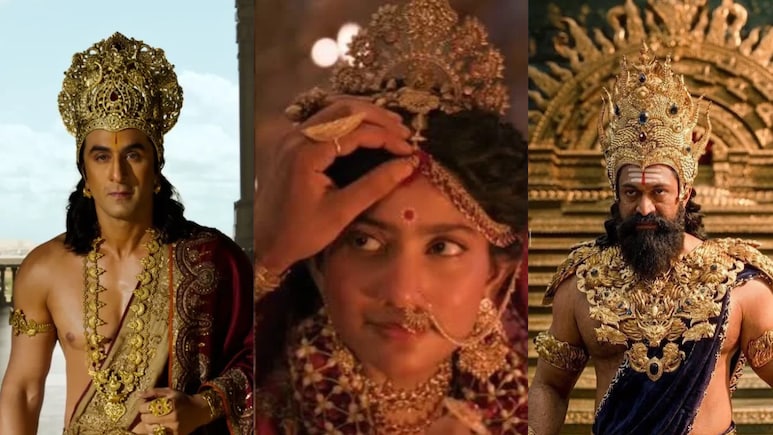
As Ramayana offers glimpses of its cinematic universe through teasers and trailers, audiences are getting a closer look at the epic's expansive world.
From Ranbir Kapoor as Lord Ram and Sai Pallavi as Sita to Rocking Star Yash as the formidable Ravana, the film brings together some of Indian cinema's biggest names.
Beyond its grand visuals and storytelling, however, the world of Ramayana is also being shaped by intricate details that define its characters, cultures and kingdoms. One such element is jewellery, with Tribe Amrapali serving as the official jewellery partner for Namit Malhotra's ambitious adaptation.
Drawing on extensive research and traditional Indian craftsmanship, the jewellery brand has developed distinct design languages for Ayodhya, Mithila and Lanka, using ornaments to reflect the identities, personalities and cultural heritage of the characters who inhabit these kingdoms.
A Jewellery Language For An Epic
Directed by Nitesh Tiwari, Ramayana is a two-part cinematic retelling of one of India's most revered epics, envisioned for a global release in IMAX.
The film features Ranbir Kapoor as Lord Ram, Sai Pallavi as Sita, Yash as Ravana, Sunny Deol as Hanuman and Ravi Dubey as Lakshman, bringing together an expansive ensemble of characters with distinct histories and identities.
Tribe Amrapali's contribution extends beyond the principal cast to include royal families, warriors, courtiers, attendants, supporting characters and crowd ensembles. The aim is to create a cohesive visual identity for each kingdom while ensuring that its individual characters retain their distinctive personalities.
Over more than 18 months, the brand's design team, led creatively by Tarang Arora and working closely with the film's creative team, researched mythology, ancient Indian ornamentation, temple art, sculptures and traditional jewellery forms. The result is three distinct design narratives that draw from India's artistic heritage while serving the film's cinematic vision.
Ayodhya: The Radiance Of Royal Heritage
The jewellery created for Ayodhya draws on classical elegance, with symmetrical designs, refined proportions and intricate traditional detailing. The aesthetic reflects the dignity of a royal kingdom, balancing grandeur with restraint.
For Lord Ram, the Surya, or Sun, motif takes centre stage, reflecting his Suryavanshi lineage and symbolising strength, righteousness and divine radiance. Circular medallions inspired by the Dharma Chakra, lotus motifs associated with purity and divinity, and finely detailed ornamental patterns further shape the designs.
Together, these elements establish a visual identity rooted in heritage and symbolism, reflecting both Ram's royal stature and his spiritual significance within the epic.
Mithila: The Poetry Of Floral Artistry
Where Ayodhya's jewellery is defined by regal symmetry, Mithila's aesthetic draws inspiration from nature and the expressive beauty of traditional Indian ornamentation. Floral motifs, graceful curves and balanced silhouettes lend the designs a sense of delicacy and understated elegance.
For Sita, intricate floral detailing and considered craftsmanship reflect femininity, purity and quiet strength. Inspired by Mithila's cultural richness and the sacred gardens associated with the Ramayana, the jewellery combines natural forms with traditional ornamentation to create pieces that feel personal while remaining connected to the kingdom's identity.
Through delicate detailing and nature-inspired motifs, Mithila's jewellery establishes a visual language distinct from Ayodhya's regal grandeur and Lanka's dramatic opulence.
Lanka: The Magnificence Of Power And Dramatic Artistry
Lanka adopts a bolder, more sculptural design vocabulary, characterised by asymmetrical forms, sharp contours, dramatic silhouettes and elaborate surface detailing. Its jewellery reflects a kingdom associated with power and opulence, using striking contrasts and richly textured ornamentation.
For Ravana, Kaikasi, Mareech, Shurpanakha and Vidyutjeeva, angular designs and dark-hued stones contribute to an aesthetic that conveys intensity, authority and formidable presence.
However, Lanka's jewellery is not limited to a single expression of power. For Mandodari and Vibhishana, bold yet more symmetrical compositions, paired with warmer, luminous stone tones, convey wisdom, balance and inner strength. These variations reflect the complexity of the characters and ensure that the kingdom's visual identity accommodates contrasting personalities.
What Tribe Amrapali's Creative Head Says About The Collaboration
Speaking about the collaboration, Tarang Arora, Creative Head of House of Amrapali, said the opportunity was particularly meaningful because the epic has been part of India's cultural consciousness for generations.
"When the opportunity to collaborate with Ramayana came to us, the most exciting part was simply being invited to be a part of this extraordinary journey. We all grew up with the story of the Ramayana as we knew it, but this project is reimagining that timeless epic for a new generation. It has the potential to become the Ramayana that today's children and future audiences will connect with and remember," he said.
Arora added that the significance of the project extended beyond any individual or brand, given the epic's deep roots in Indian mythology, culture and spirituality. He described contributing to a story with the potential to inspire generations as an honour.
The makers of Ramayana also highlighted the role of jewellery in shaping the film's visual storytelling.
"Every creative decision in Ramayana has been driven by authenticity and purpose, and the jewellery by Tribe Amrapali plays a defining role in bringing that vision to life. Each ornament has been thoughtfully designed to embody the personality, heritage, and evolution of the characters, ensuring it becomes an essential part of their visual identity. More than embellishment, these pieces are woven into the storytelling, helping create a world that is both timeless and immersive," the makers said.
Reflecting on the creative process, Arora said the challenge was not simply to design ornaments but to develop a visual vocabulary for an expansive universe of characters, each with a distinct identity, emotional journey and place in the story.
He added that the process involved balancing extensive research with artistic interpretation, ensuring that every motif, texture and design element remained meaningful while aligning with the film's cinematic vision.
Over 4,500 Jewellery Pieces Created For Part 1
Bringing the jewellery of three kingdoms to life required a detailed production process spanning research, conceptualisation, sketching, material selection, model-making, craftsmanship, assembly and final finishing. Each ornament was designed with consideration for the character wearing it, its place within the kingdom's visual identity and its role in the larger narrative.
For Part 1 alone, Tribe Amrapali created more than 4,500 individual jewellery pieces. The undertaking brought together designers, master artisans, model-makers, skilled craftspeople and production teams over countless days and nights of work.
The scale of production required more than the ability to manufacture thousands of ornaments. The team also had to maintain consistency in craftsmanship and design while ensuring that individual pieces retained their distinctive character.
Traditional metalworking techniques and intricate surface treatments contribute to the jewellery's richness. Embossed relief work, fine engraving and chasing, filigree-inspired openwork and granulation-inspired beadwork add depth, texture and detail to the designs.
From statement ornaments created for royal characters to accessories designed for supporting cast members and large crowd ensembles, each piece contributes to the film's wider visual narrative.
The collaboration also underscores the role of Indian artisans in bringing cultural heritage to contemporary audiences. Drawing on generations of jewellery-making knowledge, the project combines traditional techniques with creative interpretation to build a visual world rooted in Indian craftsmanship and suited to the scale of an international cinematic production.
Directed by Nitesh Tiwari and produced by Namit Malhotra's Prime Focus Studios in collaboration with DNEG and Yash's Monster Mind Creations, Ramayana is envisioned as a two-part cinematic epic.
Part 1 is scheduled for a worldwide release on November 5, 2026, followed by Part 2 in Diwali 2027. The films are planned for release in Hindi, Tamil, Telugu, Kannada and Malayalam, with an IMAX release also envisioned.
Sony Pictures will distribute the film internationally, excluding India, while Dharma Productions will handle distribution in the Hindi-speaking market.
Track Latest News Live on NDTV.com and get news updates from India and around the world
