





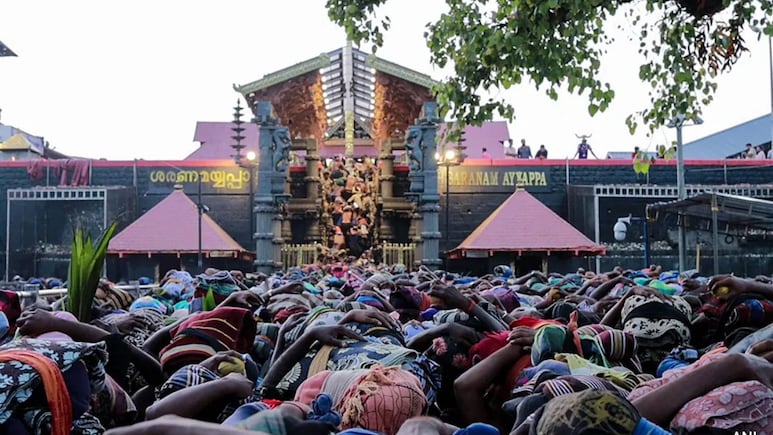
A curious situation has emerged at Kerala's Sabarimala temple, one of India's busiest pilgrimage destinations, where online darshan slots are fully booked until January 9, but thousands of devotees who secured reservations are failing to turn up.
The sharp mismatch between bookings and actual pilgrim arrivals has prompted the Kerala government to order an investigation into suspected bulk reservations and the possible resale of darshan slots by travel agencies.
The hill temple, dedicated to Lord Ayyappa, attracts millions of devotees during the annual Mandala-Makaravilakku pilgrimage season, which begins in November and continues until January.
This year, all 66,000 daily virtual-queue slots have been booked well in advance. However, fewer than 60% of those who secured slots reportedly turned up for darshan during the first three days.
The numbers present a striking contrast to the previous season, when more than 2.64 lakh pilgrims visited the shrine during the corresponding three-day period.
On November 16, the opening day of the pilgrimage season, only 26,131 devotees, including those who obtained spot bookings, reached the shrine. The number increased to 35,073 on November 17 and approximately 40,000 on November 18.
Even on November 20, ahead of the weekend, the usually crowded pathways leading to the hill shrine remained relatively empty, except for brief periods of increased activity when the sanctum was opened for darshan.
The Valiya Nadapanthal, a covered waiting area where devotees normally queue for hours, has also witnessed unusually thin crowds.
Devaswom Minister K Muraleedharan has directed Additional Director General of Police P Vijayan and Travancore Devaswom Board president K Jayakumar to investigate the reasons behind the unusually low turnout.
The Devaswom intelligence wing will also assist in the inquiry.
Officials suspect that travel agencies, particularly those operating in neighbouring states, may be making bulk reservations using pilgrims' identity documents and mobile numbers.
Investigators will examine whether these slots are subsequently being sold to devotees at inflated prices.
Another concern is the apparent absence of an effective mechanism to automatically release slots when registered pilgrims fail to turn up. This could leave thousands of genuine devotees unable to secure bookings despite available capacity at the shrine.
The lack of stringent OTP-based verification during the booking process has also emerged as a possible loophole.
However, officials have not yet established whether organised resale is responsible for the shortfall.
In response to the situation, the Travancore Devaswom Board has increased the daily virtual-queue quota by 5,000 slots until November 30.
Spot-booking capacity has also been increased for November 21 and 22 to accommodate devotees who could not secure online reservations.
The current daily ceiling is 80,000 pilgrims, including virtual-queue and spot bookings. Officials are examining whether further changes to the limit are necessary.
The previous pilgrimage season had a higher daily ceiling, with spot-booking facilities available at additional locations, including Pamba, the main base camp for the trek to the hill shrine.
The unusually low turnout has also raised concerns among traders and service providers who depend heavily on the annual pilgrimage season.
While some devotees attribute the reduced arrivals to stricter time-slot regulations and crowd-control measures, others suspect that large-scale speculative bookings may be blocking access for genuine pilgrims.
The investigation will examine booking records, reservation patterns and possible commercial transactions involving darshan slots.
Track Latest News Live on NDTV.com and get news updates from India and around the world

