





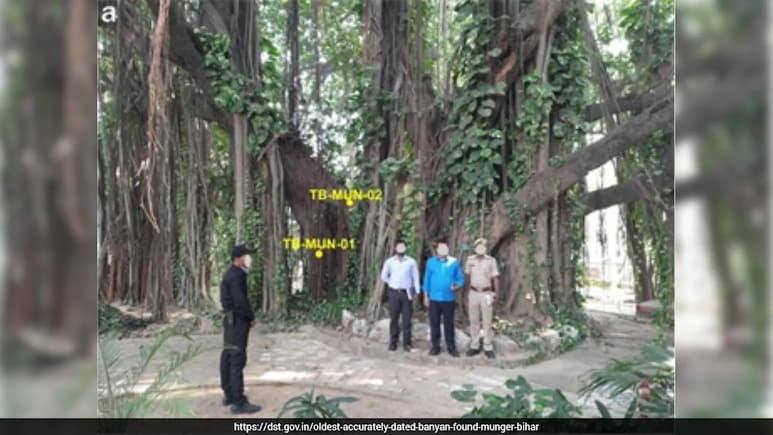
A banyan tree in Munger district of Bihar has been scientifically identified as the oldest accurately dated banyan tree known so far, with an estimated age of around 700 years. The finding marks a major breakthrough in the scientific dating of tropical trees and could transform efforts to preserve natural and cultural heritage across South Asia and beyond.
According to a notification by the Ministry of Science & Technology, the age of the Munger Banyan (Ficus benghalensis) was established through high-precision radiocarbon dating, rather than relying on historical records, folklore, or local traditions that have traditionally been used to estimate the age of ancient trees.
The research was led by Dr Trina Bose of the Birbal Sahni Institute of Palaeosciences, Lucknow, an autonomous institute under the Department of Science and Technology. She worked with researchers Dr Mayank Shekhar and Dr Akhilesh K. Yadava to develop a new scientific method for accurately determining the age of tropical broadleaf trees.
Banyan trees hold immense ecological, social and cultural importance in India. Their extensive network of roots and branches provides shelter and habitat for a wide range of birds, insects and other wildlife. For centuries, they have also served as gathering places for communities, religious events and cultural activities.
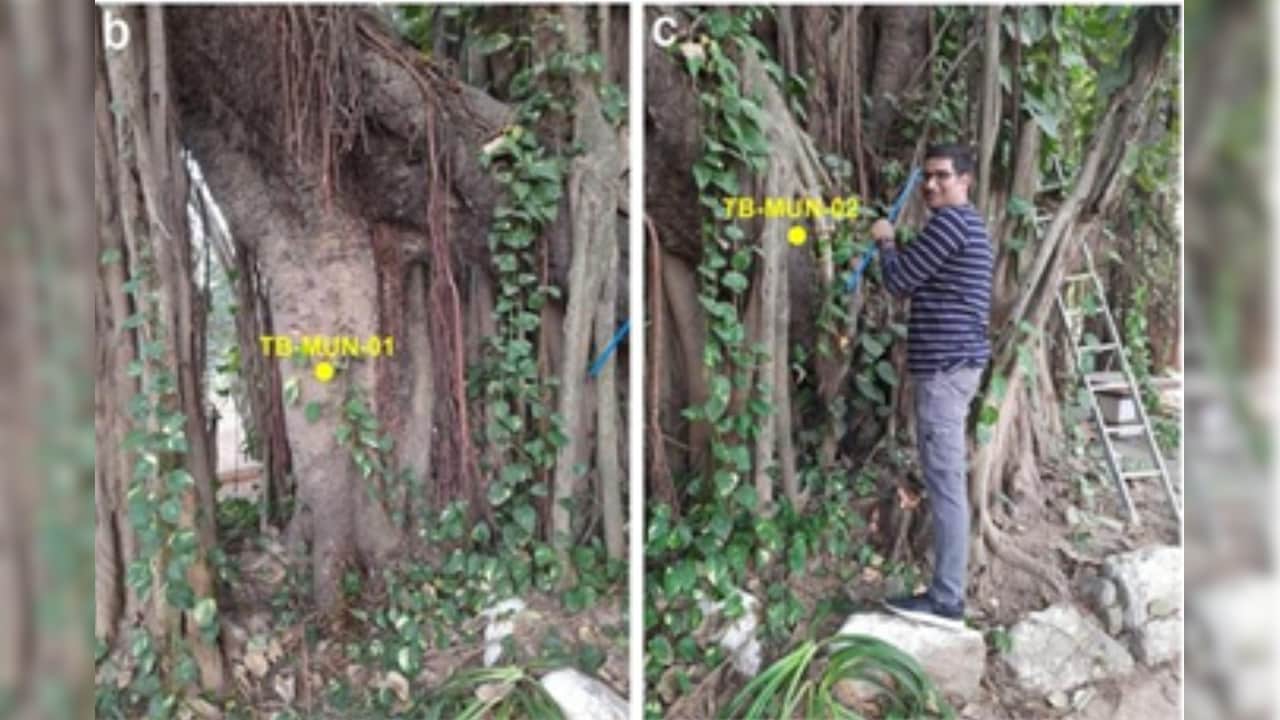
Secondary trunk sampled as TB- MUN-01. Oldest apparent branch sampled as TB-MUN-02.
The researchers explained that traditional tree-ring dating methods are ineffective for most tropical broadleaf species because they do not form clear annual growth rings. To overcome this challenge, the team collected wood samples from near the pith of a secondary trunk and an ancient primary branch of the Munger Banyan.
The scientists extracted alpha-cellulose, the most stable component of plant cell walls, and analysed the samples using Accelerator Mass Spectrometry radiocarbon dating. The results were calibrated using the latest IntCal20 calibration curve and OxCal software, allowing the researchers to establish a reliable age estimate.
The findings challenge earlier assumptions that the tree was planted near the historic Burra Bunglow around 300 to 350 years ago. Instead, the study suggests that the banyan predates the building and is likely a surviving remnant of a natural forest that once covered the region.
Published in the journal Quaternary Research, the study offers a robust scientific approach for dating heritage trees and could support conservation, biodiversity protection, heritage management and research into historical landscapes and past climates worldwide.
Track Latest News Live on NDTV.com and get news updates from India and around the world

