





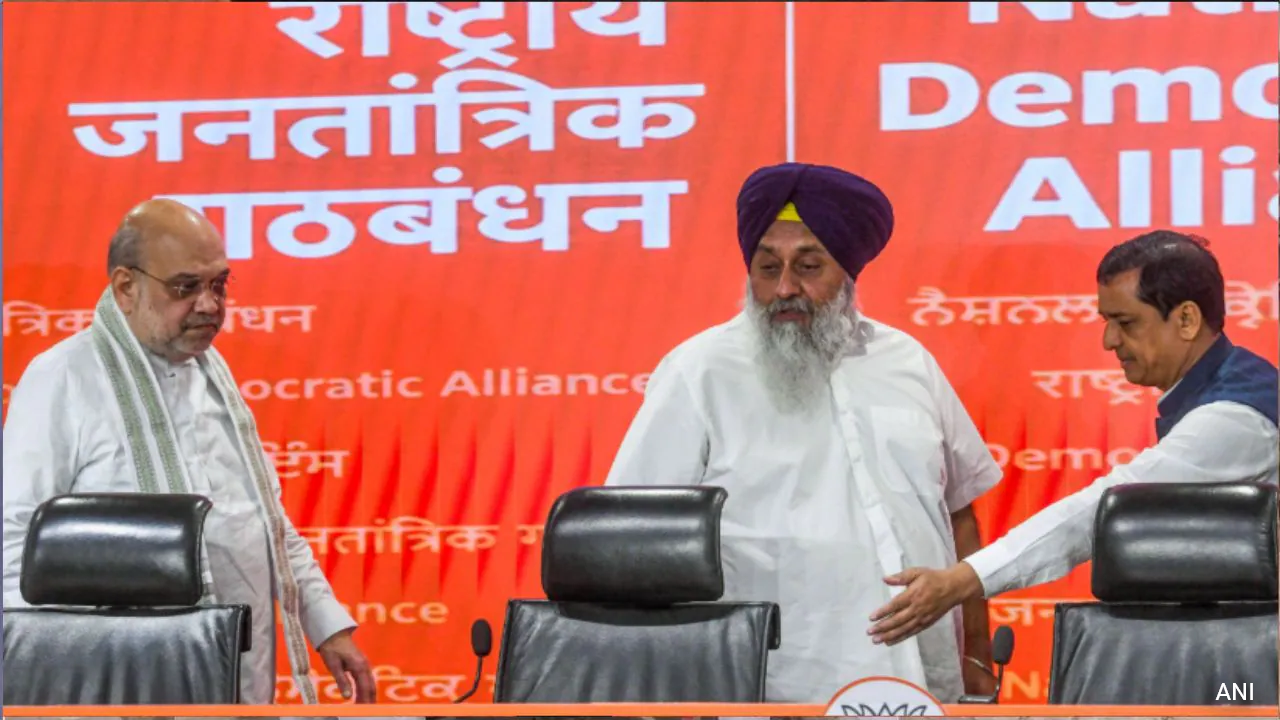
The AAP and Congress have already labelled the SAD-BJP reunion a desperate pact of two weakened parties. The numbers they avoid are simpler: in 2024 Lok Sabha polls, the two allies together polled 31.98 per cent -- ahead of both Congress and AAP. For Sukhbir Singh Badal, the same deal brings the chief minister's post that his own father never gave him. The speed of the opposition's reaction suggests the arithmetic is what actually worries them. The real challenge is whether the SAD and BJP can convert vote share into seats in this Punjab Assembly Election.
Opposition parties came attacking the moment the BJP and Shiromani Akali Dal announced their reunion on Tuesday. The AAP and Congress both called the pact a desperate move for power, not a partnership built on Punjab's needs. Arvind Kejriwal and Punjab Chief Minister Bhagwant Mann accused the two parties of breaking up and joining again whenever political convenience required it. According to Kejriwal, AAP's real alliance is with farmers, traders, women and Scheduled Caste communities.
Congress leaders matched the tone. Amrinder Singh Raja Warring and Pargat Singh described the reunion as directionless, driven by weakness and survival instinct rather than any clear plan for the state. Both parties reminded voters that SAD had walked out of the NDA in September 2020 over the three farm laws.
Kejriwal asked how Sukhbir Singh Badal could now sit with the BJP without answering for the farmers' agitation and the deaths that occurred during it. Raja Warring alleged that SAD first supported the laws, then reversed course under public pressure, and still backed the BJP in parliament on important votes such as the Presidential election while telling Punjab it had cut all ties.
The 2022 results supplied the opposition's sharpest taunt. SAD won three seats that year, the BJP two. Congress leaders mocked the new arithmetic as zero plus zero equals zero, saying two weakened parties would not change the 2027 outcome. Pargat Singh claimed the BJP has a pattern of weakening its regional partners and accused it of running several fronts inside Punjab. Mann went further and attacked Sukhbir personally, saying he was now sitting at the feet of the same BJP he had criticised for years after the 2020 split. Opposition speakers also returned to the old decade of SAD-BJP rule, citing the drug menace, corruption charges and sacrilege cases. They argued that voters still remember why they rejected that coalition the last time.
What Worries AAP, Congress
Behind the public dismissal lies a clear calculation. In the 2024 Lok Sabha election, SAD polled 13.42 per cent and the BJP 18.56 per cent. Pooled together, the figure is 31.98 per cent, ahead of Congress at 26.30 per cent and AAP at 26.02 per cent. Alliance supporters say that in a multi-cornered contest this combined share already puts them ahead in the race if the votes transfer cleanly. They also speak of a double-engine government that would release central funds, draw industry to border districts and slow the outflow of young people seeking work abroad. Amit Shah has stated that one core aim of the partnership is to strengthen Hindu-Sikh unity against forces that try to divide the state.
On security, the alliance has targeted the AAP government directly. Leaders have promised to end the drug menace within two years of taking office and to tighten coordination between the Punjab Police and the Border Security Force. They say stronger fencing and surveillance would cut cross-border smuggling. Opposition parties answer by pointing back to the same alliance's record in power between 2007 and 2017.
The coalition is now looking at specific belts where the numbers might turn into seats. Six of the most urbanised districts - Ludhiana, SAS Nagar (Mohali), Amritsar, Jalandhar, Pathankot and Patiala - contain 46 Assembly seats. In 2024 the BJP led in 23 of those segments. Five districts with Hindu-majority populations hold another 26 seats; seven more districts where Hindus form over 40 per cent of the population cover 43 seats. In Doaba and the border areas of Gurdaspur and Pathankot, the alliance hopes that combined votes will decide three-cornered fights. SAD's own 2024 leads were limited to nine segments in Malwa. Adding BJP votes in semi-rural pockets is meant to close the narrow margins where non-AAP and non-Congress votes had previously split.
Internal assessments put the coalition in contention across 50 to 58 segments, close to the 59-seat majority mark, provided the transfer holds. The plan is to use dissatisfaction over AAP's unfulfilled 2022 promises, the state's fiscal strain and law-and-order complaints, while presenting the alliance as a stable choice amid fragmented Panthic groups. Against AAP's welfare schemes and Congress's campaign, they offer central financial help for Punjab's debt, industrial incentives for border districts and closer BSF work against narcotics. However, the arithmetic alone will not settle the election. The alliance still must agree on seat sharing. Reports indicate the BJP wants around 40 seats, up from its earlier 23-seat share. Local rebellions remain possible. Rural voters who moved away after the 2020 farm laws have not yet come back.
How the BJP sacrificed its 6-year hard work to help Badal and SAD come out of crisis
The irony is hard to miss. In 2020, when the BJP faced heavy opposition over the farm laws, Sukhbir Singh Badal left the alliance to protect SAD's Panthic, rural and agrarian base. Now, with SAD reduced to a fraction of its former strength after losing many of its traditional strongholds, the BJP has handed him the elder-brother role and the chief minister's post if the alliance forms the government. Amit Shah has confirmed both points. Critics see it as a large concession. Whether SAD can recover from the 2022 collapse and the gap left by the death of Parkash Singh Badal is still uncertain.
Inside the Punjab BJP, the arrangement carries its own risk. Workers and leaders who spent the past six years building organisational presence in all 117 constituencies may resist once seats are given to SAD. The party had insisted for years that it would contest every seat on its own. That claim has been set aside. Cadres who stayed through the lean period after 2020 now watch the ground they were asked to hold being offered to the old partner. Open protest has not yet appeared, but the mood in many district offices is unsettled. Leaders who once spoke of fighting all 117 seats face questions they have not answered in public.
AAP continues to face anti-incumbency over unfulfilled 2022 promises and wider governance complaints, yet Bhagwant Mann has so far stayed clear of the corruption cases that hit AAP's leadership in Delhi. The alliance may or may not form the next government in Punjab. For Sukhbir Singh Badal, the announcement has already altered the picture. Being named the "bada bhai" and the chief ministerial face lifts him out of the crisis that followed the 2022 result. Parkash Singh Badal never offered him that role. Throughout his father's tenure, Sukhbir remained deputy chief minister. The BJP has now done what the elder Badal did not.
Whether rural and Panthic voters accept the same arrangement will be tested only when the campaign begins. The 2022 backlash has not disappeared. The arithmetic still points to a contest, not a settled outcome.
Track Latest News Live on NDTV.com and get news updates from India and around the world

