





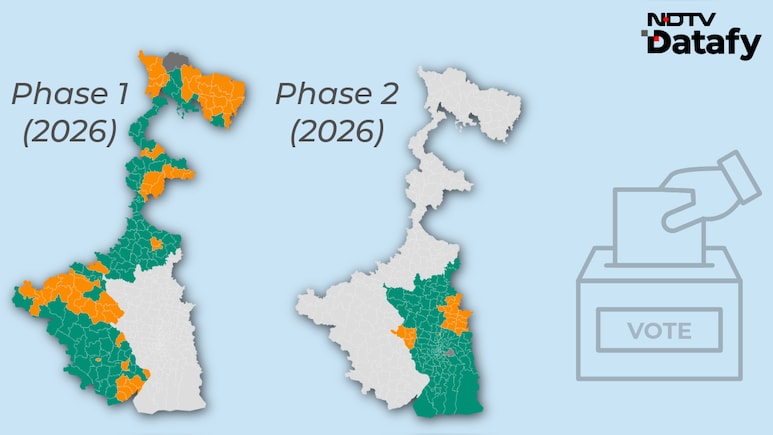
The Election Commission of India's announcement of the 2026 Assembly election schedule has produced an unusually sharp electoral contrast in West Bengal, the only state voting in just two phases. A retrospective mapping of the 2021 Assembly election results, applied to the new phase-wise structure, reveals a striking territorial divide that is likely to shape the campaign strategies of both the Bharatiya Janata Party (BJP) and the Trinamool Congress (TMC) in the months ahead.
Phase 1: Competitive Terrain With A Clear Bipolar Contest
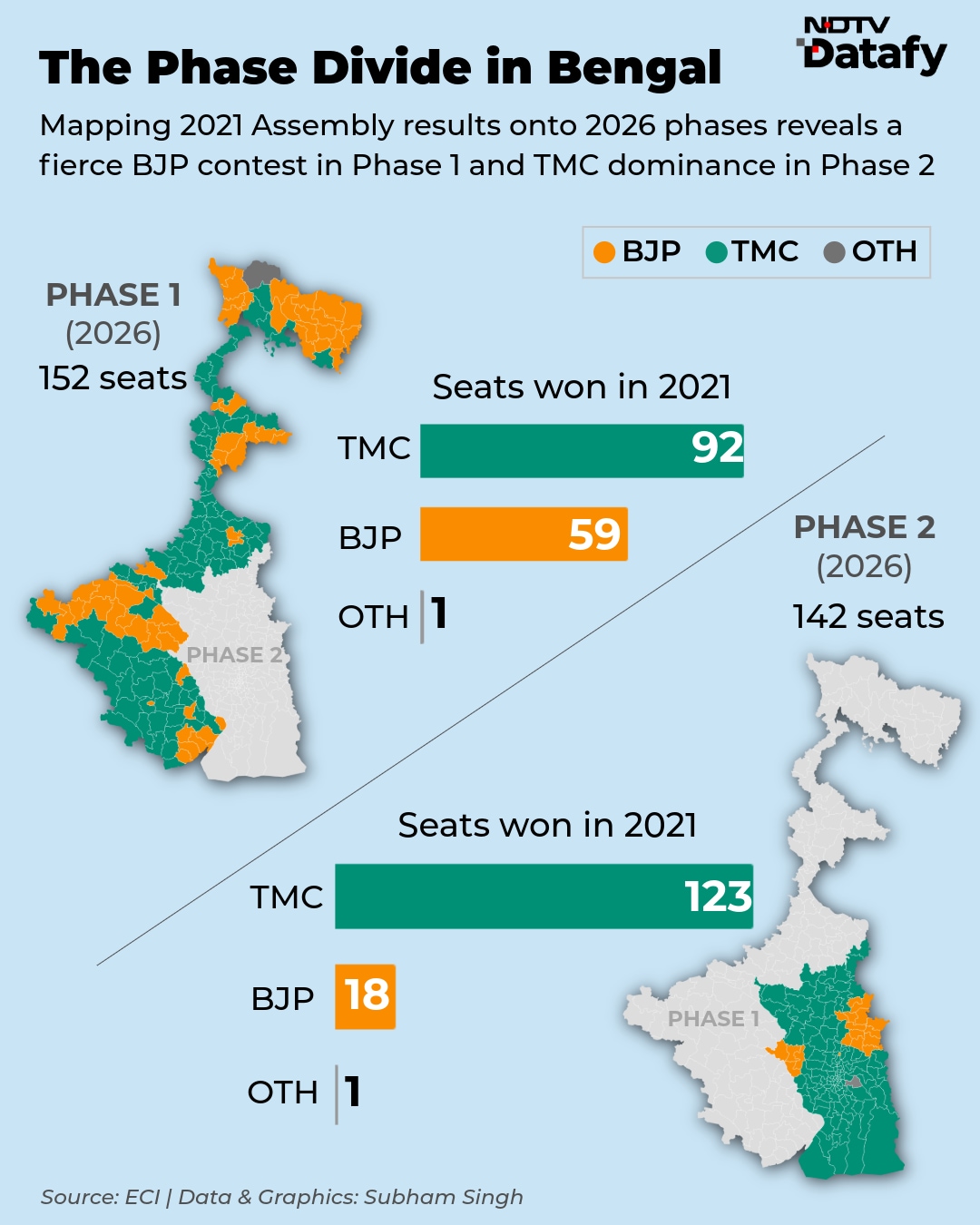
Phase-1, scheduled for April 23 this year, consists of constituencies where the 2021 contest was comparatively tight. When the 2021 results are re-projected onto the 2026 phase-1 boundaries (152 seats), TMC would have held 92 seats (60.5 per cent), the BJP 59 seats (38.8 per cent), and one seat would have gone to Others. Phase-1 shows a mixed political geography of green and saffron spread across northern, western and central West Bengal. This is also where the BJP had built its strongest presence in 2021, riding anti-incumbency sentiment and expanding its footprint far beyond earlier cycles.
Phase 2: A TMC Fortress Where BJP's Weakness Is Structural
Phase 2, scheduled for April 29, 2026, represents a far more daunting landscape for the BJP. Of the 142 seats going to polls in phase-2, TMC holds strong in 123 seats (86.6 per cent). These constituencies form a large, contiguous TMC stronghold - the same belt that delivered Mamata Banerjee her sweeping third term and has historically remained aligned with TMC's welfare-driven, organisation-heavy model. The BJP managed to win just 18 seats, translating to a modest 12.7% share, with one seat going to Others.
What this Means for BJP And TMC
The divide presents a structural challenge for the BJP. Phase-1 contains its stronger zones, concentrated in northern and western Bengal, while phase-2 represents the party's weakest zone. Any improvement here would require significant inroads into areas where TMC's organisational depth and voter loyalty have remained strong.
For the TMC, the two-phase structure appears advantageous. Phase-2, its strongest zone, comes after phase-1 voting, giving the party momentum to defend its heartland. The 2021 map shows the continued loyalty of women voters, minority blocs, and beneficiaries of welfare schemes, patterns validated again by the seat distribution.
As campaigning begins, the two-phase division has effectively split West Bengal into contrasting electoral theatres, one competitive and one overwhelmingly TMC-heavy, setting the stage for a closely watched contest in 2026.
Track Latest News Live on NDTV.com and get news updates from India and around the world

