






The Election Commission of India today announced the polling schedule for the 2026 Assembly elections in Assam, Kerala, Tamil Nadu, West Bengal and Puducherry.
Assam, Kerala and Puducherry will vote in a single phase on 9 April 2026, Tamil Nadu will go to the polls in a single phase on 23 April, and West Bengal will vote in two phases on 23 April and 29 April. Counting for all five regions is scheduled for 4 May.
This year's schedule marks a striking departure from past voting patterns, especially for West Bengal. The state, long known for multi-phase elections due to security and logistical considerations, voted in eight phases in 2021, six in both 2016 and 2011, and five in 2006. The reduction to just two phases in 2026 signals one of the most compressed electoral cycles in the state's recent history.
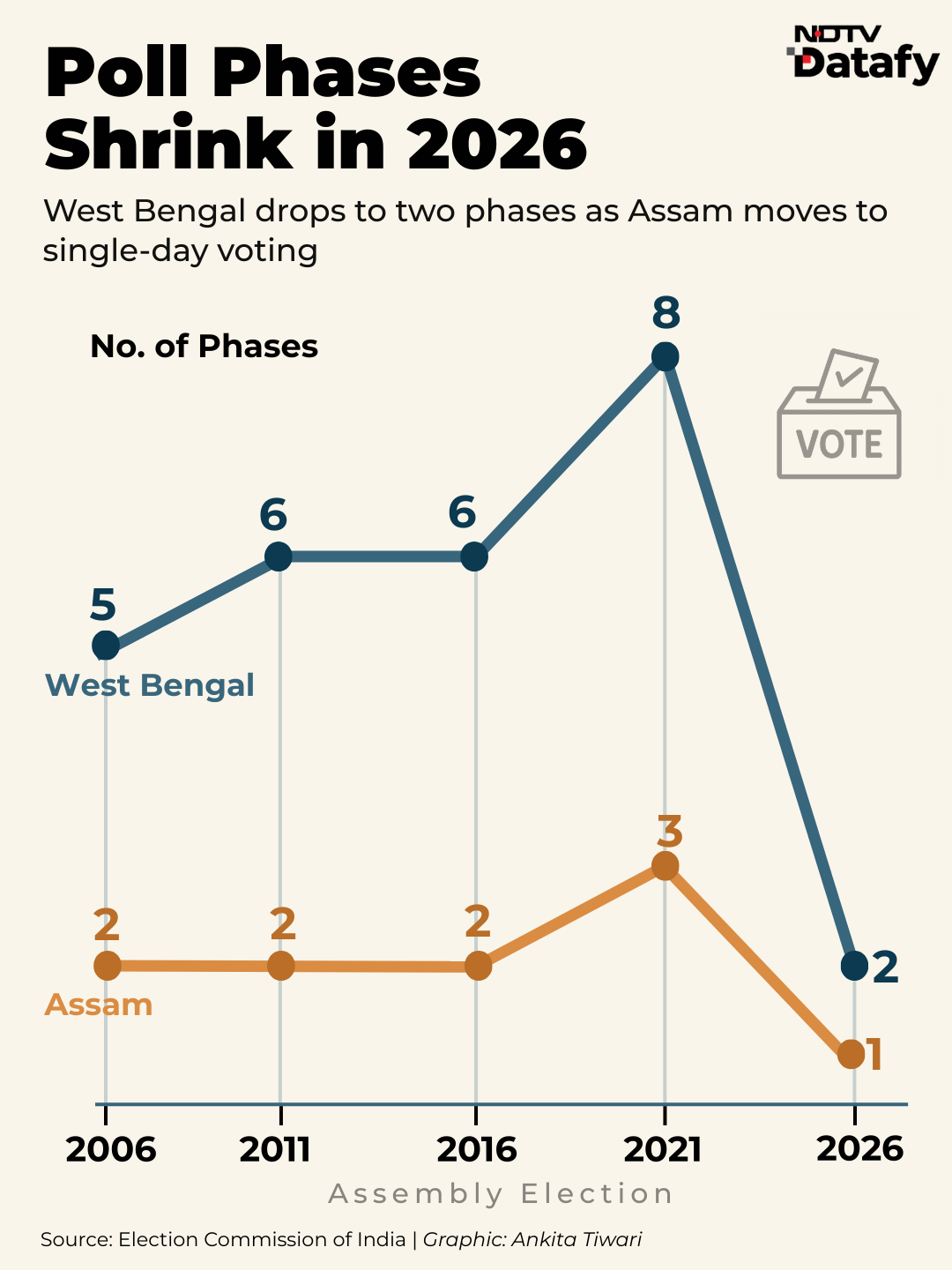
Assam reflects a similar trend. The state held two-phase elections in 2006, 2011 and 2016, expanded to three phases in 2021, and now shrinks to a single phase in 2026. These shifts have revived political discussions around whether India is inching closer, intentionally or structurally, towards the broader idea of "One Nation, One Election."
More Voters, More Polling Stations
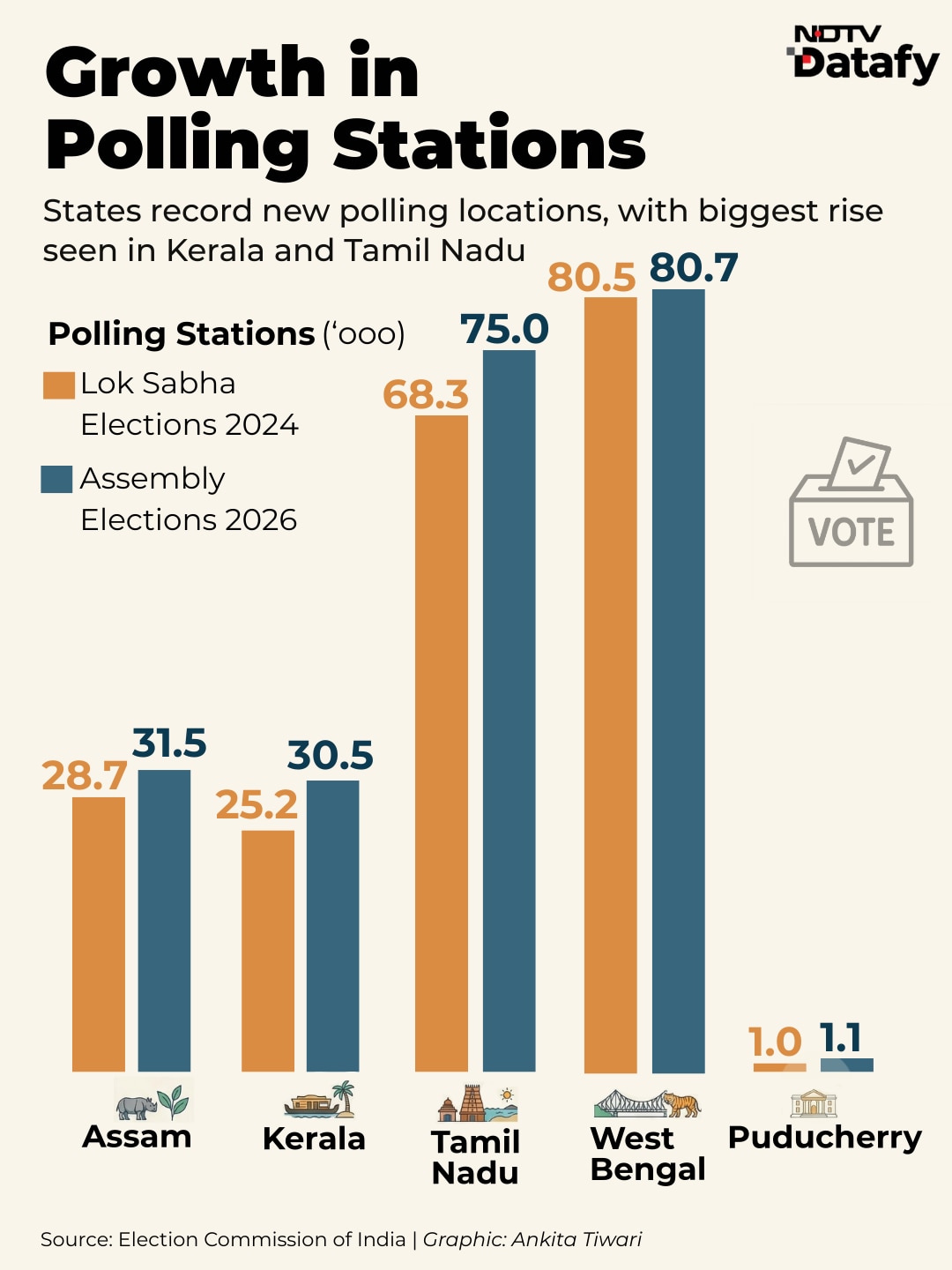
The Election Commission's latest data also shows a rise in polling stations across all five regions compared to the 2024 Lok Sabha elections, indicating an expansion designed to improve voter access and reduce booth-level pressure. Assam's polling stations have increased from 29,000 to 31,000, a jump of around 9.9 per cent. Kerala has reported one of the most substantial expansions, with booth numbers rising by nearly 20.8 per cent.
Tamil Nadu has added the highest number of booths in absolute terms, increasing from 68,000 to 75,000, about 9.8 per cent growth. West Bengal, despite its massive electorate, shows only a marginal rise of around 0.2 per cent, while Puducherry moves from 967 to 1,099 stations, marking an increase of roughly 13.6 per cent.
The updated electoral rolls present an equally dynamic picture of voter demographics. Assam has around 2.50 crore registered voters, including nearly 5.75 lakh first-time electors aged 18 to 19, accounting for about 2.3 per cent of its electorate. Kerala's rolls list roughly 2.71 crore voters, of which 1.6 per cent are new entrants.
Tamil Nadu remains one of the largest voter bases in the country, with approximately 5.67 crore electors and nearly 12.5 lakh young voters joining the rolls this cycle. West Bengal, despite being the largest among the five in terms of overall electorate with around 6.45 crore voters, has recorded the smallest proportion of first-time voters at just 0.8 per cent of its total. Puducherry, with a relatively small electorate, also reflects an upward trend in enrolment.
The data further highlights an increasingly significant senior-voter segment aged 85 and above. Assam has roughly one lakh electors in this category, Kerala around two lakh, and Tamil Nadu tops the list with nearly four lakh elderly voters. West Bengal follows closely with about 3.79 lakh, while Puducherry has approximately six thousand.
Track Latest News Live on NDTV.com and get news updates from India and around the world

