





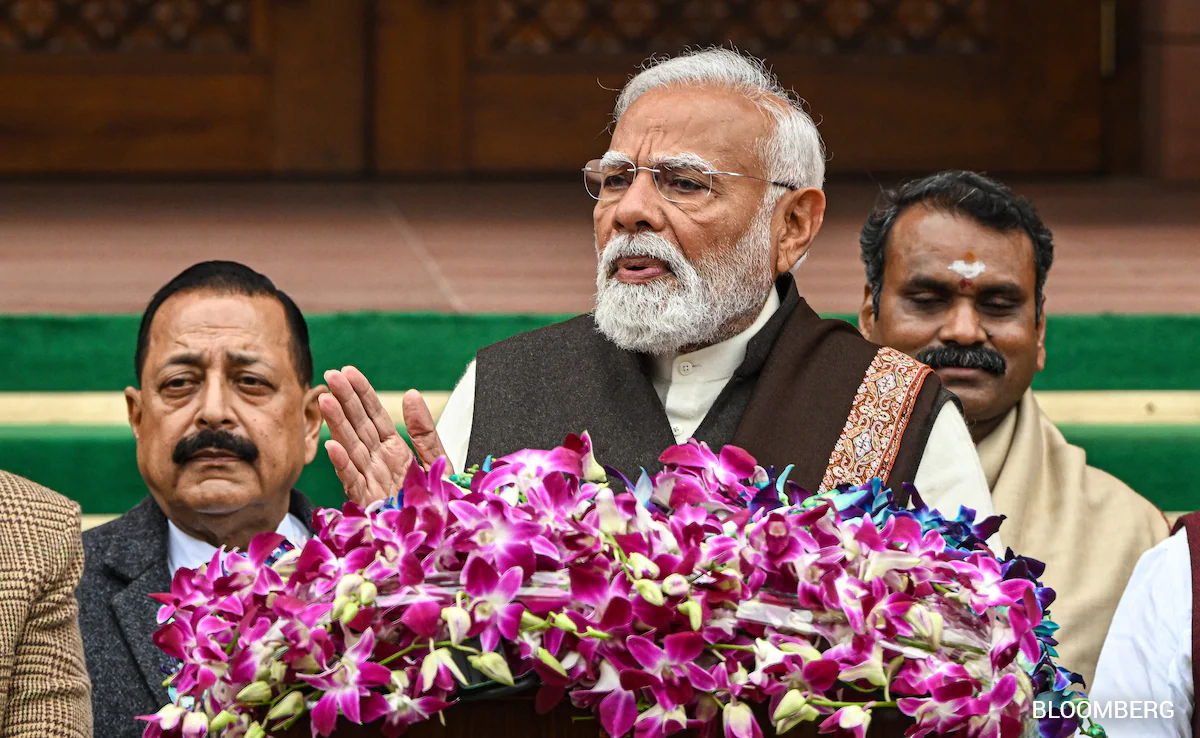
- Prime Minister Modi's budget focuses on supporting exporters hit by US tariffs and strategic sectors
- Defense spending rises 18%, infrastructure outlays increase, while debt targets remain intact
- No broad tax cuts, but a new tax on equity transactions aims to curb market speculation
Prime Minister Narendra Modi's plan to protect India's economy from Donald Trump's tariffs is coming into sharper focus.
The latest outlines of India's plan to live in the new world order dominated by the US president came on Sunday in an annual budget announcement that was packed with support for exporters battered by US tariffs, as well as fresh backing for strategic sectors like rare earths, semiconductors and critical minerals.
PM Modi's spending plan promised new outlays on infrastructure and an 18% hike in defense expenditure - a bulwark against the challenge posed by dual rivals China and Pakistan.
The Union Budget reflects the aspirations of 140 crore Indians. It strengthens the reform journey and charts a clear roadmap for Viksit Bharat.#ViksitBharatBudget https://t.co/26hIdizan9
— Narendra Modi (@narendramodi) February 1, 2026
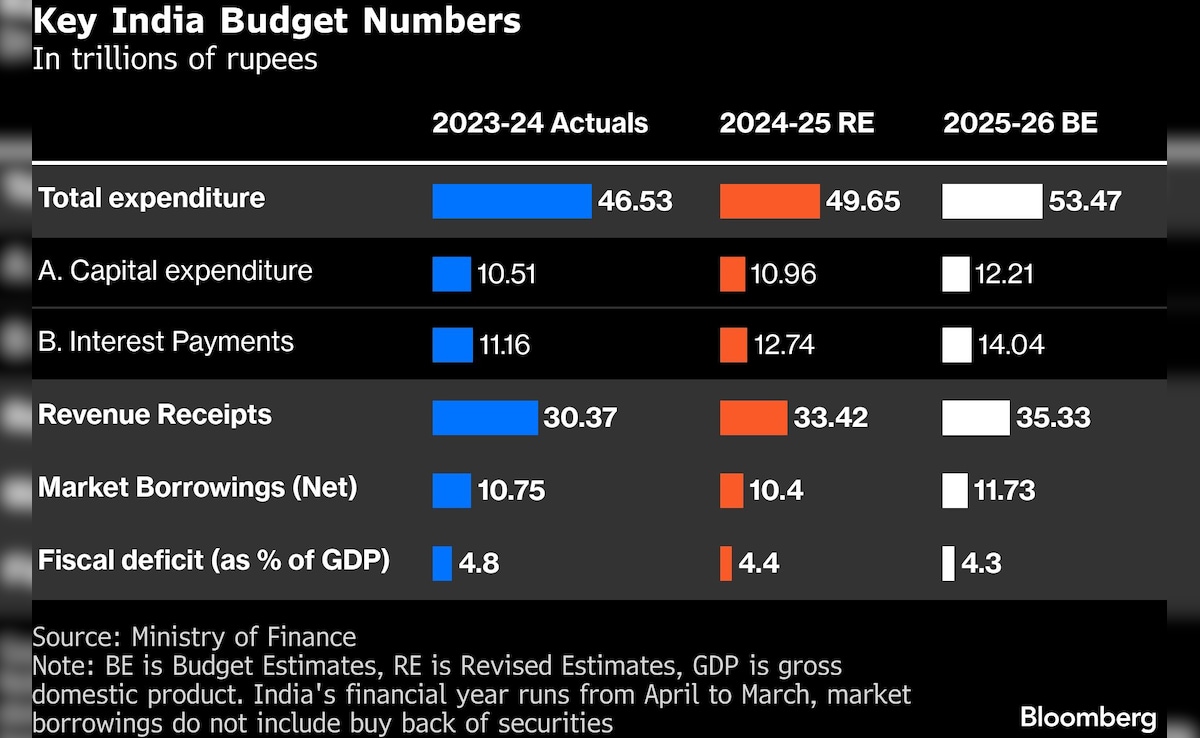
Despite those proposals, PM Modi's government largely stuck to its debt targets and kept overall outlays in check. The budget avoided the broad-based tax cuts that characterised last year's plan, while also steering clear of any new big-ticket splurges in a year when PM Modi's party will face some tough election battles in key states.
"This is a holding operation this year for the Indian economy," said Ashok Malik, New Delhi-based partner at The Asia Group, a business consulting firm. "It's aimed at insulating India while being watchful for global headwinds."
Shares broadly slumped in the wake of the budget announcement - a pullback that investors blamed on a tax hike on equity-market transactions to curb speculation, rather than overall dissatisfaction with the new spending plan. The government also plans to borrow more in the coming fiscal year than the market had expected, a move that's likely to pressure the bond market on Monday.
Setting the tone for her 90-minute budget speech to the parliament on Sunday, Finance Minister Nirmala Sitharaman declared that India faced "an external environment in which trade and multilateralism are imperiled and access to resources and supply chains are disrupted."
In the face of those threats, she called for India to "remain deeply integrated with global markets, exporting more and attracting stable long-term investment."
Though not mentioned by name, the budget was clearly geared toward addressing new challenges posed by the Trump administration. Chief among them is the 50% tariff in place since August, aimed in part at punishing India for its purchases of Russian oil. The duties, coming from India's largest trading partner, have battered labor-intensive industries, like textiles and furniture.
PM Modi's response to the fallout has been to crisis-proof the economy by making it more self-reliant. He cut consumption taxes last year to lift domestic spending, overhauled labor rules to make it easier for businesses to hire and fire, and opened up the nuclear and financial sectors to investors.
"The policy focus continues to be on improving productivity of factors of production, deregulations, sectoral ease of doing business," said Madhavi Arora, an economist with Emkay Global Financial Services Ltd. "The reformist agenda continues."
PM Modi's secondary strategy has been to strengthen trading relationships to offset the US threat. Last week, after almost two decades of negotiations, India and the European Union announced the completion of a free-trade agreement, giving exporters on both sides some reprieve from Trump's tariffs. India also sealed trade pacts with the UK and New Zealand last year.
Self-Reliance
Sunday's budget also brought new efforts to boost self-reliance in strategic sectors, with new outlays to boost manufacturing of semiconductors and pharmaceuticals, as well as an initiative aimed at helping mineral-rich eastern and southern states build mining, processing and manufacturing of rare earth minerals.
The initiatives, said Anish Shah, chief executive of Mahindra Group, "are forward-looking and essential for a resilient industrial ecosystem that can thrive amid global uncertainties."
It's unclear whether the government's cautious budget will be enough to shore up growth and create the millions of jobs the economy needs every year for its young population. While the government is projecting growth for the coming fiscal year at 6.8% to 7.2%, the market consensus is more pessimistic at 6.6%.
Opposition leaders were quick to point out that the government's spending plan was lackluster and ignored the real economic threats of youth unemployment and low household savings.
Youth without jobs.
— Rahul Gandhi (@RahulGandhi) February 1, 2026
Falling manufacturing.
Investors pulling out capital.
Household savings plummeting.
Farmers in distress.
Looming global shocks - all ignored.
A Budget that refuses course correction, blind to India's real crises.
For PM Modi's government, the focus for now is on steering the economy through uncertain times, with little space to veer from fiscal targets.
"This budget was critical," said Angshuman Bhattacharya, a partner at management consultancy EY-Parthenon, since "geopolitical events and their predictability have led to risks to an otherwise straight-line India growth story."
Track Latest News Live on NDTV.com and get news updates from India and around the world

