





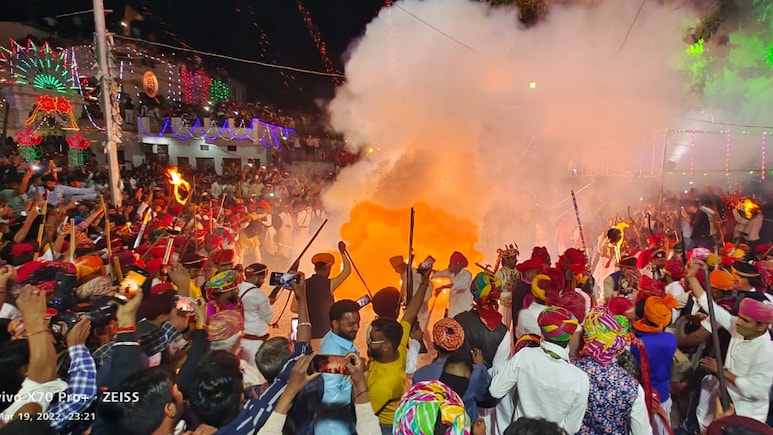
It was a unique Holi tradition going back 450 years, when a small village 'Menar' - situated between Chittorgarh and Udaipur - took on a Mughal outpost in a historic attack on the second day of the festival. In remembrance of that tradition, even today, the people of the village celebrate the attack on the Mughal outpost with gunpowder, fireworks, a canon, and guns - rather than the traditional 'gulal' and colours of Holi.
Gaurav Menaria, a resident of the village dressed in the colourful red turban of Mewar, wearing an achkan and carrying a gun, said, "This tradition is over 450 years old. In the 16th century, in the reign of Rana Udai Singh, a Mughal outpost was established here. Brahmins never pick up weapons, but the atrocity by the Mughals was so great that the brahmin community of Menar picked up arms and, with the inspiration of lord parshuram, they attacked the Mughals and drove them away from the camp."
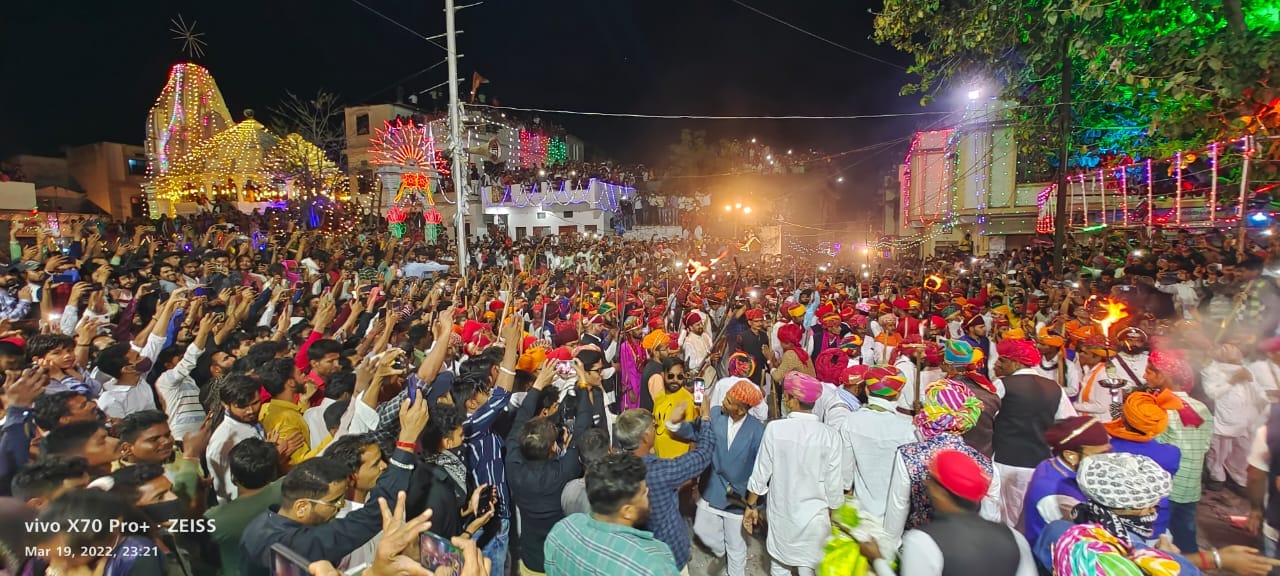
"The kings of Mewar granted the honour of the turban and its ornaments to us. These were done to honour the people of Menar for their bravery," he added, as he demonstrated how his gun can fire into the air.
Menaria is soon accompanied by other youngsters, all sporting red turbans with turban ornaments.
"We are also inspired by how Lakshay Raj Singh Mewar dresses," he told NDTV.
Lakshay Raj Singh is the custodian of the throne of Udaipur and is known for his traditional and royal style of dressing.
With guns and gun powder and swords and sticks, the men of Menar performed the 'gair' or a traditional dance performed by marital communities in Rajasthan which resembles a 'dandaiya' in the village chowk.
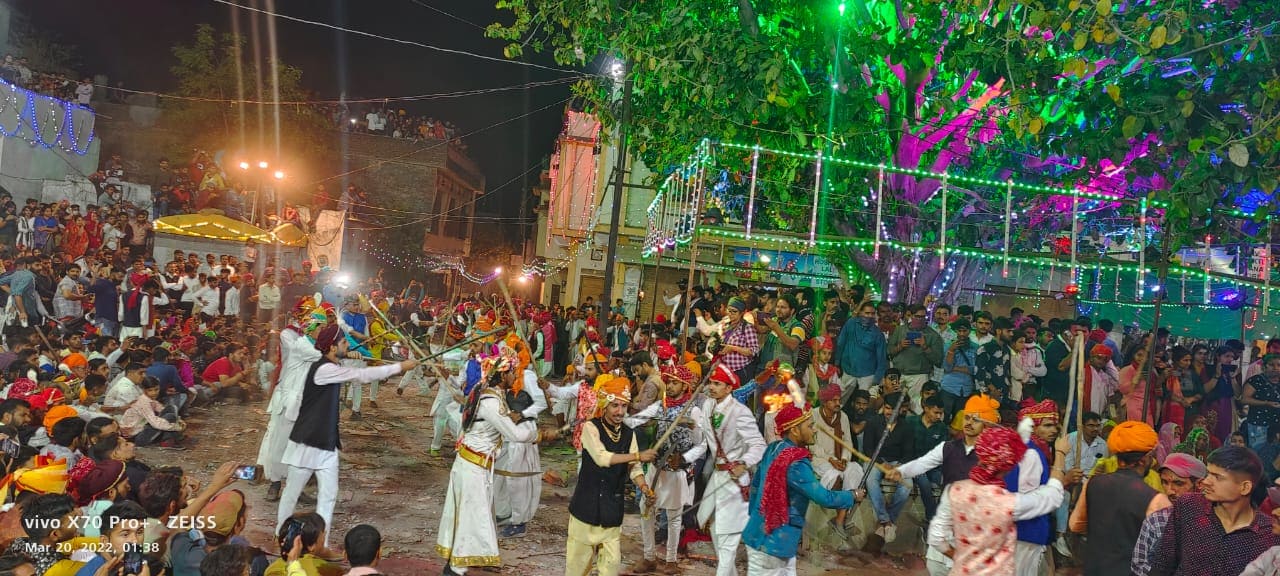
"Our ancestors defeated the mughals who were camped in small formations all over the state of Mewar. There was a chowki here of the Mughals, on the day of Jamna Beej, the Brahmins of Menar fought bravely, in which many of our people died, and the Mughals had to escape. For this, the Maharana of Mewar bestowed many titles on our community. We were given a 'jagir,' we were given red turbans to wear with ornaments and a 'nagori dhol'," another resident, Bhimalal Menaria said.
He added, "This is the only place in Rajasthan where history is reenacted in this way on the occasion of Holi each year."
It is believed that the Mughal outpost located in Menar became unpopular with the local people due to the habits of the soldiers of looting and taxing. Inspired by Maharana Pratap and his brother Amar Singh, the brahmin population of Menar attacked the Mughal camp on the second day of Holi. The Mughal soldiers, taken by surprise, were forced to flee, and even today the village re-enacts their act of bravery - wearingthe traditional Mewari paag, which is red in colour as an honour given by the rulers of Mewar for the locals.
Track Latest News Live on NDTV.com and get news updates from India and around the world

