





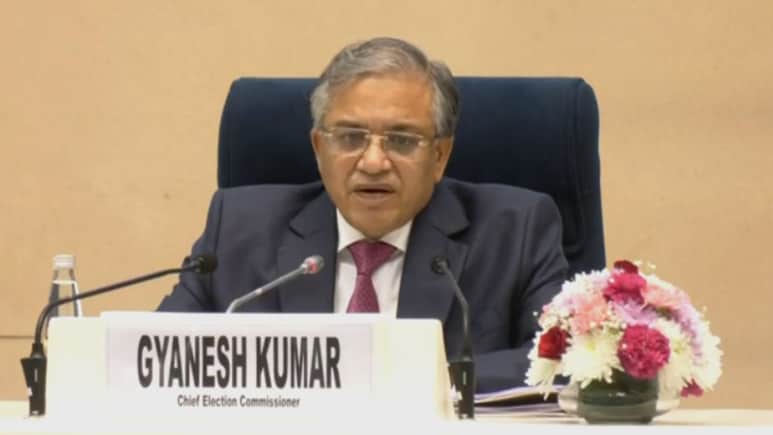
The Trinamool Congress's 10-page notice for the motion for the removal of the Chief Election Commissioner Gyanesh Kumar, commonly known as impeachment motion, cites seven key points -- including large-scale deletion of voters' names in Bihar and Bengal during the Special Intensive Revision of voter rolls, biased attitude towards certain political parties and misbehaviour on the part of the CEC. Gyanesh Kumar has become the first CEC against whom a notice for such a motion has been submitted.
The Trinamool Congress took the lead in initiating impeachment proceedings -- a result of a deal that involved lending support to the Congress's no-confidence motion against the Speaker. Signatures were collected only after the Congress -- and the entire opposition -- reached a consensus at a meeting of the INDIA bloc.
Read: No-Confidence Motion Against Speaker On, Opposition Plans Next Step -- Target Poll Panel
While a notice for impeachment requires the support of 100 members in the Lok Sabha and 50 in Rajya Sabha, the notice submitted by the Trinamool Congress had the signatures of 130 Lok Sabha and 63 Rajya Sabha members.
What Next
If the notice seems to be in order, and if there is enough material in support of the motion, the Speaker and the Rajya Sabha Chairman will jointly form a committee.
Rules mandate the formation of a three-member committee comprising a Supreme Court Judge, a Chief Justice of a High Court, and a senior advocate or a distinguished jurist.
The committee will be tasked with conducting a preliminary inquiry into the allegations offering opinion on whether a "prima facie" case for impeachment exists. If not, the matter is closed immediately. If yes, the matter will be taken up for discussion in both Houses - separately.
The Impeachment Procedure
The procedure for the removal of the Chief Election Commissioner (or other Election Commissioners) is identical to that of a judge.
The provisions for removing a Supreme Court Judge from their post are outlined in Article 124(4) of the Constitution. The Article says a Judge may be removed solely on two grounds: Proven misbehaviour and incapacity to perform their duties.
The Numbers Hurdle
Passing such a motion requires a "special majority" - meaning the support of at least 50 per cent of the total membership of the House. In addition, the support of one-third of the members present and voting at the time is also required.
Numbers indicate that the impeachment motion is likely to be defeated in whichever House it is first introduced, as the Opposition currently lacks the numbers to secure a special majority in either House.
The Chief Election Commissioner will have the right to engage legal counsel to present his defence before the House.
The Precedent
Indian parliamentary history offers a precedent for this: In 1993, during the impeachment proceedings against Justice V Ramaswami, a separate dock was constructed within the Lok Sabha chamber, from where Advocate Kapil Sibal presented arguments in Justice Ramaswami's defence.
Justice Ramaswami, however, resigned immediately after the debate.
This procedure was adopted in the case of Justice Yashwant Varma in connection with the cash row.
Justice Varma Case First?
The Lok Sabha Speaker has already formed a three-member committee to examine the impeachment motion regarding the issue of burnt currency notes recovered from the residence of Justice Yashwant Varma.
Read: Speaker Om Birla Re-Constitutes Panel To Probe Judge In Cash Row
This committee - comprising Supreme Court Justice Aravind Kumar, Bombay High Court Chief Justice Chandrashekhar, and senior Karnataka High Court advocate BV Acharya - is currently reviewing the matter.
The Speaker had formed the committee in February and it is expected that the committee will submit its report in the Monsoon Session in July-August.
The Fallout
The chances are that the impeachment proceedings against the Chief Election Commissioner may take five months or more to move forward. By that time, the elections in West Bengal would be over and a new government be in place.
What Trinamool Wants
Given the timeline, there are questions on why the Trinamool is initiating impeachment proceedings against the Chief Election Commissioner.
Read: "Don't Dare": Supreme Court Fumes As Bengal, Poll Body Spar Over Voter List
In private conversations, Trinamool Congress leaders have acknowledged that this is a strategic move designed to exert pressure on the Election Commission.
The party aims to convey a clear message to its cadre and voters, especially those whose names were struck off voters' list: That the Election Commission is at fault, that voters' names were struck off the electoral rolls improperly, and that their leader has championed their cause, taking it all the way to the Supreme Court and now, to Parliament.
Track Latest News Live on NDTV.com and get news updates from India and around the world

