





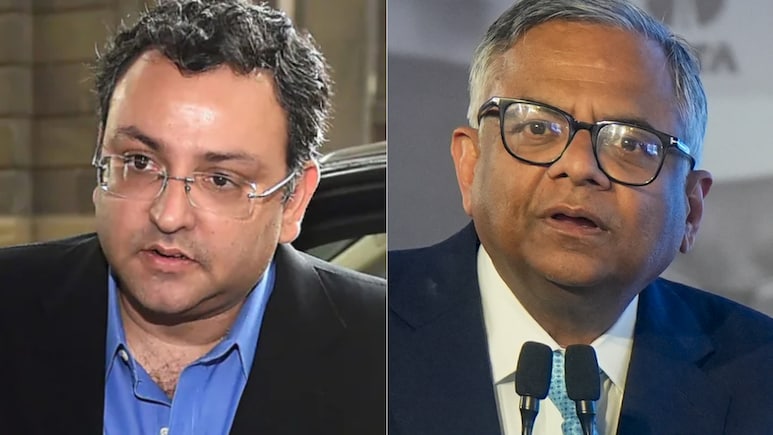
When Natarajan Chandrasekaran became the chairman of the Tata Sons, he had a legacy to take forward. The coveted chair in the holding company of one of the country's biggest industrial groups had earlier been occupied by several Tata luminaries.
But there was a difference in Chandrasekaran's appointment. He wasn't one from the Tata family. In fact, he was only the second to lead Tata Sons despite not being from the same bloodline.
The first was Cyrus Mistry of Shapoorji Pallonji & Co, the largest shareholder in Tata Sons.
Ratan Tata's decision to step down as the Tata Sons chairman in 2012 paved the way for the board members from outside the Tata bloodline to take the top post.
Read: Tata Sons Chairman N Chandrasekaran Steps Down, Won't Seek Reappointment
Mistry, who had entered the board in 2006, was chosen as its next leader. But the stint didn't last long. In a dramatic turn of events, he was sacked by the board in 2016 after the majority shareholders "lost confidence" in him.
His ouster saw Ratan Tata's brief return and then the appointment of Chandrasekaran, widely known as Chandra. Tata assumed the honorary post of Chairman Emeritus, which he held till his death in 2024, as Chandra took over in 2017.
Chandra's stint came to an end with an announcement on August 12, less than a week before the company's annual general meeting.
After a career spanning four decades, he declared today he would step down. His term runs until February next. He would not seek a reappointment, he said. (Read full statement)
Former Tata Group Bosses
In 1868, a 29-year-old Jamsetji Nusserwanji Tata set up a trading firm that went on to become one of the country's biggest business groups. He had massive dreams and a vision much needed for the country's prosperity. He had bigger projects in his mind, from steel to hydroelectric power to scientific research.

He died in 1904, and many of his ambitions remained incomplete.
His elder son, Dorabji Tata, took over not just a company but his dreams too. He established Tata Iron and Steel Company in 1907, now known as Tata Steel. Under his leadership, the Tatas got into power, hospitality, and insurance sectors.
In 1932, he established the Sir Dorabji Tata Trust. He died the same year. His cousin Nowroji Saklatvala took over next as the chairman of the Tata Group.
Known for his focus on employee welfare, Saklatvala played a key role in expanding the family business. He died in 1938 in France.
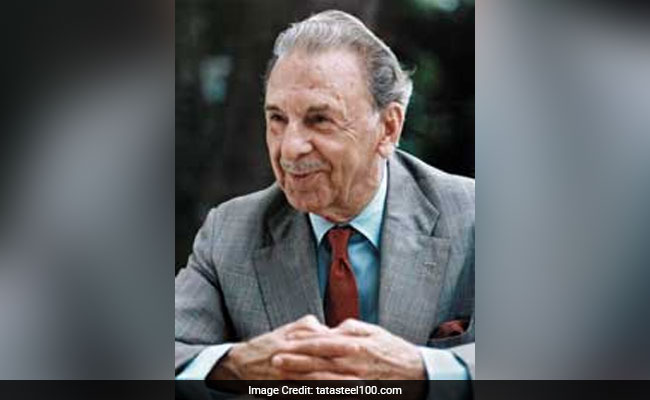
JRD Tata succeeded him as the Tata Sons chairman. He led the group for more than five decades and oversaw the establishment of flagship firms like Tata Motors and Tata Consultancy Services.
Ratan Tata took over the reins in 1991, as India opened its doors to become a liberal economy. The global footprint of Tata Group expanded like never before under his chairmanship.

He stepped down in 2012 and handed over the leadership to Cyrus Mistry. However, he did not remain in the post for long. He was removed just four years later over disagreements with the board. Ratan Tata was brought back as the interim head.
Mistry died in a car crash in 2024.
N Chandrasekaran took over in 2017 under the shadow of Mistry's ouster. Under him, Tata Group underwent massive expansion and diversification across technology, auto, and aviation sectors.
The group expanded to 31 companies operating in over 100 nations. Revenue boomed, and so did profits.
Track Latest News Live on NDTV.com and get news updates from India and around the world

