





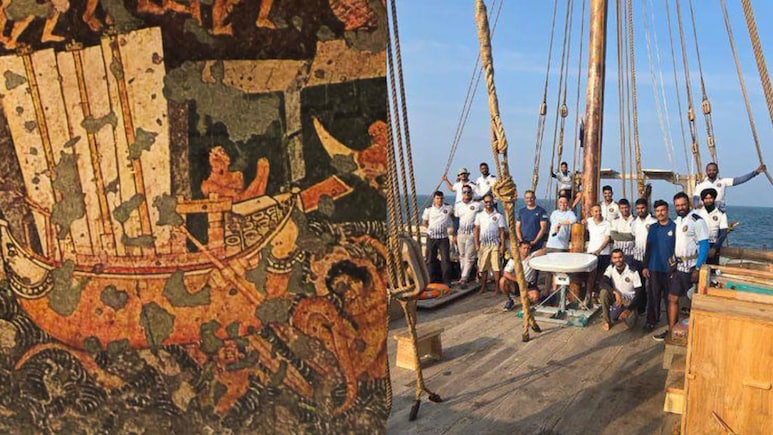
When the Indian Naval Sailing Vessel (INSV) Kaundinya set sail from Porbandar on its maiden overseas voyage, it carried a dual legacy: India's maritime past and a glimpse of its digital future. At first glance, the vessel looks like it was lifted straight from the murals of the Ajanta caves. Its wooden planks were painstakingly stitched together with coconut coir rope, sealed with natural resins, and curved using techniques perfected by shipwrights more than 1,500 years ago. Yet, as the engineless Kaundinya rode the swell of the Arabian Sea toward Muscat, the crew stayed connected with shore teams and shared live updates thanks to Eutelsat OneWeb's Low Earth Orbit (LEO) satellite internet. A constellation of over 600 satellites enabled this connectivity, even in the middle of the ocean.
The story of the Kaundinya is about more than just reviving India's shipbuilding heritage. It is about marrying tradition with cutting-edge innovation, proving that even a vessel built without a single nail can host one of the world's most advanced digital links. This high-speed satellite network beams down from hundreds of satellites orbiting Earth, ensuring that the ancient ship remains a part of the modern world.
A Ship From The Past, Reborn For The Present
INSV Kaundinya is no ordinary naval project. Envisioned by Prime Minister Narendra Modi and executed by the Indian Navy in collaboration with archaeologists, naval architects, and traditional shipwrights, the vessel resurrects the ancient "stitched-plank" method. Long before steel hulls, rivets, and welding, Indian shipbuilders joined thick wooden planks with hand-twisted coir rope to create hulls that were flexible, resilient, and perfectly suited for long ocean voyages.
Inspired by a fifth-century ship depicted in Ajanta paintings, the Kaundinya's construction required purely indigenous materials, hand-shaped wood, natural resins, and rope spun from coconut fibre. For the crew, sailing this ship across the Arabian Sea was not just a test of endurance, but a re-enactment of history. The voyage to Muscat marks a symbolic retracing of the maritime corridors that once connected India with Oman and the wider Indian Ocean world.
Ancient Hull, Modern Skies
The project faced one critical challenge: How to maintain communication, safety coordination, and crew morale on a ship with no space for modern antennas, no metal superstructure, and no conventional navigation systems. This is where Eutelsat OneWeb stepped in. The company deployed its compact, high-speed LEO satellite system aboard the Kaundinya, providing a vital communication link throughout the expedition. For a ship built using prehistoric methods, the ability to relay live updates in real time was revolutionary.
Sanjeev Sanyal, a member of the Prime Minister's Economic Advisory Council and a core crew member, noted the impact of the technology. “Throughout the voyage, having reliable satellite connectivity has been invaluable,” Sanyal said. “It allowed us to stay connected with shore-based teams, supporting communication, live feeds, and above all, morale during long and sometimes challenging periods at sea.”
Testing A New Frontier
What makes this deployment even more remarkable is that India does not yet permit commercial satellite-based internet services, as the sector awaits a formal regulatory framework. However, recognising the national importance of the Kaundinya expedition, the government granted Eutelsat OneWeb a special license for this voyage. While the Indian Army has previously used this connectivity for humanitarian missions in Myanmar and Sri Lanka, installing such a system on a traditional stitched ship was unprecedented.
The success of the mission opens a new frontier, demonstrating that even traditional, non-metallic vessels can be equipped with dependable LEO communications, a capability relevant for maritime archaeology, disaster relief, and naval expeditions. Kaundinya's arrival in Muscat, welcomed by Indian and Omani officials, represents a snapshot of how India's maritime story is evolving. By successfully integrating modern satellite technology with a stitched-plank wooden ship, India has shown that the past and future can, quite literally, sail together.
Track Latest News Live on NDTV.com and get news updates from India and around the world

