





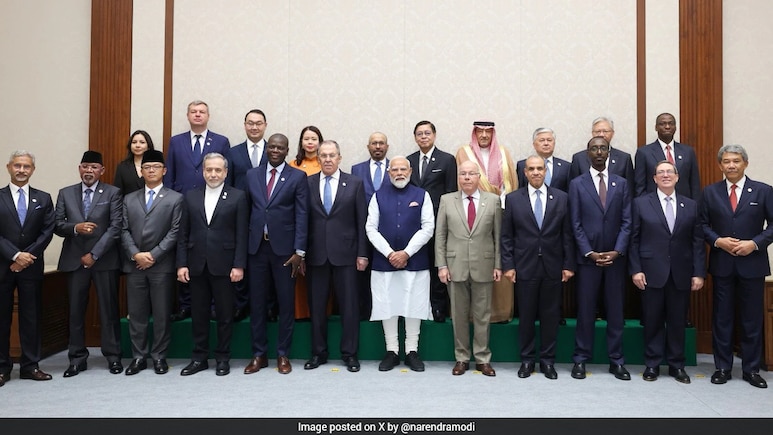
A startup fund. A digital farming network. A mental health initiative built around India's NIMHANS. A framework to keep supply chains from breaking down, and tighter cooperation on hunting fugitive offenders across borders. These are just some of the things India has quietly pushed through during its year running the show at BRICS, with the grouping's 18th summit now bearing down on New Delhi this September.
It's a lot to keep track of, and that's kind of the point. India wants BRICS to stop sounding like a talking shop and start looking like a working one, something with actual platforms and mechanisms behind the rhetoric, covering everything from farming and hospitals to AI, energy, shipping, customs and policing.
India picked up the BRICS chair on January 1, 2026, its fourth time doing so, under the banner "Building for Resilience, Innovation, Cooperation and Sustainability." Officials say more than 350 meetings have taken place since then, spanning ministers, working groups, Sherpas, business leaders and various people-to-people tracks. Out of all that grinding, the government has pulled together 20 outcomes it's calling the headline results.
A Fund And A Network For Startups
Perhaps the splashiest economic idea on the table is the BRICS Startup Innovation Fund, essentially an attempt to pool public and private money from across member countries and put it behind scalable, innovative young companies.
Tied to that, BRICS nations have signed off on an Incubator Network linking national agencies, incubators and startups across the bloc. The idea is simple enough: a promising startup in one country should be able to get referred to an incubator in another. Whether that actually happens smoothly is another question, but the scaffolding is there now.
None of this is an accident. India's been angling to make innovation and tech a bigger part of what BRICS actually does, rather than something it just mentions in communiqués.
Farming Gets The Digital Treatment
Agriculture has turned into one of the more concrete areas of cooperation. Member countries have agreed to set up a Network of Centres of Excellence on Agro-Ecology and Regenerative Agriculture, a mouthful, but the goal is straightforward: shared research on organic and regenerative farming methods.
There's also a new BRICS Network on Digital Agriculture, which will lean on AI, geospatial tech and digital infrastructure to push data-driven farming solutions. And then there's BRICS AGRIN, the Agro-Inputs, Genetic Resources and Information Network, meant to strengthen how the bloc handles seeds, germplasm and other farming inputs.
A Global Forum on Farmers' Rights in Seed Systems has been floated too, with India taking the first turn coordinating it through the Protection of Plant Varieties and Farmers' Rights Authority.
NIMHANS Steps Into A Bigger Role
Here's one that might surprise people outside the health policy world: India's NIMHANS, the National Institute of Mental Health and Neurosciences, has been handed a central role in a brand-new BRICS Network of Centres of Excellence on Mental Wellness. It's meant to drive research and help close treatment gaps that exist across member countries.
Alongside that, BRICS has launched a Mission for Healthy Lifestyle, complete with a roadmap running from 2026 to 2029. Diet, exercise, traditional food practices, prevention of chronic disease- it's all folded in there. A new expert group on Traditional, Complementary and Integrative Medicine rounds out the health push, focused on research standards and regulatory cooperation.
Smart Grids And Energy Storage
On the energy side, BRICS has adopted a set of Guiding Principles on Energy Storage and Smart Grids, and launched a Digital Centre of Excellence to go with it, a place for sharing technology, policy ideas and pilot projects. This fits into the bigger picture of India's chairship, which has leaned hard on energy resilience and clean energy as priorities.
Keeping Supply Chains From Snapping
Given how fragile global supply chains have looked in recent years, it's no shock that BRICS adopted a Logistics Supply-Chain Cooperation Framework this year. It's aimed at smoothing out transport, cargo and shipping cooperation, plus building up localised manufacturing capacity.
There's also a new Forum on Sustainable Aviation Fuels, looking at feedstock mapping and certification, the unglamorous but necessary groundwork for greener flying.
A Better Deal For Small Businesses
India's chairship has also produced a BRICS MSME Cooperation Portal and a dialogue specifically on financing for small and medium enterprises, an attempt to help smaller businesses actually get access to markets and capital across the bloc, not just the big players.
On trade more broadly, BRICS members backed a statement supporting a rules-based, inclusive multilateral trading system with the WTO still at the centre. They've also adopted a Global Value Chains Action Plan running through 2030, with a technical council and joint study aimed at making trade routes more resilient and market access less lopsided.
Digital Infrastructure and Skills
Tech cooperation is quietly becoming its own pillar. There's a proposed digital public infrastructure repository and pilot projects to help member countries with their own digital transformations, plus a BRICS Science and Research Repository for sharing scientific knowledge across the group.
On the labour side, BRICS has launched something called BRICS CONNECT, a network covering skills training, employability, labour-market data, digital employment services and social security.
Security, Drugs and Cybercrime
BRICS hasn't just been talking development and economics, either. When National Security Advisers from member countries met in New Delhi back in June, terrorism, cyber security, energy and food security, supply-chain resilience and emerging tech were all on the agenda. They also checked in on how the existing BRICS working groups on counter-terrorism and ICT security are progressing.
Heads of anti-drug agencies from BRICS countries adopted what's being called the Guwahati Declaration, a commitment to work together against drug trafficking and the organised crime that tends to travel with it, including sharing intelligence, setting up early-warning systems and going after maritime trafficking routes.
Chasing Fugitives Across Borders
One of the more consequential law-enforcement moves is an in-principle agreement to set up a BRICS Network of Law-Enforcement Practitioners, focused specifically on tracking down fugitive offenders and helping with extradition. Member countries have also welcomed a repository for informal cooperation on tracing fugitives, and an Expert Network on Asset Recovery has agreed on standardised ways of exchanging information between practitioners.
Easier Customs, Faster Trade
BRICS members are also moving toward signing an agreement on customs cooperation and mutual administrative assistance, the kind of unglamorous paperwork that, if it works, actually speeds up trade, cuts costs and tightens up border security while making illicit trade harder to pull off. Countries have already given their in-principle approval and say they're ready to sign.
What Happens at the Summit
All of this is building toward the 18th BRICS Summit in New Delhi this September, where leaders from BRICS members and partner countries, plus assorted outreach invitees and heads of international organisations, are expected to show up.
The bloc, as it stands now, has 11 full members: Brazil, China, Egypt, Ethiopia, Indonesia, India, Iran, Russia, Saudi Arabia, South Africa and the UAE, along with ten partner countries. Put together, that's roughly 49 per cent of the world's population and about 40 per cent of global GDP measured in purchasing power parity terms. Not a small club.
India's been framing its year as chair as a "whole of nation" effort, and officials say the September summit will lean even harder into the priorities of the Global South, farmer-centric agriculture, stronger health systems, future-ready mobility, women-led development, energy access, climate resilience, MSMEs, startups, sturdier value chains and sustainable development.
Strip away the acronyms and the takeaway is pretty simple: New Delhi wants BRICS to stop being just a name leaders use at photo-ops and start being a set of actual tools, networks, portals, frameworks that member countries can point to and say, this is what we built together.
Track Latest News Live on NDTV.com and get news updates from India and around the world

