





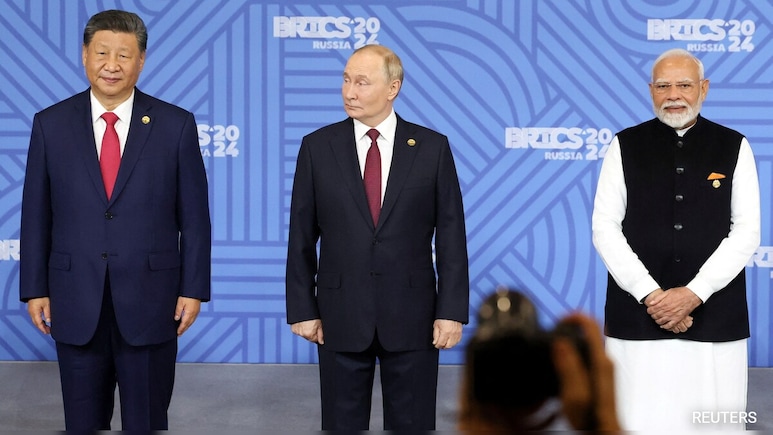
India will host one of the most geopolitically complicated BRICS summits yet on September 12 and 13, with Russian President Vladimir Putin and Chinese President Xi Jinping among the leaders expected in the capital.
The expanded BRICS grouping, which now stretches across Asia, Africa, the Middle East and Latin America, is expected to bring together leaders and senior representatives from across the bloc. Iranian President Masoud Pezeshkian is also expected to attend.
Brazilian President Luiz Inacio Lula da Silva is not expected to attend because of domestic commitments, with Brazil likely to be represented by its foreign minister. According to sources, Abu Dhabi Crown Prince Sheikh Khaled bin Mohamed bin Zayed Al Nahyan will attend instead of his father, UAE President Sheikh Mohamed bin Zayed Al Nahyan.
The attendance of Saudi Arabia and Bolivia remains unclear.
On paper, the official agenda will focus on trade, development financing and reform of global institutions. Behind closed doors, however, officials involved in the preparations expect the conflict in the Middle East to cast a shadow over much of the summit.
Iran is expected to push for language in the summit declaration reflecting its position on the recent conflict, strikes and sanctions.
That could make the negotiations particularly difficult.
BRICS operates on consensus, meaning a single delegation can block agreement on a contentious paragraph. "The language on West Asia is where the pressure is," a diplomat familiar with the preparations said. "Everyone has their own red lines."
The wording of any joint statement remains under negotiation.
Why The Middle East Could Dominate The Summit
Any escalation around the Red Sea carries immediate economic implications for Egypt, particularly because of the importance of shipping through the Suez Canal.
The Gulf states are closely watching the impact on energy markets and regional investments, while India will be keen to prevent the Middle East tensions from overwhelming the summit's wider economic and developmental agenda.
New Delhi faces a particularly delicate balancing act.
India has developed a strategic relationship with Israel while maintaining long-standing ties with Iran. Millions of Indians also live and work across the Gulf, giving the region a direct economic and human dimension for India.
A major escalation could affect India's energy supplies, shipping routes and broader economic interests.
Then There Is Putin And Xi
The presence of Vladimir Putin and Xi Jinping will add another layer to India's diplomatic balancing act.
India continues to maintain close defence and energy ties with Russia despite pressure from Western capitals. At the same time, relations with China have improved after years of military tensions along the Line of Actual Control, although the underlying strategic rivalry between the two countries remains.
With Putin and Xi both in Delhi, the spotlight will inevitably fall on India's relationships with Moscow and Beijing.
The expanded BRICS format makes the equation even more complicated.
Indonesia's President Prabowo Subianto is set to make a significant appearance, bringing Southeast Asia's largest economy and one of the world's most populous countries deeper into the BRICS conversation.
Egypt and Ethiopia add to the African representation alongside South Africa. Nigeria, Kazakhstan, Uzbekistan, Malaysia, Thailand and Cuba are among other countries expected to be represented in Delhi in various capacities, according to information provided for the summit.
The result is a grouping with sharply divergent interests.
Russia and China are strategic partners. Iran is openly hostile towards the US and much of the Western security architecture. Saudi Arabia and the UAE, meanwhile, maintain important security relationships with Washington while expanding their engagement with BRICS.
That is the contradiction India will have to manage as host.
India's Diplomatic Test
The immediate task appears simple: get the leaders into the room, keep negotiations on track and produce a declaration that everyone can accept.
The reality could come down to a handful of contested lines on the Middle East.
A senior official involved in the preparations, speaking on condition of anonymity, described the summit as a "high-pressure diplomatic exercise", where developments on the ground could alter negotiating positions with little warning.
The final declaration will therefore be closely watched.
If India manages to steer the summit towards consensus on trade, technology, development and reform of global institutions, New Delhi will have a substantial diplomatic achievement to claim.
For New Delhi, September 12 and 13 will therefore be about more than hosting Putin, Xi and other world leaders. The real test will be whether India can keep an increasingly divided room together long enough to speak with one voice.
Track Latest News Live on NDTV.com and get news updates from India and around the world

