





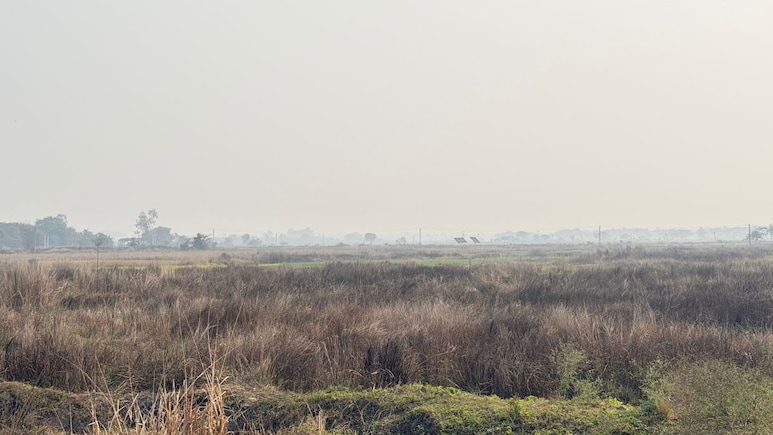
Singur, which changed the course of West Bengal politics in 2006, is once again at the centre of a controversy 18 years later. Back then the question was about why set up industry on fertile agricultural land. Today, the question is: what happened to that land?
The very movement that overthrew the Left Front's 34-year-old rule in Bengal has created a confusing situation for the farmers of Singur. While power has changed hands, the uncertainty over land, farming, and employment remains unchanged.
-

-
 'Human Pulled The Trigger, Machine Helped': Ex-CIA Chief On Iran School Bombing
 -
 CIA Ex-Chief David Petraeus: The Future Of War Is Being Written By AI
 -
 "Hundred Million Buddhas Better Than Millions Of Einsteins": BAPS Monk On AI
 -
 "Nobel Laureate In Terms Of Brain Power": CIA Ex-Director On AI Role In Warfare
 -
 CIA Ex-Director David Petraeus On AI's Expanding Role In Warfare
 -
 'Human Pulled The Trigger, Machine Helped': Ex-CIA Chief On Iran School Bombing
 -
 "Miscommunication By Eiffel Tower": BAPS Monk On 'Women Sidelined' Claim
 -
 "Nobel Laureate In Terms Of Brain Power": CIA Ex-Director On AI Role In Warfare
 -
 "Miscommunication By Eiffel Tower": BAPS Monk On 'Women Sidelined' Claim
 -
 Exclusive: BAPS' Brahmavihari Swamiji Explains Why AI Can't Replace Humanity
2006: Singur As Centre Of Politics
In 2006, the then Left Front government decided to acquire approximately 1,000 acres of fertile agricultural land in Singur for Tata Motors' Nano car factory.
The process of acquiring the land began under the Land Acquisition Act of 1894.
Allegations arose that land was being forcibly taken from farmers and that no alternative arrangements had been made for landless labourers.
Trinamool Congress chief Mamata Banerjee then began a movement on this issue. It soon intensified, gained national attention, and eventually in 2008, Tata Motors withdrew the project and set up the factory in Gujarat's Sanand.
2011: From Movement To Power
The Singur protests proved decisive in Bengal's politics. In 2011, Mamata Banerjee became chief minister, and formed a special committee to look into the Singur land issue. She announced Rs 2,000 per month and 16 kg of rice for every farmer, a scheme that still exists today.
In 2016, the Supreme Court cancelled the Singur land acquisition and ordered the return of land to farmers. Subsequently, it was claimed that approximately 60 per cent of the land returned to the farmers had been made fully cultivable.
But the ground reality looks a little different.

Farmers said that while they got their land back, it is no longer as fertile as it used to be. Approximately 50 to 70 per cent of the land is still unsuitable for regular cultivation, they said.
"We were told that there would be both farming and industry. But the reality is that neither farming nor industry remains. Everything has been destroyed. Such a large factory was shut down for just 148 people. What did Singur ultimately get? 16 kg rice and Rs 2,000?" Malay Ghosh, a Singur resident, said.
Potatoes and rice have been the main crops in Singur. Farmers said the cost of growing them has increased and they are not getting good prices.
"I only have one bigha of land. We are somehow managing to survive. Earlier, a sack of potatoes sold for Rs 400. Now it doesn't even sell for Rs 200. All the potatoes have to be kept in cold storage," Dilip, a farmer in Singur, said.
"The farmers are ruined. The government said it is giving Rs 2,000, but not all farmers get it. Local leaders give the slips selectively. We were told that the mutation process was complete, and now we won't get any money. I was part of the movement. We were beaten up black and blue... Today, I feel that such good land has been lost. At that time, we thought we were doing the right thing, but now people themselves are saying that there should have been a factory," the farmer added.
Not all farmers share the same opinion though. Some still believe there should not be industries on fertile land.
Prosenjit Das, another farmer in Singur, said they protested against the idea of having industries on agricultural land and they still find it relevant.
"If there are factories on the fields, what will people eat? At that time, the government did not talk to farmers and forcibly acquired land. We got the land back, but the land that is not cultivated becomes barren again within a year," Das said.

Local resident Doodh Kumar Dhara highlighted the need for balance.
"We want 50 per cent of the 1,000 acres to be used for agriculture and 50 per cent for industry. Where farming is possible, farming should be done. We have no objection to industry on the remaining barren land," Dhara said.
Some farmers consider the government's efforts incomplete, while others believe that attempts are being made.
"The government is working hard, but when farming doesn't happen, that same land becomes a problem again," Jayaram Ghosh said.
Farmer Piyush Kanti Ghosh said Rs 2,000 is not enough to run a household. "We need more. Arable land should remain for agriculture."
PM Modi's Visit And Renewed Political Fervour
Political activity is intensifying ahead of Prime Minister Narendra Modi's proposed visit to Singur. In 2006, the Trinamool led the movement; today, it is in power. The BJP is the Opposition in Bengal.
But amid this political noise, the question for farmers remains the same: who won? Politics or the farmers?
The Singur movement has become history, yet its effects are still felt on the ground today. The movement that changed the government could not completely change the lives of farmers. Today, Singur stands between two poles: on one side, barren land, and on the other, the search for employment and industry.
In this struggle, if anyone has been left behind the most, it is the farmer of Singur.
Track Latest News Live on NDTV.com and get news updates from India and around the world

