





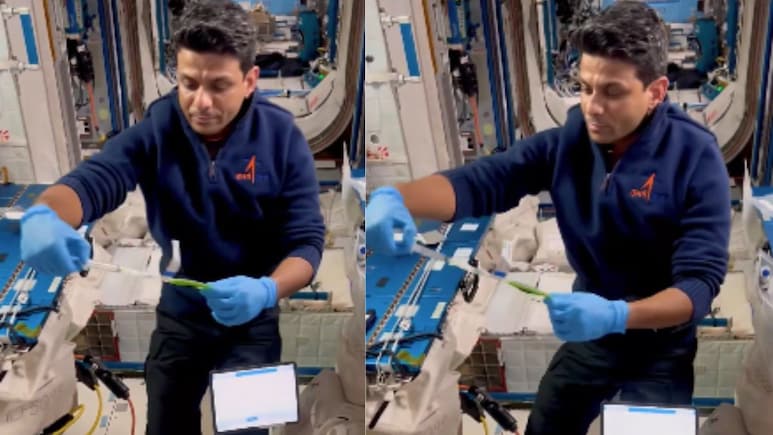
Even the simplest laboratory tasks on Earth rely on gravity, but in space, they can quickly become complex, astronaut Shubhanshu Shukla has revealed.
Shukla, who has been growing microalgae aboard a spacecraft for two weeks, described the unique challenges of working in microgravity in a recent social media post. He shared a video from his 2025 mission.
"Any experiment in space quickly reminds you that gravity does a lot of unpaid work on Earth," he wrote, describing how a routine task such as extracting samples became a challenge when air bubbles refused to rise in the microgravity environment.
Shukla revealed that there's very little gravity in space, so liquids and air don't behave the way they do on Earth. When Shukla was trying to collect microalgae samples, air bubbles floated freely and wouldn't rise to the top like they normally would.
Any experiment in space quickly reminds you that gravity does a lot of unpaid work on Earth. Without it, even the simplest tasks turn into puzzles. Here, I was extracting samples from bags of microalgae I had been growing for the past two weeks.
— Shubhanshu Shukla (@gagan_shux) February 9, 2026
The challenge: collecting samples… pic.twitter.com/HLQPuA9cEj
"On Earth, you simply flip the syringe and let gravity usher the bubbles politely to the top. In microgravity, they refuse to cooperate—no rising, no settling, just floating wherever they please," he added.
So, Shukla acted like a centrifuge, a machine that spins really fast to separate liquids from gases. By spinning and moving the syringe carefully, he created his own "artificial gravity" that pushed the liquid toward the tip of the syringe.
"Lacking gravity, I provided my own by spinning, using motion to push the liquid toward the syringe tip and persuade the air to move elsewhere. It took a few tries (and a bit of trial-and-error choreography) before it worked," Shukla wrote.
He also mentioned that microgravity makes even mundane tasks challenging. So, it is required to think and plan everything in advance.
The process was repeated across twelve bags, with four samples per bag, and multiple spins for each sample. "Let's just say I logged an impressive number of rotations that day—proof that in space, science sometimes looks a lot like interpretive dance," he quipped.
Shukla went to the International Space Station (ISS) in 2025 as part of the Axiom-4 (Axe-4) mission, where he stayed for about 18 days. He carried out dozens of scientific experiments, including growing and collecting microalgae samples.
Track Latest News Live on NDTV.com and get news updates from India and around the world

