





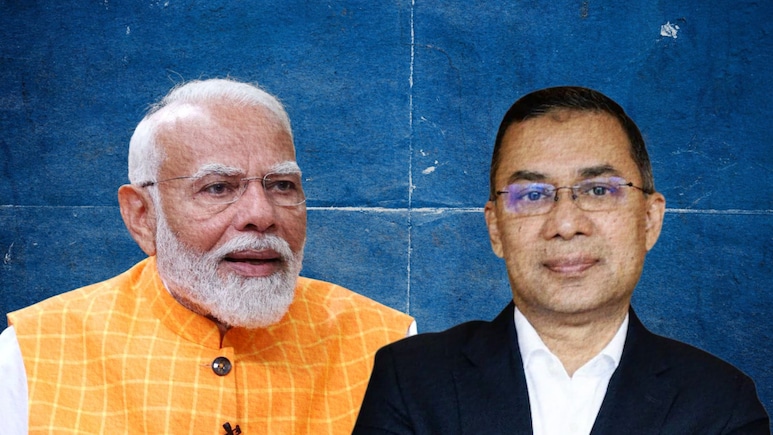
Dhaka is more comfortable with the idea of Prime Minister Tarique Rahman coming to India on a standalone bilateral as opposed to a multi-national forum like the BRICS and this message was conveyed to the Indian High Commissioner in Bangladesh, Dinesh Trivedi during his meeting with Rahman in Dhaka, NDTV has learnt. Soon after, Trivedi flew back to New Delhi and held meetings with Prime Minister Narendra Modi and top officials in the Ministry of External Affairs.
Dhaka and New Delhi are now working on a plan to prepare for a visit in the later part of next week which was first reported by NDTV.
Trivedi has the challenging task of rebuilding ties with an important neighbour with whom ties have been strained since 2024 and he has moved ahead with the idea of reset in the relationship with a focus on people to people ties. And he has held key meetings in Dhaka in connection with the reset. Amidst domestic challenges, the Tarique Rahman-Narendra Modi meeting will be a key diplomatic event in the Bay of Bengal region.
The High Commissioner's visit to Delhi was to discuss and lay out a plan for the visit and the terms of engagement, especially the crucial areas in the India-Bangladesh relations.
REBUILDING TIES, REVIVING CONNECTIVITY
India had planned investments in railways and road infrastructure in Bangladesh and the conversations will focus on addressing some of those areas where Indo-Bangladesh cooperation has been completely halted due to the political shift in the country.
Bangladesh has received the largest share of India's infrastructure development assistance, with New Delhi extending several Lines of Credit amounting to $8 billion to Dhaka between 2009 and 2019 for regional connectivity and energy projects.
While the Agartala-Akhuara rail-link meant to connect the northeastern states with Bangladesh was inaugurated in 2023, it has not yet been fully operationalised.
Important road projects like the four-lane upgradation between the Ashuganj and Akhaura land ports, and the Maitri Setu bridge over the Feni River connecting Tripura with Bangladesh have been completed but they have not completely served the purpose they have been constructed for due to political constraints.
The bridge structure and adjoining Indian land-port checkpoints at Sabroom are built, but synchronized immigration and customs operationalization on the Bangladesh side have faced logistical and political transition holdups.
RESTORING PASSENGER RAILWAY CONNECTIVITY
Three passenger train services connect India and Bangladesh. The Maitree Express (Kolkata to Dhaka), the Bandhan Express (Kolkata to Khulna), and the Mitali Express (New Jalpaiguri to Dhaka). All international passenger trains between India and Bangladesh are temporarily suspended due to security and political factors.
Conversations on restarting railway services to improve people to people connect may materialise if the reset in ties progress with a bilateral meeting between Rahman and Prime Minister Narendra Modi.
Maitree Express was the first express train service connecting Dhaka in Bangladesh to Kolkata in West Bengal. The Bandhan Express started services in 2017 connecting Kolkata with the Bangladeshi city of Khulna, recreating the previous Barisal Express train route.
The Barisal Express was a historic pre-partition international mail and passenger train. It was launched in 1884, and connected Kolkata (Sealdah station) in India with Khulna in what is now Bangladesh. The Mitali Express, started in 2021, connects New Jalpaiguri (NJP) in West Bengal's North Bengal region with Dhaka Cantonment in Bangladesh. The train passes through the Haldibari (India) and Chilahati (Bangladesh) border.
Amid a shortage of railway rakes in Bangladesh, India is set to supply a rake of 19 LHB broad-gauge passenger coaches to the neighbouring country, offering much-needed support to its rail network.
INDIA HELPS ITS NEIGHBOURS
Bangladesh has been grappling with an energy crisis for more than three weeks. The fuel crisis is disrupting power generation in the country leading to curbs on establishments and load shedding, even in the capital Dhaka. As power generation has been unable to meet demand, load-shedding has been imposed outside Dhaka since last week. Now there are power cuts in Dhaka.
Earlier this month, Trivedi met Minister of Power, Energy and Mineral Resources of Bangladesh, Iqbal Hassan Mahmood, and exchanged views on further strengthening India-Bangladesh cooperation in the power and energy sectors.
The discussion focused on the importance of cross-border power and energy connectivity as a key pillar of India-Bangladesh economic partnership. Both sides reaffirmed their shared commitment to advancing cooperation based on mutual interest and mutual benefit, with a view to enhancing energy security, promoting sustainable development, and supporting the prosperity of the people of both countries.
Bangladesh's State Minister for Foreign Affairs Shama Obaed Islam has said that whenever the heads of government of the two countries speak or bilateral discussions take place, opportunities arise to resolve many problems.
In March this year, India sent a major consignment of diesel to Bangladesh, when it was facing a critical fuel shortfall due to supply disruptions due to the war in Iran.
GANGA WATER TREATY
Rahman has said his government will deliver Padma Barrage plans. Critical for the project is the Ganga Water Agreement - signed in 1996 for 30 years - is up for renewal this year. India and Bangladesh are in the middle of negotiations over the renewal of the treaty that has been in operation for the last 30 years.
Bangladesh is demanding more water from the Ganga as the Padma Barrage will be built further downstream from the Farakka Barrage in West Bengal. Currently water from the Ganga is diverted into the Bhagirathi (Hooghly) river that serves the critical purpose of maintaining the Haldia Port and feeding the entire Greater Kolkata region.
The Ganga River is known as the Padma as soon as it enters Bangladesh around 22 km downstream from the Farakka Barrage in Murshidabad District in West Bengal. The true test of the reset, many feel, will rest on whether talks move forward on Ganga water sharing talks.
REGIONAL SECURITY, INDIA'S CONCERNS
After the fall of the Sheikh Hasina government, the interim government led by Muhammad Yunus emboldened anti-India voices and released terrorists like Ansarullah Bangla Team (ABT) chief Jashimuddin Rahmani. Ansarullah Bangla Team (ABT) and Al-Qaeda in the Indian Subcontinent (AQIS) are linked extremist networks in South Asia.
Rahmani is a vocal supporter of the terrorist organisation Al-Qaeda and its offshoot in the Indian subcontinent-AQIS.
After coming to power the Tarique Rahman government has said it will seek better relations with India and India is likely to raise regional security issues in bilateral discussions.
Regular meetings on regional security have also resumed between the head of India's Research and Analysis Wing (R&AW) Parag Jain and Rahman's Defence Affairs Adviser Brigadier General (retired) AKM Shamsul Islam meeting in Dhaka on Monday. Jain met officials from the Directorate General of Forces Intelligence (DGFI) in Bangladesh.
Track Latest News Live on NDTV.com and get news updates from India and around the world

