





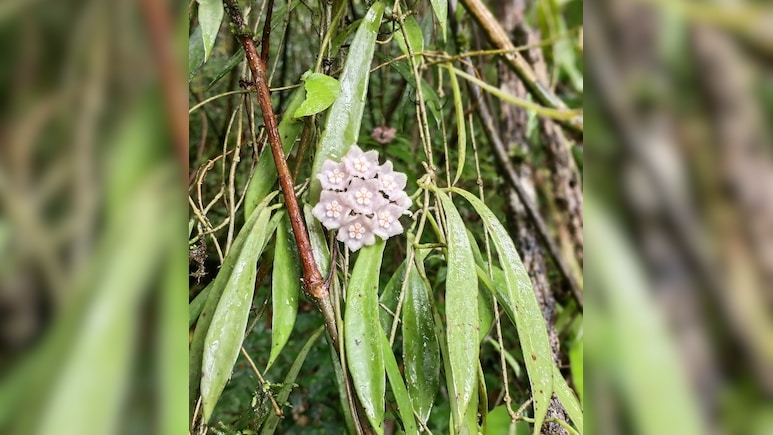
In a striking reminder that India's biodiversity continues to reveal new surprises even in the 21st century, a community-protected forest in Nagaland has yielded a previously unknown species of flowering plant, discovered by researchers from Nagaland University.
The finding underscores the importance of conservation and traditional forest stewardship in safeguarding India's rich botanical heritage.
The newly described species, named Hoya nagaensis, a member of the 'wax plant family' was discovered in the Kavunhou Community Reserved Forest in Phek district, some 110 kilometers from the capital Kohima during systematic botanical surveys of high-altitude forests.
The plant belongs to the Hoya genus, known for its waxy, star-shaped flowers and milky latex, and was found growing in a temperate forest ecosystem that remains largely unexplored by science.
Researchers say the plant produces distinctive star-shaped flowers and exudes a milk-like latex, a characteristic of many species in the Apocynaceae or milkweed family. While no medicinal applications have yet been studied, scientists note that such latex-producing plants have historically yielded important compounds, making the species of potential interest for future pharmacological research, subject to careful scientific evaluation and conservation safeguards.
The discovery was led by Dr Gyati Yam, Assistant Professor in the Department of Forestry, Nagaland University, along with researchers Vieneite-o Koza and Joynath Pegu.

The work was supported by the university's Start-Up Project for Young Faculty (SUPYF) and has been published in the peer-reviewed international journal Kew Bulletin, published by the Kew Botanical Garden in UK, one of the most venerated botanical gardens and herbaria of the world. India is home to about 20,000 different flowering plants and is considered a biodiversity hot spot.
"This discovery highlights how much of Nagaland's forest biodiversity remains undocumented," Dr Yam said. "Our work focused on exploring high-altitude forests and formally describing plant species that were previously unknown to science, while also understanding how community-reserved forests help protect fragile ecosystems."
According to the researchers, Hoya nagaensis is currently known from only a single location, making it highly vulnerable. Due to its extremely restricted distribution and threats such as shifting cultivation and forest disturbance, the species has been provisionally assessed as Critically Endangered.
"The unique aspect of this discovery is that it comes from a community-protected forest," said Vieneite-o Koza. "The distinctive leaf shapes and floral characteristics clearly separate this species from other known Hoya species, and the findings show that community conservation plays a critical role in protecting rare and endemic plants."
Joynath Pegu added that the discovery demonstrates the effectiveness of traditional forest stewardship practiced by local Naga communities. "Despite increasing pressures on forests, community-managed areas like Kavunhou continue to serve as refuges for species that might otherwise be lost before science even knows they exist," the researcher said.
Scientists say the finding reinforces Nagaland's status as a biodiversity hotspot and highlights the urgent need for habitat-based conservation. By documenting the plant's unique morphology and ecological context, the study strengthens India's botanical records and provides a foundation for future research into ecology, conservation, and potential uses of the species.
As pressures on natural habitats intensify, researchers stress that conservation is the key to protecting India's plant heritage, ensuring that discoveries like Hoya nagaensis are not the last of their kind but part of a continuing story of scientific exploration and community-led stewardship in the country's forests.
Track Latest News Live on NDTV.com and get news updates from India and around the world

