





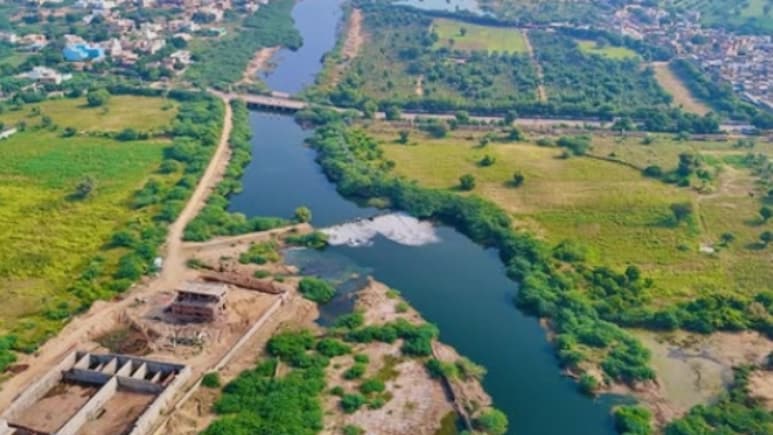
The Supreme Court has reprimanded the Rajasthan government regarding the pollution in the Jojari River, saying it is "shameful" if the state "wants to poison its citizens". Dismissing the Special Investigation Team's (SIT) probe as a "mere eyewash," a bench of Justice Vikram Nath, Justice Sandeep Mehta, and Justice R Mahadevan on Tuesday noted that a recent report by an expert committee clearly indicates that "highly acidic" water is still flowing in the river - a vital lifeline for lakhs of people in Jodhpur and surrounding districts.
The Supreme Court had taken suo motu cognisance of the discharge of industrial waste, primarily from textile and other factories, into the river on September 16 last year. In its order passed in November last year, the court had said contamination in the Jojari River, the Bandi River, which flows through Pali, and the Luni River, which passes through Balotra, reflected a sustained "systemic collapse" of regulatory vigilance and "utter administrative apathy" stretching over nearly two decades.
On May 29, it issued several directives to the Rajasthan government, including the constitution of an SIT to investigate the discharge of industrial waste into the Jojari River, measures to curb pollution, and the monitoring of industrial units. The court had also said that state agencies had failed to stop the open discharge of industrial waste into the river and that the functioning of Common Effluent Treatment Plants (CETPs) in Jodhpur, Pali, and Balotra was under scrutiny.
The expert committee appointed by the Supreme Court - headed by former judge Justice Sangeet Lodha - submitted its second report on the matter on Tuesday. Based on site inspections, the committee reported a strong stench in several stretches of the Jojari River and found the water to be highly acidic. The report stated that merely cleaning the river would not suffice and the pollution would not end until all legal and illegal waste discharge points were identified and either closed or regulated.
During the hearing, the Supreme Court raised serious questions regarding the functioning of the SIT and observed that it has done nothing so far. A review of the report suggests that the investigation is not proceeding in the right direction but is merely a sham.
Appearing for the Rajasthan government, Additional Solicitor General SV Raju informed the court that the SIT was constituted last month and has submitted its initial report to the expert committee. He further stated that the Rajasthan State Pollution Control Board has initiated disciplinary action against certain officials and suspended the regional officers responsible for monitoring and collecting water samples from the CETP.
However, the court was not satisfied with these responses and noted that the expert committee had sought a response from the Pollution Control Board on July 3, yet no reply had been received to date.
The court also remarked that state officials had attempted to obstruct the committee from inspecting the concealed pipeline through which industrial waste was being discharged into the river. The bench observed that the committee was being provided with incorrect reports.
The Supreme Court further noted that the committee had requested the state government not to release water from the dam to prevent the toxic waste and silt accumulated in the river from flowing downstream, but water was released regardless.
The court stated that the Chief Secretary of Rajasthan would be personally held accountable for compliance with its directives.
During the hearing, the Additional Solicitor General assured the Court that strict action would be taken against officials found to have disregarded the committee's instructions. He mentioned that while all factories situated along the riverbanks are currently closed, the expert committee could consider representations from industries willing to adopt pollution control measures.
In response, the Supreme Court noted that the expert committee had engaged in discussions with the industries, and steel industries had submitted a time-bound plan to ensure 'Zero Liquid Discharge' (ZLD) into the river. Meanwhile, the court directed textile industries that if they wish to resume operations, they must satisfy the expert committee that their activities will align with court directives and the broader public interest.
"We will now ensure 100% compliance by the chief secretary. No one will be permitted to poison the citizens," the court said.
The industries were also instructed to cooperate in freeing the river from toxic waste as a priority.
The proposed industrial park project at Kakani has also been halted for the time being after the expert committee's intervention. In its report, the committee noted that the project was being developed on 12.805 hectares of land within the river's high flood zone and lacked the mandatory buffer zone, posing a serious threat to the river's rejuvenation process.
An earlier report by the committee revealed that over 1,500 industrial units were discharging industrial waste into the Jojari River, surrounding farmlands, and other areas, contaminating vast tracts of land with toxic waste. The report further highlighted that the Nehda Dam on the Bandi River -- originally constructed for rainwater harvesting -- had transformed into a conduit for industrial effluent, causing severe adverse effects on the local environment, agriculture, livestock, and public health.
Issues such as infertility, miscarriages, and skin ailments were observed in crops irrigated with the polluted water and in livestock consuming that water and fodder.
The matter is scheduled for the next hearing in two weeks.
Track Latest News Live on NDTV.com and get news updates from India and around the world

