





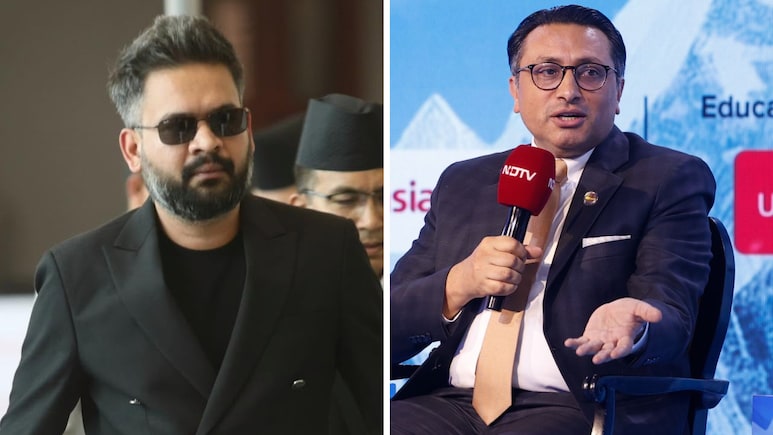
Nepal Prime Minister Balendra 'Balen' Shah's first foreign visit after taking office will be to India, and the government hopes to schedule it before the end of the year, Nepal's Finance Minister Swarnim Wagle said on Thursday. Speaking at NDTV's Anviksha summit in Kathmandu, Wagle said the dates were still being worked out but that the destination was not in doubt.
"Coming into office, [Balen] was very focused on the domestic agenda. The first 100 days at least were focused on... the 100-point agenda that we had, and the rating that we've given ourselves is 87.2 per cent on that," he said, speaking to NDTV Editor-in-Chief Rahul Kanwal.
"After that, we've begun to discuss the Prime Minister's visits abroad. I am pretty confident that his first visit abroad will be to India, and the dates will need to be worked out, but I am very hopeful that this will happen before the end of the year," Wagle said.
#NDTVWorldAnviksha | Powering Nepal's Economic Future: Dr. Swarnim Wagle (@SwarnimWagle), Minister of Finance, Nepal Speaks To NDTV's @rahulkanwal And @AdityaRajKaul#NDTVAnviksha #IdeasAcrossBorders #IndiaNepalDialogue pic.twitter.com/kd4hEkvV4q
— NDTV (@ndtv) August 27, 2026
India's ruling Bharatiya Janata Party (BJP) MP Ravi Shankar Prasad, who was in the audience, called the announcement significant. "The whole foundation of Nepal-India relations is so strong. You cannot segregate them through passports or through geographical boundaries... And if today [Wagle] has firmly stated that the first visit of the honourable Prime Minister Balen Shah will be to India, that shows the way as to what is going to be the relationship - that's quite remarkable," Prasad said.
Balen Shah, 36, an engineer and rapper who served as mayor of Kathmandu from 2022, was sworn in on March 27 after the Rastriya Swatantra Party won a landslide in the March 5 general election, the first vote held after the September 2025 Gen Z protests unseated the then government. Wagle, the party's vice-chair, took charge of the finance ministry.
Investment Pitch
Wagle said his country's budget proposed amending 27 acts on contracts, private property, and parity between domestic, diaspora and foreign investors. "We've started by cleaning up the mess, really. The incentives were perverted; the institutions, the rules of the game, were really rigged," he said. He listed five growth engines the government has identified, listing clean energy, tourism, revival of manufacturing along the border, high-value agriculture, and digitalisation.
Wagle said he had met Nepal's largest taxpayers, many of them Indian-owned, two weeks ago. "From Unilever to ITC to lots of others, all of them pledged rather informally that they plan to double their investment here. Some were unconditional; others were conditional on reforms that the government plans to undertake."
On the currency peg
Wagle also sought to soften the RSP manifesto's commitment on reviewing the Nepali rupee's peg to the Indian rupee, currently 1.6 to 1, saying the party had promised a study, not a change. "It was just a topic mentioned in the manifesto that we may need to review. We didn't pledge to change it; we said we would conduct a study to review, and the Rastra Bank (the central bank of Nepal) has actually undertaken a few studies," he said.
He said the productivity gap between the two economies had widened over three decades. "The peg that held in 1993 may not be relevant in 2026. But having said that, is it the right time to change? The conditions have to be way more conducive," Wagle said. He added that he agreed with the International Monetary Fund's (IMF) description of the peg as a "stable nominal anchor".
Wagle noted the peg had been adjusted five times in the past. "So it's not heresy to even talk about it. In 1993, our per capita incomes were comparable. Now, you (India) are twice as rich as us. In terms of collective GDP, your economic clout is 100 times richer than us, and you are 50 times more populous."
Congress MP Shashi Tharoor, also in the audience, asked whether Nepal would be better off without the peg, citing the unpegged Sri Lankan rupee. Wagle said devaluation would not help Nepal at present. "Foundations have to be built. We're talking about five, 10, or 15 years down the road... Right now, we are too dependent on India; 70% of our trade is with India."
On Balen Shah
Asked to describe PM Balen Shah, Wagle said he is the world's youngest serving head of government, and governs differently from his predecessors, though facing a "paradox" after a stint as mayor of Kathmandu."He is now presiding over the poorest government in Asia, but he ran the richest city in Nepal," Wagle said.
"A conventional politician would be giving three or four speeches a day. But Balen Shah avoids that, and he's on record saying, 'I want my actions and the results to speak for themselves.'"
Wagle insisted that Shah is cautious about the legality of his actions at all times. "There is a caricature of him that, 'Oh, maybe he wants his own way to prevail.' But one thing I must share with this audience. He's always asking, 'What does the law say?' That was a surprise to me." He said he had teased Shah with Henry Kissinger's line from the Nixon administration: "The illegal we do immediately; the unconstitutional takes a little while."
Flood Response
As the summit took place a day after flash floods devastated large areas in Nepal, Wagle said Shah had visited the Nuwakot region among those affected. "I was sitting with him for almost 90 minutes reviewing what more we could do, where we could improve the next phase of the disaster handling."
He said the government had faced public criticism on earlier occasions but not on this one. "I haven't seen any notable criticism of the way we've handled the current disaster that we're living through right now. This is because we've partly learned what ought to be done to allay the anxieties of the common people."
Wagle added, "Sometimes, even if the intent is very clear and very noble, our inexperience may show. And those are the moments when we really have to own up and say, 'Okay, we goofed up here, but we are ready to correct course.'"
Five-Year Target, Compared To India, China
Wagle said the RSP manifesto targets a $100-billion economy for Nepal in five to seven years, requiring growth of at least 7%.
"In 1980, the per capita income of India, China, and Nepal was almost identical at $200 per capita. India today is close to $3,000 per capita. China is at 13,000, and Nepal is under 1,500. So that pace of catch-up is really what we want," he said.
A Tharoor Sidenote
Asked about a viral meme pairing him with Shashi Tharoor over their vocabularies, Wagle said the comparison was flattering.
"I'm a big fan of Shashi, and he is a great inspiration. There's a lot to learn from him and the career path that he has taken," he said.
Tharoor responded, "One word that I'm fond of using, which I would commend to you, Mr Finance Minister, is defenestrate, because you defenestrated the previous prime minister."
Track Latest News Live on NDTV.com and get news updates from India and around the world

