





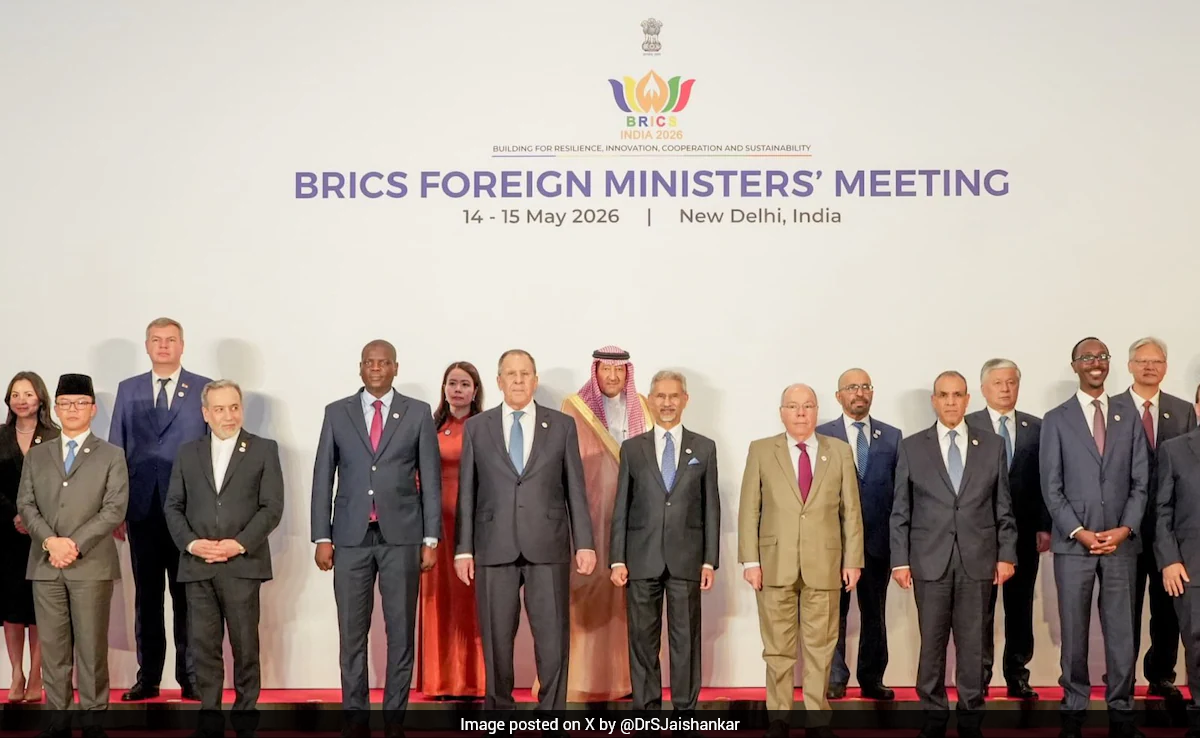
India on Thursday flagged grave concerns over the West Asia crisis and its impact on energy supplies and maritime stability in the Strait of Hormuz and urged BRICS nations to develop "practical ways" to navigate "unprecedented" geopolitical and economic uncertainty as well as "unilateral coercive" sanctions.
In his address at the opening day of a two-day BRICS conclave in New Delhi, External Affairs Minister S Jaishankar asserted, without naming specific nations, that respect for sovereignty and territorial integrity must anchor international relations, maintaining that "dialogue and diplomacy" offer the only sustainable path to conflict resolution.
Jaishankar said India stands ready to contribute constructively towards de-escalation efforts and to support initiatives aimed at restoring stability while noting that "peace cannot be piecemeal" and "it is essential to uphold international law, protect civilians, and avoid targeting public infrastructure".
He also underlined the importance of new members "fully" appreciating and subscribing to the BRICS' consensus mechanism on various important issues, remarks that came amid sharp differences between the United Arab Emirates (UAE) and Iran over the West Asia conflict.
It is learnt that there were heated exchanges between Iranian Foreign Minister Abbas Araghchi and UAE's Minister of State for Foreign Affairs Khalifa Shaheen Al Marar during one of the two sessions at the conclave and Russian Foreign Minister Sergey Lavrov intervened to cool the tempers.
Iran and the UAE have been sparring in recent weeks over Iran's alleged attacks on energy infrastructure in the UAE that has resulted in BRICS coming out with a consensus statement on the West Asia crisis.
BRICS, originally comprising Brazil, Russia, India, China, and South Africa, expanded in 2024 to include Egypt, Ethiopia, Iran, and the UAE, with Indonesia joining in 2025.
"It is essential for the smooth advancement of BRICS that later members fully appreciate and subscribe to the BRICS' consensus on various important issues," Jaishankar said.
In his remarks, he also strongly pitched for ensuring safe and unimpeded maritime flows through the Strait of Hormuz and Red Sea, and voiced concerns over the "grave humanitarian implications" of the conflict in Gaza.
The India-hosted meet assumed greater significance as the influential bloc grapples with the economic consequences of the West Asia crisis, particularly the severe energy supply disruptions, and Washington's policy on trade and tariffs.
Besides Araghchi and Lavrov, Brazilian Foreign Minister Mauro Vieira, Indonesian Foreign Minister Sugiono and South Africa's Minister for International Relations Ronald Lamola were among the senior leaders attending the meeting.
"The conflict in West Asia merits particular attention. Continuing tensions, risks to maritime traffic, and disruptions to energy infrastructure highlight the fragility of the situation," Jaishankar said.
He said safe and unimpeded maritime flows through international waterways, including the Strait of Hormuz and Red Sea, remain vital for global economic well-being.
"The wider region also gives rise to serious concern. The conflict in Gaza has grave humanitarian implications.
"A sustained ceasefire, humanitarian access, and a credible pathway towards a durable and peaceful resolution remain essential. India supports a two-state solution where the Palestine issue is concerned," he said.
Jaishankar also made a mention of challenges facing Lebanon and Syria as well as prevailing situation in Sudan, Yemen and Libya while calling for sustained international engagement and coordinated diplomatic efforts to address them.
"Taken together, they underline a clear reality: stability cannot be selective, and peace cannot be piecemeal. It is essential to uphold international law, protect civilians, and avoid targeting public infrastructure." "India stands ready to contribute constructively to de-escalation efforts and to support initiatives aimed at restoring stability," Jaishankar said.
Without naming any country, he also underlined the need for addressing what he called "the increasing resort to unilateral coercive measures and sanctions inconsistent with international law and the UN Charter".
"Such measures disproportionately affect developing countries. These unjustifiable measures cannot substitute dialogue, nor can pressure replace diplomacy," he said.
The external affairs minister, referring to "unprecedented geopolitical and economic uncertainty" facing the world said these developments are weakening growth prospects and deepening vulnerabilities.
"Many of these issues have far-reaching consequences beyond their immediate region. Their impact is particularly severe for emerging markets and developing countries, through pressures on energy, food and fertilizer security, supply chain disruptions, inflationary trends and constraints on growth," he said.
In this context, BRICS solidarity assumes particular significance, he said.
Jaishankar also described terrorism as a "continuing threat" and that there can be no justification for terrorism in any form.
"Cross-border terrorism violates the basic principles of international relations. Zero tolerance must remain an uncompromising and universal norm," he said.
Jaishankar noted that technological advancements are reshaping the global landscape and there is a need to bridge the digital divide.
"While they offer opportunities, they also raise concerns relating to trust, transparency, and equitable access," he said.
"Climate change continues to be a defining challenge. Climate action must go hand in hand with climate justice, with credible commitments, adequate financing, and accessible support," he said.
Jaishankar also pitched for reform of the UN Security Council.
"Even as challenges mount, the multilateral system unfortunately weakens. The state of the United Nations, which is at its core, is particularly worrisome. With each passing day, the case for reformed multilateralism only gets stronger." "This includes the reform of the UN Security Council in both the permanent and non-permanent categories. Continued delay comes at a high cost," he said.
"The message from our times is clear: cooperation is essential, dialogue is necessary, and reform is overdue. We must work together to shape a more stable, equitable, and inclusive international order," he said.
Jaishankar said India remains committed to engaging constructively with all partners in advancing these objectives.
The BRICS foreign ministers also made a joint call on Prime Minister Narendra Modi.
India, as the chair of the BRICS, is hosting the conclave of the foreign ministers ahead of the annual summit of the grouping in September.
The BRICS has emerged as an influential grouping as it brings together 11 major emerging economies of the world, representing around 49.5 per cent of the global population, around 40 per cent of the global GDP and around 26 per cent of the global trade.
(Except for the headline, this story has not been edited by NDTV staff and is published from a syndicated feed.)
Track Latest News Live on NDTV.com and get news updates from India and around the world

