





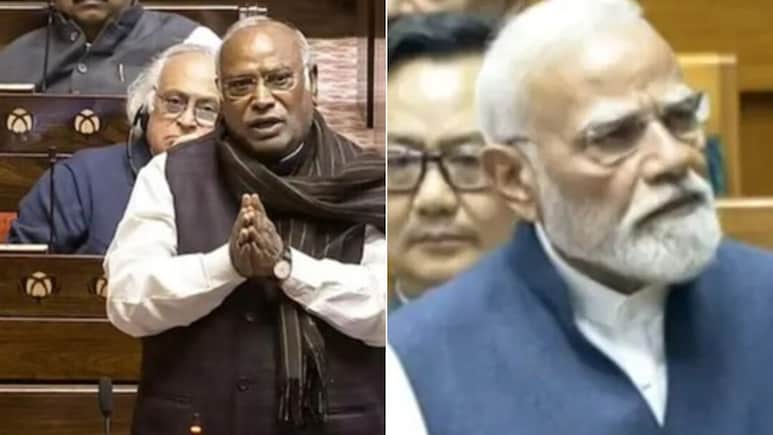
Mallikarjun Kharge raged Thursday as three bills - one on delimitation, a second on increasing Lok Sabha seats, and a third to reserve 33 per cent of parliamentary, state assembly seats for women - were tabled in a special session of parliament.
The Congress chief accused the BJP of trying to sneak through a 'flawed' delimitation bill - which will redraw parliamentary and assembly constituencies - under the guise of reserving seats for women. "The opposition will not allow parliament to be hijacked by flawed delimitation bills disguised as 'women's reservation'," he said, "We will fight this assault on democracy..."
The Opposition will not allow Parliament to be hijacked by flawed delimitation bills disguised as Women's Reservation.
— Mallikarjun Kharge (@kharge) April 16, 2026
We stand united and will fight this devious assault on our Democracy with all our strength. pic.twitter.com/nOj4fLDEMg
The issue was perhaps best explained by the opposition party's Shashi Tharoor, who said, "The government has a plan to re-delimit constituencies and increase seats in areas where the ruling party is strong."
"And they are using women's reservation as an excuse to bring about that change... by trying to amend the constitutional amendments that they had already brought in 2023," the Lok Sabha MP from Kerala's Thiruvananthapuram said.
VIDEO | Delhi: On Women's Reservation Bill, Congress leader Shashi Tharoor says, "The issue is very simple. The government has a plan to redelimit the constituency and increase the number of seats in areas where the ruling party is strong. They are using women's reservation as an… pic.twitter.com/zbuTC2B6JA
— Press Trust of India (@PTI_News) April 16, 2026
The government has said it is necessary to link the two, i.e., delimitation and reservation of seats for women, to operationalise the 33 per cent quota plan by 2029, when the next Lok Sabha election will be held. Hitting out at the opposition, Parliamentary Affairs Minister Kiren Rijiju said they should stop criticising the move and support women's empowerment.
It has also insisted delimitation will not adversely impact states' representation at the centre, responding to criticism by southern states who fear losing seats to Hindi-speaking northern counterparts that are seen as strongholds of the ruling BJP.
What are the three bills
The three bills tabled were:
- Constitution (131st Amendment) Bill, 2026,
- Delimitation Bill, 2026, and
- Union Territories Laws (Amendment) Bill, 2026.
Law Minister Arjun Ram Meghwal tabled the first two and Home Minister Amit Shah the third. And then chaos erupted.
Of these three, the latter two are ordinary proposals, meaning they need only a simple majority to sail through the House.
The former, the bill to amend the constitution - needs a special majority in both Houses.
What is the women's quota bill
The bill seeks to reserve 33 per cent of all seats in the Lok Sabha and state assemblies for women. Within this another 33 per cent will be reserved for women from marginalised groups, i.e., Scheduled Castes, Scheduled Tribes, and tribal communities.
NDTV Explains | What Is Women's Reservation Bill
It also seeks to reserve these based on 2011 Census data, the last completed national ennumeration exercise. The argument is that waiting for the 2026/27 count will delay implementation and force women to wait for equal representation.
What changes in numbers of seats
The headline number is 850, i.e., the number of Lok Sabha seats jumps from 543.
Of these, 815 have been allotted to states and 35 to union territories. The increase has been linked to demographic changes, such as population growth and rural-urban migration patterns that have led to expanded boundaries for cities and towns.
How these 850 seats are to be allocated is the contentious point.
NDTV Explains | Why Delimitation Has Become Centre-South Flashpoint
The opposition's women's quota vs expansion argument
The opposition's argument is that the increase in Lok Sabha seats - by nearly 50 per cent - means it is likely existing male MPs will retain seats. The demand is to redistribute current seats to accommodate reservation for women lawmakers.
The perception, many have argued, is that the reserved seats for women are 'extra'.
Delimitation
Meanwhile, southern states have protested against the possibility a majority of the new being given to northern, Hindi-speaking states, where the ruling BJP has a big electoral advantage.
NDTV Explains | What Is Delimitation? Why Is Tamil Nadu Wary Of It?
The redrawing of constituency boundaries and allotment of seats has been proposed based on population data from the 1971 census, and this is to be retained for the next 30 years.
But its critics contend this will put southern states - which have, on average, now have smaller populations than those in the north, thanks to effective governance - at a disadvantage by reducing the number of MPs representing it at the federal level.
Conversely, northern states that have not controlled population as well, will get an outsized say in parliament.
With the government insisting the 2029 deadline makes simultaneous passage of both bills unavoidable, and the opposition threatening to stall proceedings, the special session has set up an incendiary showdown over this three-day special session.
Track Latest News Live on NDTV.com and get news updates from India and around the world

