





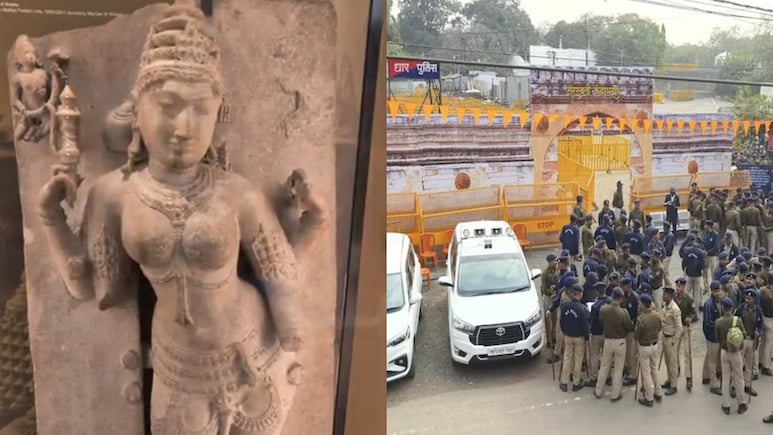
A recent ruling by the Madhya Pradesh High Court on the disputed Bhojshala complex in Dhar has once again drawn national attention to an ancient idol of Goddess Saraswati that has remained outside India for over a century.
In its judgement declaring the Bhojshala complex a temple dedicated to Goddess Saraswati or Vagdevi, the court also asked the government to consider formal steps for bringing back the historic idol currently housed in the British Museum in London.
"The Archaeological Survey of India (ASI) shall have full supervisory control over the preservation and conservation. Further relief claim by the petitioner to bring the idol of goddess Saraswati from the London Museum to establish same within Bhojshala complex, the petitioners have made number of representation before the Government, which may consider the representations to bring back the idol," the bench said.
The idol is believed to have originally stood inside the shrine complex during the reign of King Bhoj in the 11th century.
Idol Taken To England During British Rule
The statue, around four feet tall and weighing nearly 250 kilograms, is considered one of the most historically significant artefacts associated with Bhojshala. Sanskrit inscriptions in Devanagari script carved onto the sculpture further underline its cultural and archaeological importance.
According to historical accounts, large portions of the Bhojshala complex were damaged during Alauddin Khilji's invasion in 1305. Centuries later, during excavations carried out in 1875 under British rule, the idol was reportedly recovered from the debris. A British officer is said to have taken the sculpture to England in 1880, where it has remained ever since.
"While Britain preserves pieces of art in an excellent way, not many curators of the UK's museums understand Sanskrit language and that makes it difficult for them to fully comprehend the true cultural, artiistic meaning and value of the artefacts.." said Dr Vivek Gupta, an art historian and Postdoctoral fellow at the University College of London.
NDTV has accessed exclusive visuals of the ancient idol preserved at the British Museum in London. The museum, one of the largest in the world, attracts millions of visitors annually and houses nearly 7.5 million artefacts.
#NDTVExclusive | London Museum holds Vagdevi idol, awaits India return @RadhikaIyer_ reports pic.twitter.com/5uuooO0hvG
— NDTV (@ndtv) May 16, 2026
If the government formally seeks the idol's return, the process of repatriation could move forward, potentially paving the way for the sculpture to be reinstalled at Bhojshala.
India has, in recent years, secured the return of several antiquities taken abroad during the colonial period. One of the most notable instances came in 2022, when six artefacts were repatriated from the Glasgow Museum to India.
Track Latest News Live on NDTV.com and get news updates from India and around the world

