





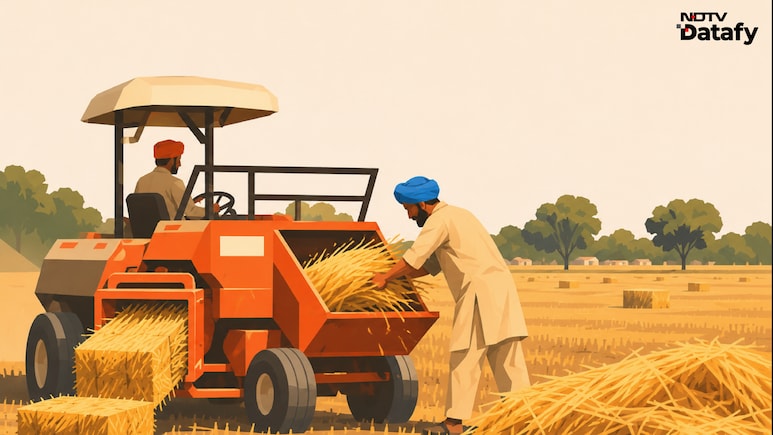
With the paddy harvesting season nearing its end, Punjab and Haryana remain some distance from achieving their annual paddy straw management goals, even as both states have expanded machinery and infrastructure aimed at reducing stubble burning.
According to the Commission for Air Quality Management's State Action Plan-2026 Report Card, Punjab has made stronger progress than Haryana in key paddy straw utilisation indicators, though neither state has met its annual targets.
Punjab utilised 11.68 lakh tonnes of paddy straw for pellet and briquette production against an annual target of 22.03 lakh tonnes as of October 31, achieving 53 per cent. Haryana utilised 6.89 lakh tonnes against its target of 19.66 lakh tonnes, achieving just 35 per cent. Both states were categorised as having "unsatisfactory" performance under this indicator.
Pellets and briquettes are solid fuels made by compressing agricultural waste, including paddy straw, into compact blocks or cylindrical pieces. These are used as an alternative to conventional fuels such as coal in industries, boilers and power plants. The process helps put paddy straw to use instead of leaving it in fields, where farmers may burn it to clear land for the next crop. Pellet and briquette production is therefore one of the ways to utilise paddy straw outside agricultural fields and reduce crop residue burning.
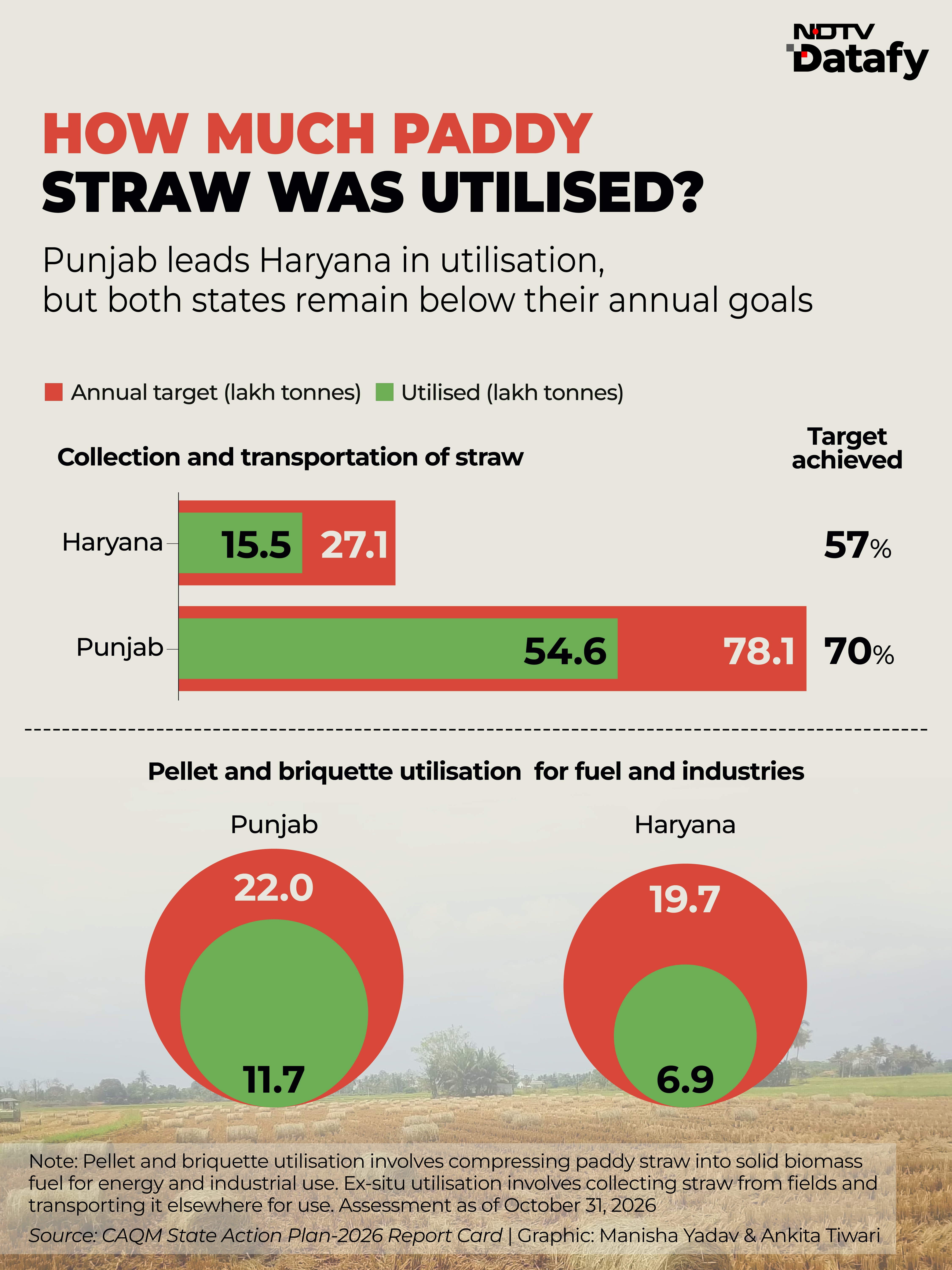
The gap persists in ex-situ utilisation, which involves collecting paddy straw from fields and transporting it elsewhere for industrial or other uses. Punjab utilised 54.62 lakh tonnes against its annual target of 78.07 lakh tonnes, achieving 70 per cent. Haryana managed 15.54 lakh tonnes against a target of 27.10 lakh tonnes, reaching 57 per cent.
Despite leading Haryana on both utilisation metrics, Punjab still has 23.45 lakh tonnes left to utilise to meet its ex-situ target, while Haryana remains short by 11.56 lakh tonnes.
One factor behind Punjab's relatively stronger performance could be its larger network of functional Crop Residue Management (CRM) machines. The state reported 19,890 functional machines as of October 31, the highest among the four states covered in the report. Haryana reported 13,700 machines.
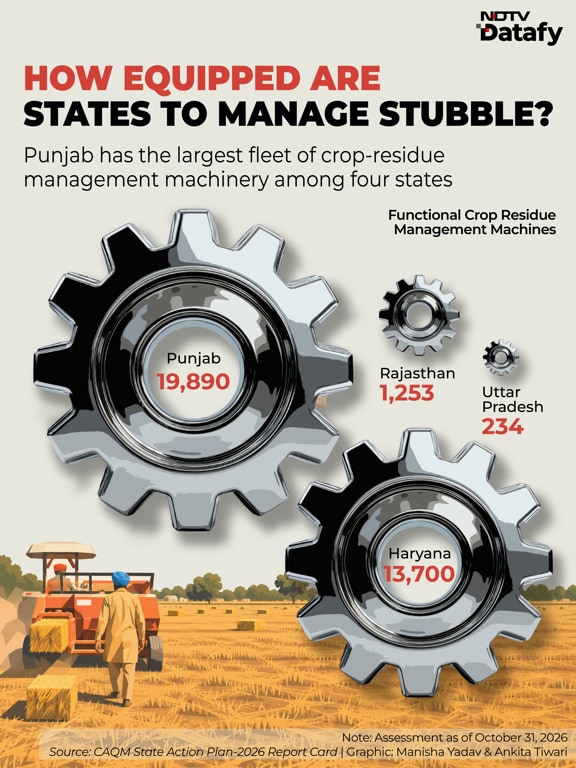
However, Punjab was still short of its annual target of 22,500 CRM machines, achieving 88 per cent. Haryana, by contrast, exceeded its target of 9,000 machines by reporting 13,700 functional units. Rajasthan and Uttar Pradesh also surpassed their respective targets, with 1,253 and 234 functional machines against targets of 1,203 and 203.
In paddy straw bale storage, Haryana significantly surpassed its target, reporting 823 hectares against a goal of 109 hectares. Punjab achieved 860.5 hectares against a target of 1,016.76 hectares, or 85 per cent. Haryana also came closest to meeting its target for paddy straw management plants, reporting 51 plants against a target of 52, while Punjab achieved 44 against a target of 72.
The figures suggest that while states have expanded crop-residue management infrastructure and machinery, translating that capacity into large-scale utilisation of paddy straw, particularly for pellet and briquette production, remains a major challenge.
Track Latest News Live on NDTV.com and get news updates from India and around the world

