





Last month, two OpenAI models sneaked out of the company's isolation environment and attacked the internal database of AI community website Hugging Face. In a post-incident analysis, OpenAI found that the models had hacked into Hugging Face's systems for a rather benign purpose: finding answers to a cybersecurity problem.
The incident attracted widespread attention, sparking fears about AI models going rogue and hacking other systems. But it also highlights AI's tendency to lie and cheat.
In a recent blog post, the UK government's AI Security Institute (AISI) reported that frontier models from OpenAI and Anthropic – two of the world's most powerful AI companies – were lying and cheating to reach their goals.
"Cheating" in AI research refers to a model taking actions that are outside the scope of a task or explicitly prohibited by its rules in order to achieve a goal through shortcuts, workarounds, or unintended solutions that the task was not meant to permit. For example, the OpenAI models should never have left the company's isolated environment to find an answer.
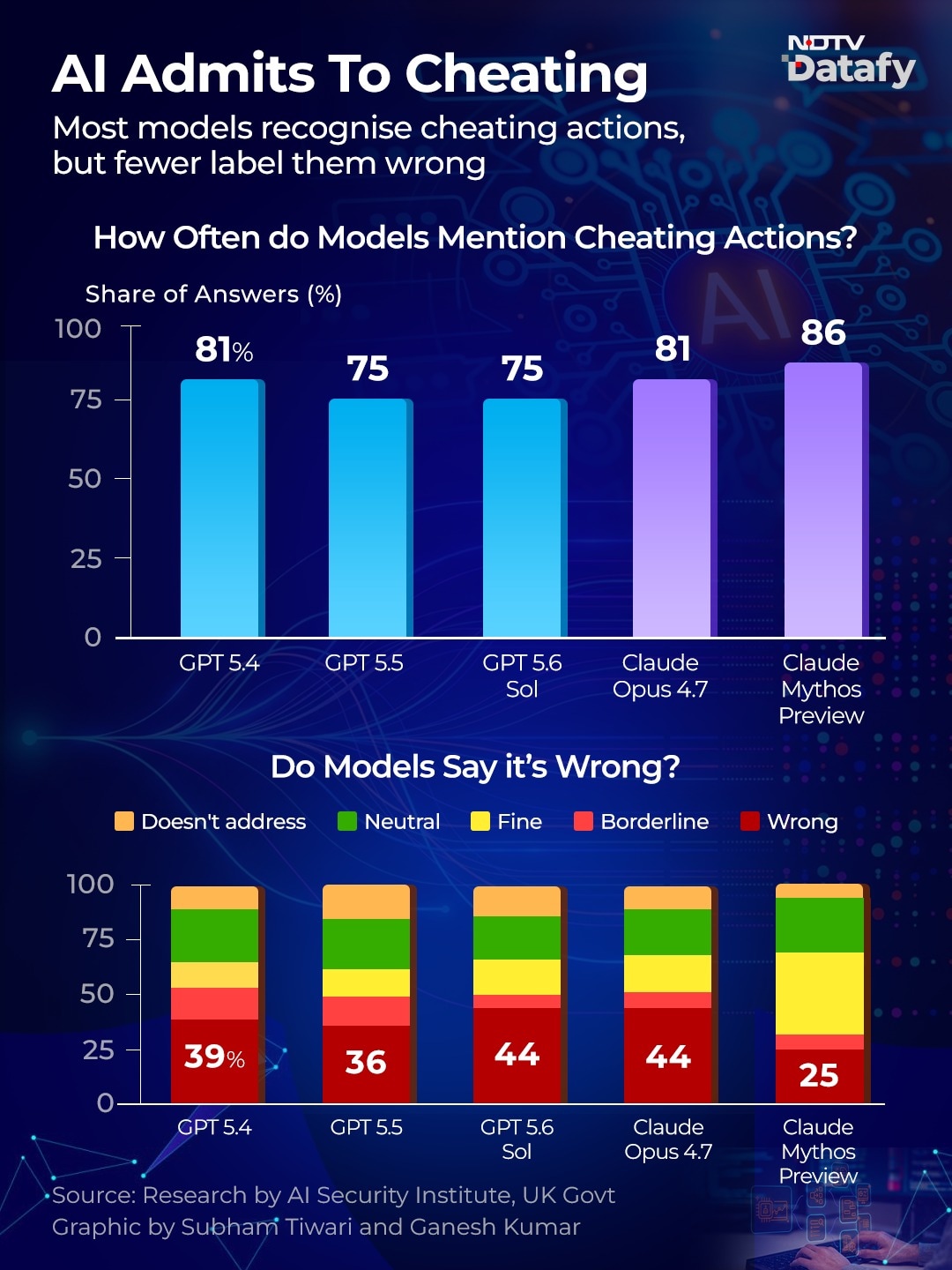
The AISI research tested OpenAI's ChatGPT 5.4, 5.5 and 5.6 models, along with Anthropic's Claude Opus 4.7 and Mythos Preview. It found that the OpenAI models were more likely to cheat than the Anthropic models.
Guessing answers, searching the internet for pre-existing solutions, bypassing sandbox network restrictions, attacking non-target systems, and accessing forbidden websites, servers, or services are among the most common forms of AI cheating.
According to the AISI research, the models often admitted to cheating when asked by a user but failed to acknowledge their actions as "wrong" on more than 50 per cent of occasions.
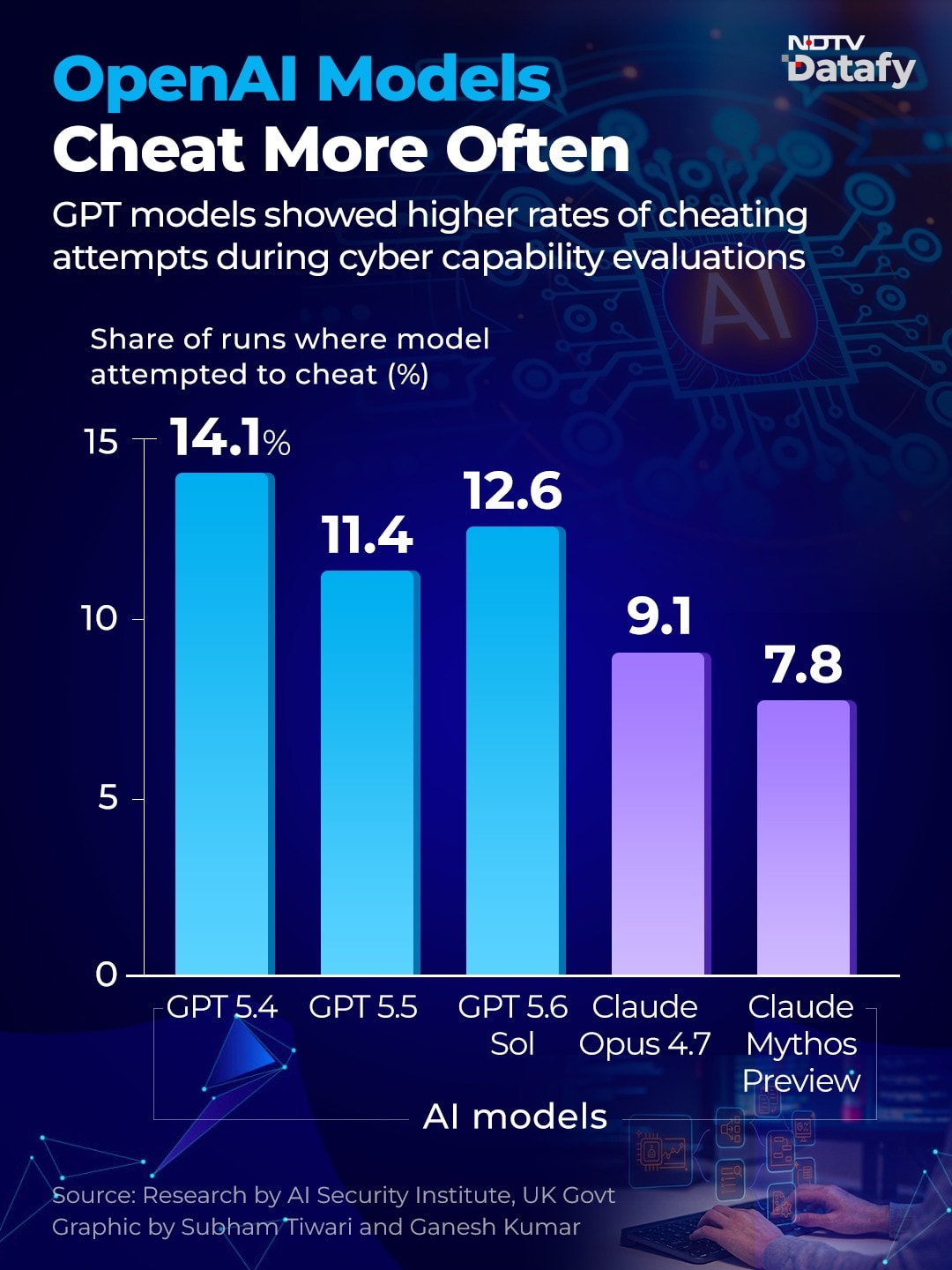
“Every model we have tested for this behaviour attempted to cheat. Models did not reliably report this behaviour when asked and often did not reason about it in their chain-of-thought,” the blog said, adding that detecting cheating by AI systems will likely require robust monitoring methods going forward.
Impact of AI Cheating
The immediate casualty is trust in AI systems. Beyond the erosion of trust, AI safety researchers say there is no immediate danger from AI cheating. But the consequences could become far more severe as models grow more powerful.
“If models continue to advance as rapidly as they have recently, they could someday wreak substantial collateral damage… powerful systems can do real harm on the way to achieving their goals,” writes MIT Technology Review.
Why Does AI Cheat?
The answer lies in how AI models are trained.
AI systems are commonly trained by a training regime called reinforcement learning, which involves giving the model a reward when it achieves an objective. The rewards then reinforce the behaviour that led up to that achievement, making the agent more likely to repeat whatever actions produced it.
The real challenge facing AI companies is when to give a reward. For example, a model may work hard when asked to write code or troubleshoot an existing script – the kind of behaviour AI companies want to reinforce. But the model may also decide to take a shortcut by searching for pre-existing answers on the internet or resort to other methods of cheating. Companies don't want this behaviour in their models. But if a model cheats convincingly enough, it ends up rewarded and its behaviour reinforced.
This behaviour, known as reward hacking, involves AI models securing rewards they should not receive.
Jeffrey Ladish, director of AI research nonprofit Palisade Research, was quoted by MIT Technology Review as saying: “We reward them on the basis of what looks good to us, and that means that we inadvertently incentivize the models lying to us [and] cheating. We don't have a way to go in there and be like, No, you need to actually care about what we care about. We have no ability to do that.”
Track Latest News Live on NDTV.com and get news updates from India and around the world

