






Karnataka is often seen as one of India's strongest economic engines. It is home to the country's biggest technology hub, thriving industries and thousands of startups. But away from Bengaluru's glass towers, a different story is unfolding.
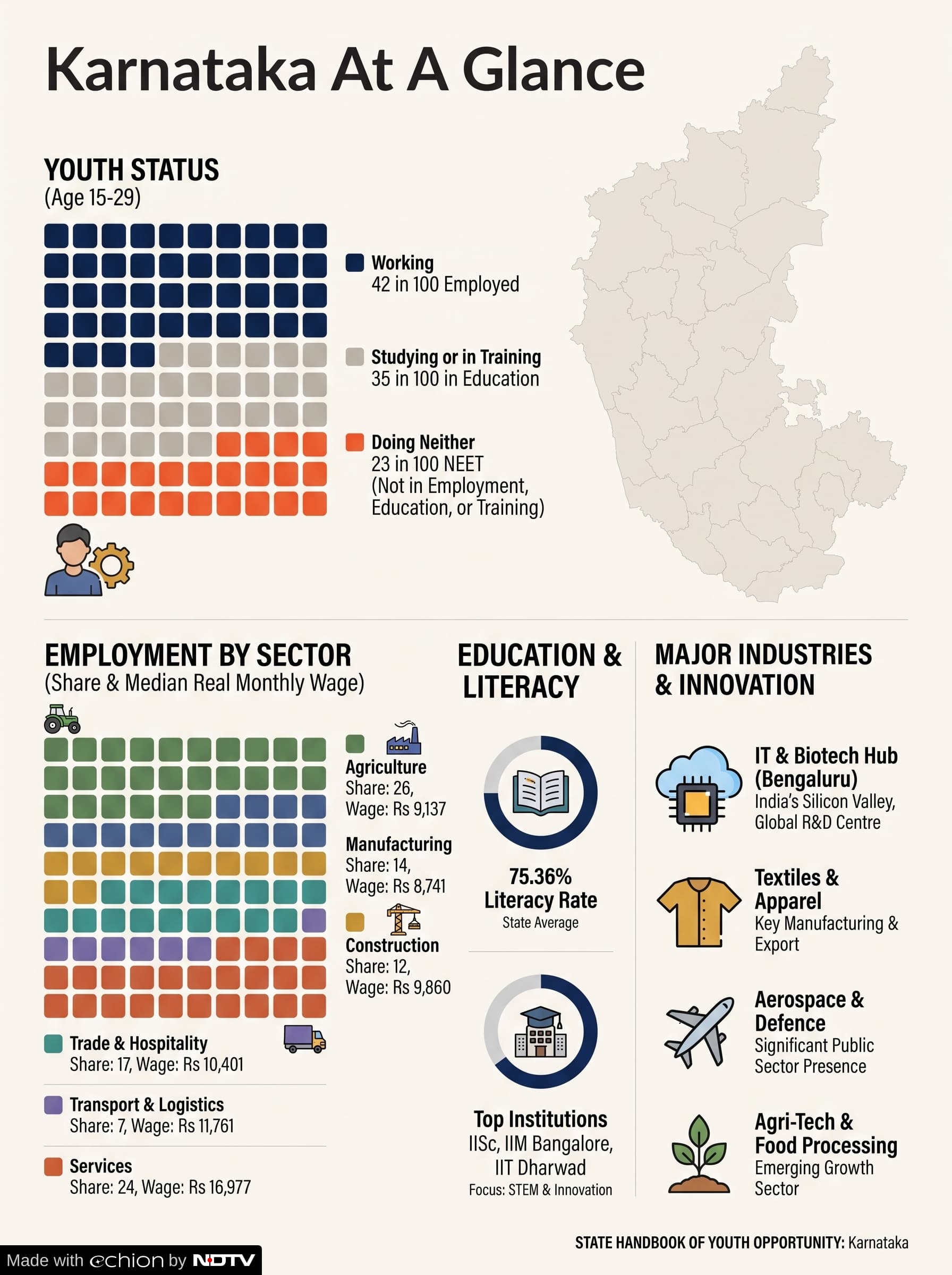
Nearly one in four young people in Karnataka below the age of 35 is neither working, studying nor undergoing any training, according to the Karnataka State Handbook on Youth Opportunity released by the Future of India Foundation. The report estimates that around 23 per cent of the state's youth fall into this category despite Karnataka's unemployment rate declining to 8.6 per cent.
The findings suggest that economic growth has not translated into equal opportunities across the state. With jobs and industries concentrated around Bengaluru, young people from several districts are increasingly forced to migrate to the capital in search of work, adding further pressure on the city's infrastructure and housing.
The report says around 42 per cent of Karnataka's youth are currently part of the workforce, while another 35 per cent are studying or receiving training. Among those employed, 44 per cent are in regular salaried jobs.
Bengaluru vs Rest Of Karnataka
Using 180 indicators drawn from 27 government databases, the report ranked districts across five parameters -- education, skilling, employment opportunities, quality of work and workforce participation.
The results reveal a sharp regional divide. Bengaluru Urban topped the rankings with a YouthPOWER score of 65, while Yadgir, one of Karnataka's most underdeveloped districts, scored just 42. Karnataka's overall score stood at 48.5, slightly below the national average of 50.
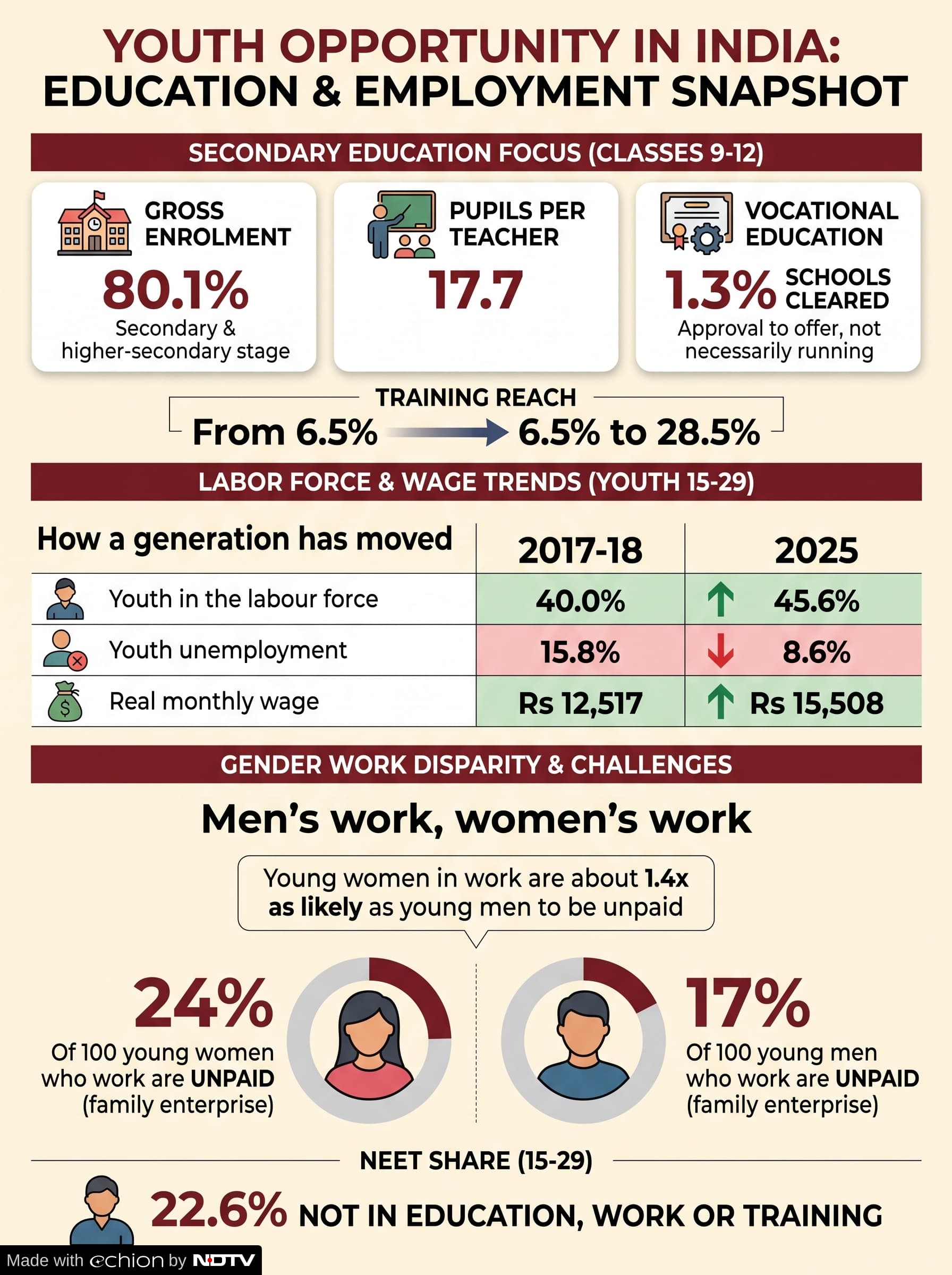
The report, however, notes that the share of youth participating in the labour force has improved significantly over the past few years. It increased from 40 per cent in 2017-18 to 45.6 per cent in 2025. During the same period, unemployment declined from 15.8 to 8.6 per cent, real monthly wages rose by around 23 per cent, and the proportion of young people receiving vocational or technical training increased from 6.5 to 28.5 per cent.
Yet, the benefits remain uneven.
Commenting on the findings, Kartik Narayan, CEO of Apna.co, said the challenge is not merely about skills but about access to opportunities. "Jobs need to go to people where they are rather than expecting people to go to jobs. The moment opportunity concentrates in one geography, you're not selecting for talent, you're selecting for mobility," Narayan said.
He added that the 23 per cent of Karnataka's youth who are neither in education, employment nor training should not automatically be viewed as lacking skills or motivation.
"They're immobile. And when women in 20 districts can't travel to a market alone, that immobility becomes a ceiling on women's workforce participation. The real arbitrage isn't just on skill; it's on who can afford to migrate. Until jobs are distributed where people are, we're leaving talent on the table," he said.
Karnataka Workforce Gender Divide
The report also points to persistent gender barriers. Despite Karnataka's Shakti scheme, which offers free bus travel to women, women in 20 of the state's 31 districts still face restrictions on travelling alone to markets, health centres or outside their communities.
In nearly a dozen districts, most women also have limited say in household decisions that affect their lives. The report further highlights that graduate unemployment among women stands at 24 per cent, while only one in four young women participates in the workforce. Just one-third can independently travel to a nearby market or clinic.
Skill development infrastructure also appears to be under strain.
Although Karnataka has one of India's largest networks of Industrial Training Institutes (ITIs), the report says many students leave without earning the certification they enrolled for. Such cases have been reported in districts including Bagalkot, Bidar, Chikkamagaluru, Davangere, Kalaburagi, Kodagu, Raichur, Vijayanagar and Vijayapura. Around half of trainer positions in ITIs remain vacant, while only one in four registered enterprises offers apprenticeships.
Lack Of Access To Credit
The report also examined lending patterns across districts. While most districts channel bank credit towards agriculture, industry and businesses that can generate employment, Mysuru and Udupi stand out for a higher share of personal loans. According to the report, this may limit the flow of capital into businesses capable of creating local jobs.
To bridge these gaps, the Future of India Foundation has recommended strengthening local employment, improving skilling, supporting entrepreneurship and making youth development a priority in district governance.
"The YouthPOWER score card gives elected representatives, administrators and citizens non-partisan language to act on it (concerns of the youth)," said Ruchi Gupta, Executive Director of the Future of India Foundation.
Track Latest News Live on NDTV.com and get news updates from India and around the world

