





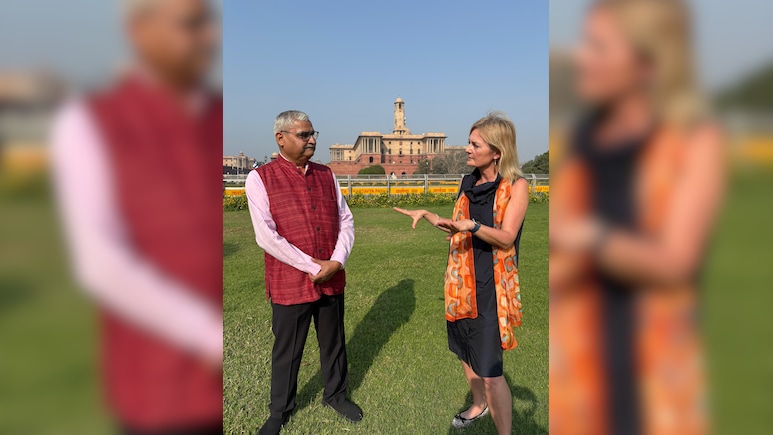
As tensions rise in the Middle East, with the United States and Israel locked in an escalating confrontation with Iran, the consequences extend far beyond geopolitics. According to Dr Magdalena Skipper, Editor-in-Chief of Nature and one of the world's most influential voices in science, modern conflicts strike at the heart of global research, disrupting collaboration, undermining evidence-based decision-making, and threatening the foundations of international study.
Speaking to NDTV during her visit to India, Dr Skipper framed the US-Israel-Iran war through both a scientific and humanitarian lens. “Any war creates enormous disruption and human suffering,” she said, adding that such conflicts generate "a crisis for researchers, social scientists, and public-health researchers." Wars, she argued, are not just political events; they are systemic shocks to the global knowledge ecosystem.
-

-
 NDTV World Summit 2026: Behind The Scenes As Ayush And Vedika Preview Two-Day Mega Event
 -
 Who Is Rajiv Mehta? Lilavati Hospital Trustee To Speak At NDTV World Summit 2026
 -
 Ex-CIA Director To Decode 'War In Times Of AI' At NDTV World Summit
 -
 From Call Centre To Billion-Dollar Disruptor: Nikhil Kamath At NDTV World Summit
 -
 'Every 5 Years, You'll See A New India': Swami Sarvapriyananda Ahead Of NDTV World Summit
 -
 AI Can Think, But Can It Be Conscious? Swami Sarvapriyananda Weighs In
 -
 Alain Ebobisse, Africa50 CEO, To Attend NDTV World Summit 2026. All About Him
 -
 Kriti Sanon At NDTV World Summit: A Look At Her Career And Business Ventures
 -
 Ex-CIA Director To Decode 'War In Times Of AI' At NDTV World Summit
 -
 Who Is Vikram Rai, CEO, South Asia GE Aerospace, Set To Attend The NDTV World Summit 2026
Science today is a deeply international enterprise. Laboratories depend on the cross-border movement of people, data, and equipment. Sanctions, border closures, and economic restrictions, common features of modern conflicts, directly impede that flow. “Researchers want to collaborate without borders or restrictions,” Dr Skipper said. When these barriers emerge, even temporarily, they can stall entire fields of research.
The current war nearly disrupted her own travel to India after flights were cancelled due to regional instability. That personal disruption mirrors a larger pattern affecting thousands of scientists whose work depends on mobility. From medical research to climate science, conflicts fracture networks that have taken decades to build.
In the case of Iran, science is not merely collateral damage; it is central to the dispute. The standoff over uranium enrichment and nuclear capability is, at its core, a technological issue. While Dr Skipper avoided political prescriptions, she acknowledged the deep entanglement between advanced science and global security. Nuclear technology, she implied, illustrates both the power of scientific knowledge and the risks that arise when trust between nations collapses.
Yet even in these circumstances, she argued that science can play a constructive role. Research conducted during and after conflicts often provides the data needed to prevent future wars through arms-control verification, environmental monitoring, or public-health interventions. However, war makes it significantly harder to deliver scientific relief where it is most needed.
“The shockwaves are felt worldwide,” Dr Skipper said. Energy markets, supply chains, and climate commitments are all affected by instability in the Gulf. In a tightly interconnected world, no conflict remains local for long.
Dr Skipper also spoke candidly about political leadership and its influence on science, particularly in the United States. Reflecting on President Donald Trump's second term, she expressed concern over what she described as sustained negative attention toward research. She cited executive orders aimed at reducing funding and restructuring agencies responsible for government-funded science.
While she acknowledged that any system can benefit from reform, she drew a sharp distinction between improvement and damage. “There is a difference between improving a system and hitting it so hard that it almost dismantles it,” she said. Although the US Congress later reversed many of the funding cuts, Dr Skipper warned that the long-term consequences may not be easily undone.
Her greatest worry lies with the next generation. “If you are 17 or 18 today and thinking about building a career,” she asked, “and you lived in a country where the leadership is constantly critical of science and technology… is this a career you would choose?” Persistent scepticism toward evidence risks drying up the scientific pipeline through discouragement rather than policy alone.
This concern is not confined to the US. Globally, rising hostility toward expertise and increasing restrictions on mobility threaten the openness on which science depends. Combined with war-driven isolation, the result could be a fragmented global research landscape.
Asked about the possible "end game" of the US-Israel-Iran war, Dr Skipper declined to speculate politically but was clear about her hopes. “The first thing I would like the end game to be, as soon as possible, is the end of the conflict,” she said. Her perspective is fundamentally humanist; while those far from the region read about war in headlines, the consequences for those within it are immediate and life-altering.
Science, she implied, has a role in shaping that conclusion, not by choosing sides, but by maintaining channels of dialogue, preserving shared facts, and documenting consequences honestly. At a time when wars are increasingly entwined with advanced technology, Dr Skipper's message was clear: undermining science weakens the world's capacity to resolve war. Protecting scientific collaboration offers one of the few neutral spaces where trust can still be built.
Track Latest News Live on NDTV.com and get news updates from India and around the world

