





India strongly pushed back against Pakistan's remarks at a United Nations Security Council (UNSC) meeting on Tuesday, while also making a broader case for reviewing outdated Security Council mandates and mediation frameworks that no longer reflect present-day realities.
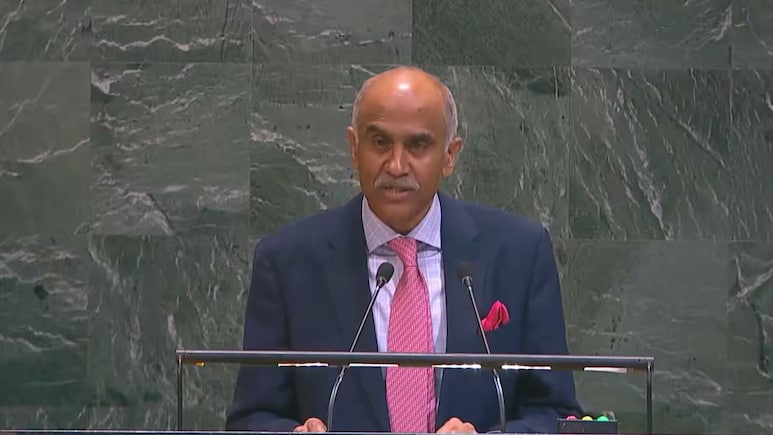
Speaking at the UNSC Arria-formula meeting titled "Bridging the Implementation Gap: Security Council Resolutions and Maintenance of International Peace and Security," India's Permanent Representative to the UN, Ambassador Parvathaneni Harish, underscored the distinction between resolutions adopted under Chapters VI and VII of the UN Charter and argued that not all Security Council mandates should be treated as having perpetual relevance.
Delivered India's statement at the Arria formula meeting on “Bridging the implementation gap: UNSC resolutions and Maintenance of International Peace and Security”.
— Parvathaneni Harish (@AmbHarishP) June 23, 2026
Highlighted the distinct nature of Chapter VI and Chapter VII of the UN charter in their applicability.
Chapter… pic.twitter.com/R90Jid5kSG
The meeting, co-chaired by China and Pakistan, focused on the implementation of Security Council resolutions and the challenges associated with enforcing them. India used the platform to stress that the nature and purpose of resolutions differ depending on the chapter of the Charter under which they are adopted.
Ambassador Harish noted that Chapter VII resolutions deal with threats to peace, breaches of peace and acts of aggression, authorising concrete measures aimed at restoring international peace and security. Failure to implement such measures, he said, could lead to immediate deterioration of security situations and undermine the principles of multilateralism and international law.
In contrast, he argued that Chapter VI resolutions are designed to facilitate the peaceful settlement of disputes through mechanisms such as negotiation, mediation, conciliation and arbitration. These measures, he said, are shaped by specific political circumstances and therefore cannot be assumed to remain relevant indefinitely.
Drawing attention to long-standing issues on the Security Council's agenda, the Indian envoy cited the Palestine question as an example where mediation frameworks have continuously evolved over time in response to changing realities on the ground. He said there was an "undeniable case" for reviewing outdated mediation arrangements and cautioned against treating earlier interventions as permanently applicable.
The remarks were widely viewed as significant in the context of Pakistan's longstanding attempts to invoke decades-old UN resolutions on Jammu and Kashmir. India has consistently maintained that references to outdated frameworks ignore subsequent political and diplomatic developments, including bilateral agreements between New Delhi and Islamabad.
Ambassador Harish also linked the debate to ongoing UN reform efforts. Referring to the UN80 initiative, under which member states are reviewing mandates of the UN General Assembly to improve efficiency and effectiveness, he argued that Security Council mandates should not be exempt from similar scrutiny. According to India, periodic reviews would help ensure that UN interventions remain relevant, practical and aligned with contemporary geopolitical realities.
The sharpest exchange came toward the end of India's intervention when Ambassador Harish responded directly to comments made by Pakistan's representative during the meeting. Accusing Pakistan of politicizing the forum, he said it was "incredible" that a co-chair expected to remain balanced and impartial had chosen to raise issues unrelated to the discussion.
Reiterating New Delhi's long-held position, the Indian envoy declared that the Union Territory of Jammu and Kashmir is "strictly internal to India" and asserted that it "always has been, is, and will remain so."
The exchange highlighted the continuing diplomatic tensions between India and Pakistan at multilateral forums, even as the discussion formally focused on the broader issue of Security Council resolution implementation. India's intervention reflected its growing emphasis on reforming international institutions and reassessing legacy frameworks that it believes no longer correspond to contemporary realities.
Track Latest News Live on NDTV.com and get news updates from India and around the world

