





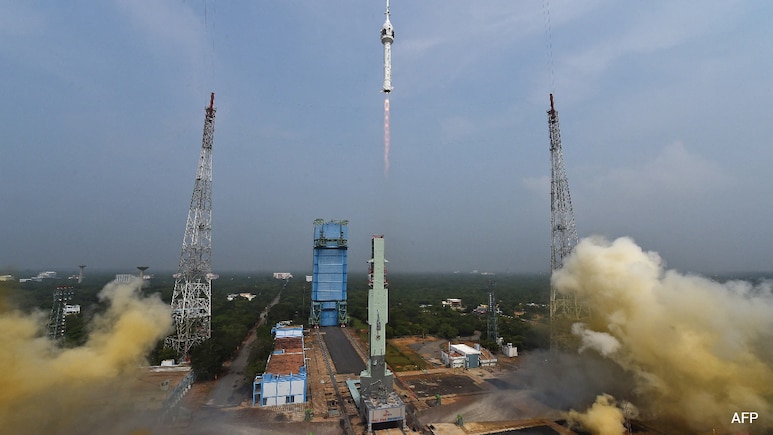
India has demonstrated that it can build rockets, launch satellites, explore the Moon and Mars, and nurture a vibrant private space ecosystem. But if the country wants to become a major player in the rapidly expanding global space economy, it must now solve a different challenge: financing growth.
That is the central message of a new report 'Space Economy 2036: The India Blueprint', released at a meeting of the India International Space Conclave hosted by the Indian Space Association (ISpA) in New Delhi. Prepared by Starfleet India Capital Advisors and ISpA, the report argues that India has developed space capability but has yet to create the financial architecture required to transform that capability into a globally competitive space economy.
The report estimates that India's space sector will need investments of $34-37 billion between 2026 and 2036. Public funding can support only part of that requirement. According to the study, public budgets may provide $14-15 billion, leaving a financing gap of $19-21 billion that must come from private capital, banks, insurers, pension funds and capital markets.
"India has charted its ambitions in space. The challenge now is matching ambition with a capital plan. Money is not the constraint. What is missing are the structures that let banks, insurers and pension funds price space risk," said Akshat Johri, Founder and CEO of Starfleet India Capital Advisors and editor of the report. "This Blueprint sets out those structures, and it is a live report. We will update it as the market moves, so that it stays a working tool for government, industry and investors."
The report comes at a time when India's space sector is undergoing a dramatic transformation. The country's space economy was valued at about $8.4 billion in 2022-23 and accounted for roughly 2% of the global space economy. The Government of India has articulated a target of building a $44 billion space economy by 2033, including $11 billion in exports. The Indian government has already laid out a road map for the Indian Space Research Organisation till it can land an Indian on the moon by 2040 and bring him back safely and towards that the government has already sanctioned Rs 33,000 crores of investments to the Indian space agency.
Speaking about the report Gaganyatri Group Captain Shubhanshu Shukla, Pilot, Axiom Mission 4 Mission says, "I am struck by how much of what the report proposes is about trust: giving a lender confidence in a contract, an insurer confidence in a mission, an investor confidence in a company. Spaceflight works the same way. A crew trusts the systems because every one of them has been tested, documented and proven. Building that kind of confidence into India's space finance is exactly the right ambition. To the young Indians who will design, build, finance and fly the next generation of missions: the opportunity in front of you is larger than any my generation had."
Looking further ahead, India's broader space vision aims to position the country among the leading space powers by 2047, the centenary of Independence. Achieving that ambition will require sustained investments in satellites, launch systems, communications networks, Earth observation services, navigation applications and emerging space technologies.
India's accomplishments provide a strong foundation. ISRO has completed more than 100 launch missions and placed hundreds of Indian and foreign satellites into orbit over the past several decades, it already has over 50 satellites in orbit and Pixxel Space, Bengaluru launched India's first fully functional satellite constellation. The country has also witnessed an explosion in private participation since space sector reforms began in 2020. Today, India has more than 400 space start-ups working across launch vehicles, satellites, geospatial applications, communications and data services, of these 400 some exist only on paper.
Yet today there is a tendency to focus disproportionately on rockets and satellites while overlooking where the largest economic value will eventually be created. The real money will likely be made downstream, through companies that use satellite data, communications services and positioning technologies to solve problems in agriculture, logistics, insurance, climate monitoring, disaster management, mobility, security and national infrastructure.
That insight is significant because discussions about the space economy often become dominated by launch vehicles and spacecraft manufacturing. While those sectors remain important, the downstream activity constitutes a large share of the overall market opportunity. Investors can only finance sustainable businesses when they see recurring revenue backed by long term demand.
There are five technologies that could reshape the future market: reusable launch systems, climate monitoring services, direct to device satellite connectivity, in space servicing and orbital data centres. Each of these technologies requires a different financing pathway and different levels of market maturity before large pools of capital can be attracted.
India's private launch companies also face a formidable challenge. Start-ups such as Skyroot Aerospace and Agnikul Cosmos have made significant progress and demonstrated indigenous capabilities. However, they are entering a marketplace dominated by global giants, particularly SpaceX, whose launch frequency, operational experience and economies of scale are unmatched.
Competing internationally will require not just technological excellence but also patient capital, insurance mechanisms, reliable procurement frameworks and access to debt financing. Venture capital alone will not be enough. The report notes that start-up equity currently supplies only a fraction of the roughly $2 billion in annual private capital that will be needed each year through 2036.
To address these challenges, the study proposes ten priority recommendations. These include creation of a Parikrama Fund for growth stage companies with a corpus of $ 53 billion, a dollar denominated India Space Growth Fund at GIFT City, adoption of service procurement models similar to NASA's Commercial Orbital Transportation Services programme, expansion of infrastructure financing, development of green bonds for climate observation satellites and establishment of domestic space insurance capabilities.
In this promising horizon, there is still an important policy gap. Despite major reforms, India still operates largely under a space policy framework. The country does not yet have a comprehensive Space Act passed by Indian Parliament. Nor does it have a codified liability regime that clearly defines responsibilities and risk allocation across government and private operators. There is the need for a three layer liability framework and risk management architecture if institutional investors are to participate confidently in the sector.
Another reality confronting the industry is the relatively limited scale of public expenditure. ISRO's annual budget remains modest compared to the ambitions being articulated and compared with major global space powers. The Department of Space allocation is currently around Rs 13,400 crore annually, a level that cannot by itself finance the scale of growth envisioned for the coming decades.
Lt Gen A.K. Bhatt (Retd), Director General, Indian Space Association, says, "This report matters. [Because] It does not ask the Government to spend more. It asks the institutions India already has, its banks, insurers, pension funds, export-credit agencies and capital markets, to recognise space as an asset class they can price, and it sets out precisely what each of them would need to do so."
Its recommendations are specific, its sequencing is realistic, and its emphasis on sustainability recognises that the orbits we use are a shared and finite resource. Space is also a domain of national security. A strong, privately financed industrial base is a strategic asset in its own right, giving the nation depth, resilience and choice. Financing that base well is therefore not only an economic question.'
The report's conclusion is clear. India's space ambitions can no longer be sustained through grants, government budgets and venture capital alone. The next phase of growth must be driven by mainstream finance. Banks, insurers, pension funds, bond markets and institutional investors will have to become active participants.
As the report puts it, the transition from grants to capital markets is not merely a funding reform. It is the moment when India's space ambition stops being a government programme and becomes an economy.
Track Latest News Live on NDTV.com and get news updates from India and around the world

