



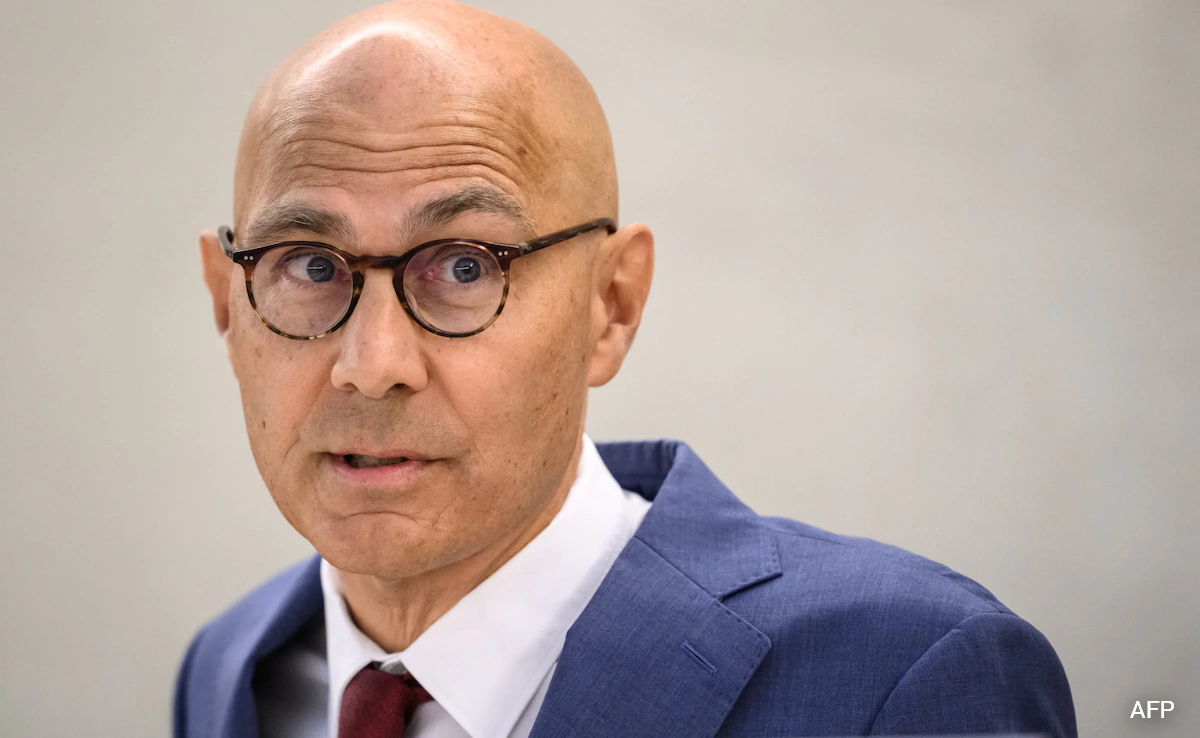
As the world grapples with the promises and perils of artificial intelligence, India has emerged as a key global voice in shaping its ethical future. Speaking exclusively to NDTV at the high-profile AI Summit in New Delhi, United Nations High Commissioner for Human Rights Volker Turk praised India's leadership, saying the country is uniquely positioned to help define the "red lines" for artificial intelligence through a strong human rights framework.
With more than 70 countries participating and over 300,000 people attending, the summit has become one of the largest global gatherings focused on AI. While the technology offers unprecedented opportunities in health, education and sustainable development, Turk warned that unchecked use of AI also carries serious risks, including surveillance, cybercrime and abuse of power.
"The huge opportunities of AI are clear, but there are also risks," Turk said. "Human rights are precisely the frame through which we must address them, because they are about obligations of states and responsibilities of companies. These are the guardrails that put constraints on power."
He stressed that while innovation should not be stifled, regulation is essential. According to him, every country must find ways to regulate the design and development of AI, ideally through a global framework. The United Nations, he said, has been working extensively toward this goal.
What makes the New Delhi summit especially significant, Turk noted, is that it is being held in the Global South and led by India. "It is really great that this topic is being discussed here in India for the first time in this way. India can help advance the red lines of the Global South and ensure that AI does not become the privilege of a few," he said, in a clear endorsement of India's leadership role.
Responding to questions about India's responsibility as one of the world's largest democracies, Turk underlined the importance of education, access and sharing of technology. He referred to Article 27 of the Universal Declaration of Human Rights, which recognises the right to share in scientific advancement. "Scientific knowledge is a human right," he said. "It must not end up in the hands of a few in Silicon Valley. This summit shows how India is encouraging startups to innovate while also doing good and creating prosperity."
Turk said he was impressed by interactions with Indian startups that aim to combine technological innovation with social impact. The human rights framework, he added, not only inspires imagination but also provides a clear track to follow so that safety and risk concerns are not ignored.
The conversation also turned to global conflicts, with Turk addressing the fragile ceasefire in Gaza. He said it was crucial that the ceasefire hold and lead to a genuine two-state solution. "Self-determination of the Palestinian people is in the long-term interest of both Israelis and Palestinians," he said, adding that peace remains the only sustainable path forward.
On questions surrounding alternative "peace boards" outside the UN framework, Turk was firm in defending the relevance of the United Nations. "The legitimacy and convening power of the UN cannot be replaced. Without it, the world would be more chaotic and anarchic," he said, saying that if the UN did not exist, it would have to be reinvented immediately.
Discussing the Russia-Ukraine conflict, Turk echoed sentiments often voiced by India's leadership that wars cannot be solved on the battlefield. He said any peace must be in line with the UN Charter and international law and involve negotiations between both parties, supported by mediation from influential countries. Highlighting the humanitarian toll, he pointed to attacks on critical infrastructure during harsh winter conditions, which disproportionately affect women and children.
Turk also reminded viewers that while conflicts like Gaza and Ukraine dominate headlines, the world is currently facing 61 active conflicts, many of which remain "forgotten crises" deserving global attention.
Shifting focus to South Asia, he addressed the evolving situation in Bangladesh following political unrest and a transition of power. Turk said it was vital that human rights remain central during the transition, particularly to protect minorities and ensure equality regardless of status or gender. He expressed hope that lessons from the past would lead to justice, reconciliation and healing.
On terrorism, a longstanding concern for India, Turk unequivocally condemned it as "horrific" and said it must never be justified. He emphasised the need to focus on survivors and victims while adopting comprehensive, community-oriented approaches to prevention. He also flagged the growing role of technology and social media in radicalisation, calling for early-warning mechanisms and rights-based responses to stop violence before it escalates.
Concluding the interview, Turk shared his personal takeaway from India and the summit. "India is an extremely vibrant country, full of energy and inspiration," he said. He highlighted India's deep historical connection to human rights, recalling the role of Indian women leaders in shaping the Universal Declaration of Human Rights and embedding gender equality in it.
"That history needs to be honoured and translated into today's realities - climate change, the digital world and AI," Turk said. Calling India a "very important global power," he added, "We need India's voice when it comes to peace, development and human rights."
As the AI Summit in New Delhi draws global attention, the message from the UN's top human rights official is clear: India is not just hosting a conversation on artificial intelligence, it is helping shape its moral and human future.
Track Latest News Live on NDTV.com and get news updates from India and around the world

