





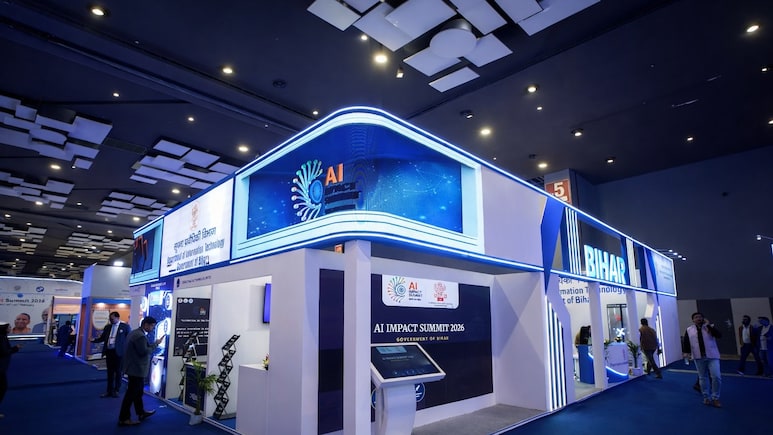
As the world progress is towards getting used to artificial intelligence in our day-to-day lives, the state of Bihar is also tightening its seat belts to walk hand-in-hand with AI.
Artificial intelligence is being used by the state of Bihar in several sectors. At AI Impact Summit 2026, NDTV took a glance of the Bihar pavilion and your present you, some of the highlights that reflects how Bihar is using artificial intelligence
In a major step toward digital democracy, the State Election Commission, Bihar has used Artificial Intelligence based E-Voting in the Urban Local Bodypolls and is now preparing to expand the model for the next Assembly elections in next term
ACC to state election commission of Bihar, for the first time, Bihar introduced a secure mobile-based voting system aimed at solving one of the biggest challenges in elections ie voter exclusion. Migrant workers, students living outside their constituencies, senior citizens, pregnant women, persons with disabilitiesand patients who are unable to visit polling booths were given an alternative: vote from their smartphones.
Process Of E-Voting
The Commission rolled out a dedicated mobile application that allowed voters to complete the entire process from registration to vote casting digitally. A voter had to download the official app, give consent, complete mobile verification through OTP, enter EPIC details and then verify identity through live facial recognition.
Unlike systems linked to Aadhaar, Bihar's model used the voter's EPIC database photograph for authentication. It combined facial recognition, liveness detection, device-level verification and blockchain-backed encryption to ensure that: voter is genuinE, no impersonation takes place , vote remains secret, vote cannot be tampered
Each vote was encrypted and recorded through blockchain technology, making it immutable and auditable. A smart contract system acted like a digital EVM, enabling secure counting. Decryption of votes was allowed only after Returning Officers authenticated the process using Digital Signature Certificates (DSCs), two-factor authentication, and hash verification.
This ensured that the system remained secure at every stage from voting to counting
Why Bihar Felt The Need
Urban turnout has often been affected by migration and mobility. Many eligible voters are willing to vote but cannot travel back to their registered constituency on polling day. The Commission identified this as a structural gap in participation.
The idea behind eVoting was simple: physical limitations should not become democratic limitations.
State Election Commissioner Deepak Kumar said, "This was entirely the Commission's idea. Many believed such AI-based remote voting could never happen in Bihar, but we were determined to make it possible. It is the first time in India that this kind of eVoting has been implemented in a live election. We faced several technical and operational challenges but through mock voting demonstrations and transparent testing, we built confidence in the system. Our aim was simple no voter should be left out because of distance, age or health."
Challenges Faced
Implementing eVoting was not easy.
Digital literacy varied across age groups. Senior citizens and first-time users needed assistance in navigating the app. Facial recognition faced practical challenges old EPIC photos, poor lighting, low-resolution cameras, and unstable internet connections led to authentication failures in some cases.
There was also initial skepticism from political stakeholders regarding secrecy and fairness. To address this, the Commission conducted mock drills, demonstrations, and transparent briefings to build trust.
Returning Officers also had to be trained to use DSC tokens for digitally signing and unlocking ballots. Institutional readiness required structured capacity-building.
How It Helps Bihar
Despite challenges, the initiative marked a shift toward inclusive governance.
Bihar's AI push is not limited to elections.
Dastavez AI, founded by Anmol Bharti and Amrit Bharti, is using artificial intelligence to simplify legal drafting. It helps lawyers, startups and common citizens generate contracts, notices and agreements quickly and affordably. The platform reduces errors, saves time and improves legal access in simple language.
At the policy level, Tiger Analytics has signed an MoU with the Government of Bihar at the India-AI Impact Summit 2026 to establish a large AI Centre of Excellence in collaboration with IIT Patna. The initiative focuses on AI skill development, applied research, and governance solutions. It aims to build a long-term AI ecosystem in the state.
Together, these initiatives show a clear direction: Bihar is not just adopting artificial intelligence it is integrating AI into governance, law, and public systems.
From digital voting to legal-tech innovation and AI skill development, the state is shaping a model where technology is used to expand access, improve transparency, and strengthen democratic participation.
Track Latest News Live on NDTV.com and get news updates from India and around the world

