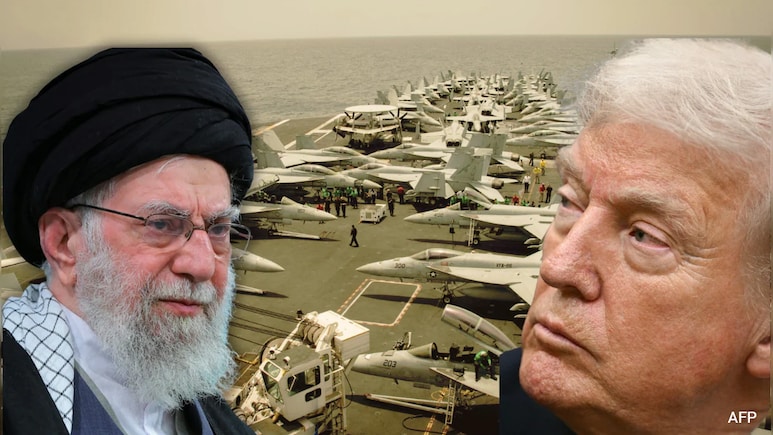
The US military is ready to attack Iran as early as this weekend, even though President Donald Trump has not made a final decision yet on whether he'll authorise an armed confrontation with Tehran, according to reports by CNN and CBS. The development comes amid a massive US military buildup in the Middle East, including warships, fighter jets, and refuelling aircraft, laying the foundation for a potentially sustained campaign against Iran.
According to a CNN report, the White House has been briefed that the military is ready for an attack by the weekend, but Trump remains unconvinced that it's the best course of action. Citing the source, the US publication reported that the American commander-in-chief has privately argued both for and against military action and polled advisers and allies on the best course of action.
It remains unclear if he will make a decision by the weekend. "He is spending a lot of time thinking about this," a source said.
Trump—who ordered strikes on Iran last year—has repeatedly threatened Tehran with further military action if ongoing talks do not reach a replacement for the nuclear deal the US president tore up in 2018, during his first term in office.
US Military Buildup in the Middle East
Washington currently has 13 warships in the Middle East: one aircraft carrier—the USS Abraham Lincoln—nine destroyers and three littoral combat ships, with more on the way, according to a US official.
The USS Gerald R. Ford—the world's largest aircraft carrier—is currently in the Atlantic Ocean en route from the Caribbean to the Middle East, after being ordered there by Trump earlier this month. It is accompanied by three destroyers. It is rare for there to be two US aircraft carriers—which carry dozens of warplanes and are crewed by thousands of sailors—in the Middle East.
The United States had two of the massive warships in the region in June last year when it targeted three Iranian nuclear sites during Israel's 12-day campaign of strikes on Iran.
Trump has also sent a large fleet of aircraft to the Middle East, according to open-source intelligence accounts on X and the flight-tracking website Flightradar24. These include F-22 Raptor stealth fighter jets, F-15 and F-16 warplanes, and the KC-135 aerial refuelling aircraft that are needed to sustain their operations.
On Wednesday, Flightradar24 showed multiple KC-135s flying near or in the Middle East, as well as E3 Sentry airborne warning and control aircraft and cargo planes operating in the region.
Reasons Why The US Can Attack Iran

Iranians walk past an anti-US billboard installed on a building on Enqelab Square in Tehran (AFP)
A war between Washington and Tehran is looming — and there are six major factors suggesting Trump might push the button sooner rather than later.
Nuke Deal: The biggest factor is the long-running nuclear dispute between Washington and Tehran. Both nations have had off-and-on talks about striking a nuclear deal for months. US and Iranian officials held talks in Geneva on Tuesday aimed at averting US military intervention, with Iran saying afterwards that they had agreed on "guiding principles" for a deal.
But White House Press Secretary Karoline Leavitt said Wednesday that while there was "a little bit of progress made", the two sides are "still very far apart on some issues". Leavitt also told journalists there are "many reasons and arguments that one could make for a strike against Iran," adding, "Iran would be very wise to make a deal."
Trump has repeatedly suggested he wants a new nuclear deal with Tehran, but he has at times also said he would like to see regime change — igniting the possibility that any new military operation could go well beyond nuclear targets.
Protests: Trump came close to striking Iran in early January over the killings of thousands of protesters by the Iranian regime. He ordered the Lincoln to the Middle East as Iran cracked down on protests that were initially driven by economic grievances but which turned into a mass movement against the Islamic Republic.
The clerical leadership that took power after the 1979 Islamic revolution responded to the demonstrations with deadly force and has held onto power, with many opponents of the system looking to outside intervention as the most likely driver of change. Trump had repeatedly warned Iran that if it killed protesters, the United States would intervene militarily and also encouraged Iranians to take over state institutions, saying, "Help is on the way."
He pulled back from ordering strikes last month, saying Tehran had halted more than 800 executions under pressure from Washington, but has since renewed threats against Iran.
Chekhov's Aircraft Carrier: By sending the second aircraft carrier to the Middle East amid his repeated threats, Trump is sending a signal that he will strike Iran if he can't swiftly secure a deal. So far, there are no signs that a deal is anywhere near, but the horns are blaring, signalling an impending war.
Israeli Pressure: The Israeli government has been ready for a war with Iran far beyond the pinprick strikes Trump considered back in January, according to an Axios report. As per the report, even during the nuclear talks, Trump and Israeli Prime Minister Benjamin Netanyahu have been coordinating closely and agreed to put new economic pressure on Iran.
The Oil Factor: The current oil market also offers a strategic window for Trump to strike Iran. Markets are well-supplied, prices are relatively low, demand growth is modest, and Iran's proxy capabilities are weakened, according to an Axios report.
The oil prices would jump if a strike happened. But the rise would reportedly be likely limited — in dollars and duration — if no barrels are actually lost or even if only Iran's exports are disrupted.
Regime Weakness: Another factor that may motivate Trump to order a strike is the perceived weakness of the Ayatollah Sayyed Ali Khamenei-led Iranian regime. Massive protests against the regime and the damaging Israeli and US strikes last year have also weakened the regime's hold over the country.
Iran would certainly retaliate in case of an attack, but Israeli and US officials may feel that retaliation would be more limited now than some months or years from now.
Track Latest News Live on NDTV.com and get news updates from India and around the world


