





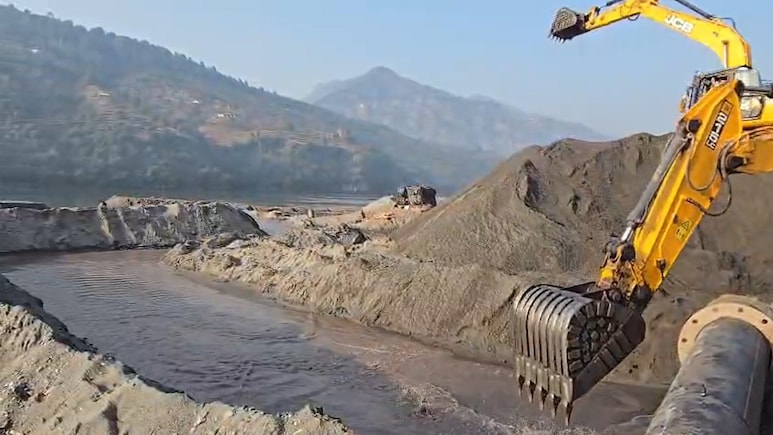
With the suspension of the Indus Waters Treaty with Pakistan, India has accelerated desilting operations at reservoirs on Himalayan rivers covered under the pact—a key development after decades of operational restrictions. NDTV's ground report found that dredging has also begun in the reservoir of the Salal Dam on the Chenab River, decades after key sediment-management facilities were rendered inoperable.
The Salal power station in Jammu and Kashmir has suffered a dramatic loss of storage capacity of up to 96 per cent due to the absence of any sediment-management facilities under the Indus Waters Treaty. As a result, the reservoir's original storage capacity of 284 million cubic meters (MCM) has dwindled to just 9.91 MCM, as recorded in a bathymetric survey conducted in May 2025.
With the water-sharing treaty no longer in effect, NHPC (National Hydroelectric Power Corporation) has launched a silt-management plan at the facility to ensure sustained operational efficiency. The move is expected to reverse losses and damages inflicted on the Salal power project and, in the longer run, increase the capacity of the reservoir to 694 MW.
Earlier, when the Indus Waters Treaty was in effect, India was not able to carry out all these measures. The 1960 Indus Waters Treaty and a 1978 agreement previously prohibited India from using undersluice gates for sediment management, forcing them to remain sealed.
About The Salal Project
The NHPC-run Salal Hydroelectric Project is a 690 MW run-of-the-river power plant located on the Chenab River in the Reasi district, and it supplies electricity to the Northern Grid, including Jammu and Kashmir.
After Indus Waters Treaty Pause, India Has Started Major Desiltation Of Chenab River Near Salal Dam - Watch This Exclusive Report By NDTV's @deepduttajourno pic.twitter.com/UlYoJ7SICc
— NDTV (@ndtv) February 25, 2026
According to official documents, the Salal concrete dam was originally designed with six undersluices (gates located at the base of a dam) and six silt-excluder gates (silt-stopping structures) to manage sediment. However, following the treaty signed in 1960 and a subsequent agreement in 1978, the six undersluices were permanently plugged, and the operation of the silt-excluder gates was prohibited.
Officials said that in the absence of any sediment-management facilities, silt started accumulating in the reservoir thereafter. However, in the absence of the treaty, a three-pronged plan is being undertaken for the first time after the suspension of the treaty last year.
Inside NTPC's Plan
"We are working under an effective silt management plan to ensure the operational effectiveness of the power station. One of the activities under this is dredging, through which we are trying to remove silt from the dam," Salal Power Station executive director Anish Gouraha had earlier told news agency PTI.
He said that the plan focuses on three key measures—dredging, flushing, and under-sluicing—to reduce sedimentation in the dam and improve power generation efficiency.
To address the crisis, a no-objection certificate (NOC) was issued to Reach Dredging Limited, Kolkata, for the desilting of the Salal Dam reservoir, and the work commenced on November 25, 2025.
Reach Dredging Limited (RDL) has also been involved in dredging operations for the removal of deposited sediments from the Salal Dam reservoir. The company that specialises in river engineering, land reclamation, and operating portable dredgers has obtained permission from the Jammu and Kashmir Department of Geology and Mining for the disposal of one lakh metric tonnes (MT) of silt. Of this, 1,77,802 MT has been dredged so far, while 68,490 MT has already been disposed of.
In a parallel move, another NOC was issued on February 17 to Dharti Dredging and Infrastructure Limited, Mumbai. "Statutory clearances are in process, after which the work will commence," the official said.
Separately, a tender was also floated on February 9 to make functional the permanently plugged undersluices. The last date for bid submission is March 23. The ongoing and proposed measures are aimed at restoring at least partial storage capacity and improving the long-term operational viability of the hydropower station.
For the third component, undersluicing, Gouraha said bids have been floated, and responses are being evaluated. "A final decision is yet to be taken, but this is also an integral part of our sedimentation management strategy," he said.
Track Latest News Live on NDTV.com and get news updates from India and around the world

