





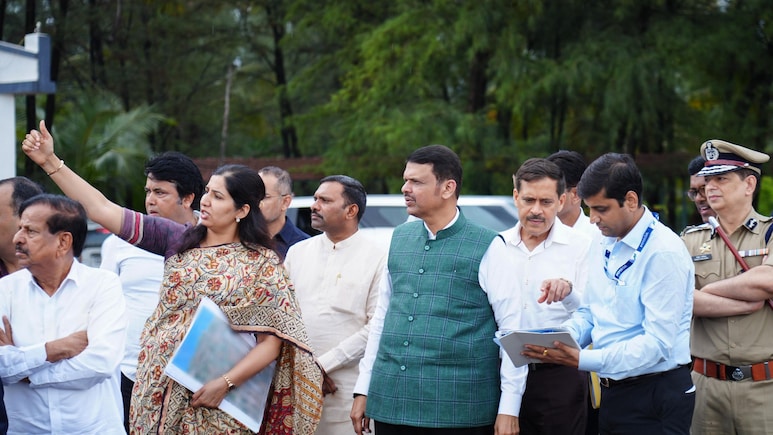
- India plans its first offshore airport off Maharashtra's western coast near Kore Beach in Palghar district
- Airport will handle about 90 million passengers annually and link with Vadhavan Port and transport projects
- Maharashtra ordered a DPR and may extend Uttan-Virar Sea Link for direct connectivity to the airport site
India is set to build its first offshore airport, marking a major milestone in the country's aviation and infrastructure ambitions.
The Maharashtra government has ordered a detailed project report (DPR) for the proposed airport off the state's western coast, with Chief Minister Devendra Fadnavis also directing officials to examine extending the Uttan-Virar Sea Link to provide direct connectivity to the site.
Unlike conventional airports built entirely on land, an offshore airport is constructed on reclaimed land or artificial islands in the sea. The model has been successfully adopted by countries such as Japan, Hong Kong and South Korea to overcome land constraints while creating large aviation hubs.
For Maharashtra, however, the project is about much more than adding another airport. Along with the proposed Vadhavan Port, high-speed rail and new road links, it could reshape the economic landscape of the Mumbai Metropolitan Region (MMR), unlock fresh investments in Palghar and create a new growth corridor north of Mumbai.
What Is An Offshore Airport?
An offshore airport is built on reclaimed land or artificial islands in the sea instead of on the mainland. It helps cities expand aviation capacity where land is scarce, while reducing pressure on densely populated urban areas.
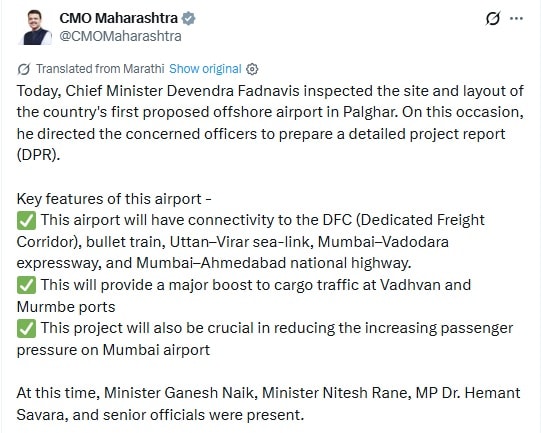
How Will India's First Offshore Airport Boost Economy?
The proposed airport is expected to come up near Kore Beach in Palghar district. Designed to handle around 90 million passengers annually, it is planned alongside other mega infrastructure projects, including the Vadhavan Port and major transport links. Together, they could transform a region that has long remained on the fringes of Mumbai's urban expansion.
For developers tracking the area, the announcement is less of a surprise and more of a turning point.
"Developers who have worked this corridor for decades will tell you the infrastructure was always coming. The question was never whether. It was when, and at what scale," said Shravan Nawany, Director of Nawany Group.
According to Shravan Nawany, three major public agencies have independently backed the same growth corridor within the past two years, strengthening confidence in the region's long-term prospects.
He points to three developments. CIDCO invited bids earlier this year for over 126 acres of industrial land linked to the Vadhavan Port project. MMRDA has been appointed the Special Planning Authority for 446 villages across Palghar and Raigad, paving the way for planned urban development. Now, the state government has initiated the airport's DPR while also proposing a direct sea-link connection.
"When CIDCO, MMRDA, and the state government arrive at the same corridor without coordinating their announcements, it is not a strategy. It is evidence," Nawany said, adding that each decision reinforces the region's investment case independently.
The airport is only one piece of a much larger infrastructure puzzle.
The upcoming Vadhavan Port is projected to generate around 10 lakh jobs across logistics, shipping, freight and related industries. That workforce will need housing, offices, retail and supporting infrastructure.
Nawany believes Vasai-Virar and Palghar are best placed to absorb much of that demand because they already serve as the nearest large urban centres with relatively affordable land and room for expansion.
He also noted that the period between a DPR being announced and a project becoming operational is often when property markets begin pricing in future infrastructure. "That window opened in Palghar with this statement from the Hon'ble CM," he said.
Airports Have Changed Property Markets Before
Airport-led development is hardly new for Mumbai.
The Navi Mumbai International Airport offers a recent example. Long before commercial flights began, surrounding locations such as Ulwe, Panvel and Kharghar had already witnessed sharp appreciation as investors anticipated future demand.
Nawany argues that the market typically moves well before aircraft start taking off.
"The repricing happened long before the first flight landed," he said, referring to Navi Mumbai Airport. According to him, investors who entered during the planning stage captured much of the value creation, while operational milestones merely validated earlier expectations.
He believes the proposed offshore airport could follow a similar trajectory.
A Changing Growth Corridor
What makes the latest proposal particularly significant is its location.
For years, discussions around an airport linked to Vadhavan Port largely centred on sites closer to Dahanu. The proposed location near Kore Beach shifts the focus considerably southwards, bringing the project much closer to Virar.
The proposed extension of the Uttan-Virar Sea Link further strengthens that connection by directly integrating the airport with Mumbai's transport network.
If executed alongside the deep-water port, the Mumbai-Ahmedabad bullet train and other regional infrastructure projects, the airport could create a new development corridor stretching across northern MMR.
While the project remains at the DPR stage and several approvals lie ahead, the announcement signals the state's intent to build another major aviation hub outside Mumbai.
Track Latest News Live on NDTV.com and get news updates from India and around the world

