




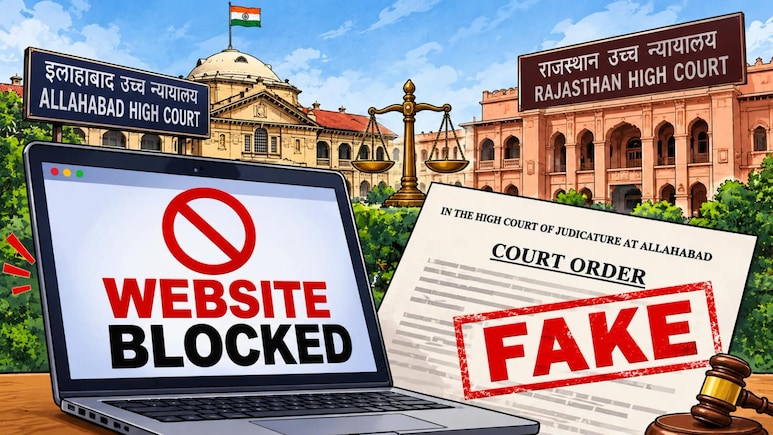
The Central government ordered the blocking of 129 websites based on court orders that have now turned out to be fake. A Reuters investigation has revealed that two purported orders from the Rajasthan and Allahabad High Courts were forged to mislead the Department of Telecommunications (DoT) into directing Internet Service Providers (ISPs) to block the websites.
The DoT issued the blocking directives on July 21 and September 2, acting on the basis of the purported court orders submitted to it. Both directives were accompanied by emailed copies of what appeared to be orders issued by the respective High Courts. However, checks with the official records of both courts revealed that neither order had been registered.
The revelations have raised concerns over the use of artificial intelligence and forged court seals to fabricate judicial orders and target websites, as well as the verification mechanisms in place within the Central government before issuing website-blocking directives.
According to Reuters, both forged orders carried blue court seals bearing India's national emblem, resembling those found on genuine court documents.
The forged order purportedly issued by the Rajasthan High Court was emailed to the DoT at 8.59 pm on July 19, directing authorities to take action within 24 hours. It carried the signature of an individual identified as 'Aryan Chaudhary', who was described as an 'Advocate-on-Record'.
The Rajasthan High Court has confirmed that the order was fake and that no such document existed on its servers. The court is also considering legal action in connection with the matter.
Acting on the basis of this forged order, the DoT issued instructions to internet companies on July 21 to block 34 betting websites.
The Allahabad High Court also found that an order purportedly issued in its name to affect another round of website takedowns was fake. The court subsequently filed a police complaint on November 6, Reuters reported. An investigation has been initiated against unknown persons on charges of forgery and cheating.
The purported Allahabad High Court order was dated August 14 and was cited to seek action against 95 gambling-related websites. When Reuters sought clarification from the court administration about the order, officials found that it was fake.
After the matter was brought to the attention of the Chief Justice of the Allahabad High Court, the Registrar General and the court's computer section were tasked with verifying the document's authenticity.
System Manager Arindam Lahiri examined the court's digital servers and databases and submitted a report on November 3, 2026, which revealed that the case cited in the purported order - Writ Petition No. 30480/2026 - did not exist in the court's records and had never been registered.
The report also found that no such order had been uploaded to the court's portal for August 14, 2026, the date on which it was allegedly issued.
The private secretary to the judge concerned also confirmed in writing that the judge had never passed any such judgment or order, according to Reuters.
The investigation uncovered an elaborate attempt to make the forged order appear authentic. Correspondence from the DoT indicated that an individual posing as a lawyer had emailed the fabricated document to the department, seeking the blocking of 95 websites.
After the court's internal inquiry confirmed the forgery, the Registrar General, acting on the Chief Justice's instructions, directed that police action be initiated on November 5.
A case was subsequently registered against unknown persons at the Cantt Police Station in Prayagraj on November 6, following a written complaint by the High Court's Joint Registrar (Civil).
The Prayagraj Police have registered the case under Sections 318(2), 336(2), 336(3), 337, 338 and 340(2) of the Bharatiya Nyaya Sanhita (BNS), which deal with cheating, forgery and the use of forged documents as genuine, along with relevant provisions of the Information Technology Act.
According to DCP (City) Sagar Jain, the police's cybercrime and technical investigation teams are working to identify the IP address and computer system used to execute the fraud, as well as those responsible.
Together, the two forged court orders resulted in the blocking of 129 gambling-related websites, an industry operating in violation of Indian law.
(With Inputs From Vishwas Sharma and Deepak Gambhir)
Track Latest News Live on NDTV.com and get news updates from India and around the world

