





The government on Friday slashed special additional excise duties for petrol and diesel by Rs 10 per litre each, bringing the centre-imposed taxes down to Rs 3 per litre of petrol and making it zero for diesel.
However, industry sources say the reduction is unlikely to translate into lower prices at fuel stations for most consumers as the cut will larely be absorbed by oil marketing companies (OMCs) to offset heavy losses on pump sales.
OMCs are currently losing Rs 48.8 per litre of petrol or diesel sold, in large part due to the surge in Brent crude prices; the global benchmark crossed US$100 per barrel red line after the US-Israel war on Iran and the Strait of Hormuz blockade.
In a long X post, Petroleum Minister Hardeep Singh Puri said: "International crude prices have gone through the roof in the last month, from around US$70 per barrel to around US$122 per barrel. Consequently, petrol and diesel prices for consumers have gone up all over the world. Prices have increased by around 30 to 50 per cent in South East Asian countries, 30 per cent in North American countries, 20 per cent in Europe, and 50 per cent in African countries."
"The Modi government had two choices - either increase prices drastically for citizens of Bharat as all other nations have done or bear the brunt on its finances so that Indian citizen is insulated from international volatility."
International crude prices have gone through the roof in the last 1 month from around 70 dollars/barrel to around 122 dollars/barrel. Consequently, petrol and diesel prices for consumers have gone up all over the world. Prices have increased by around 30%-50% in South East Asian…
— Hardeep Singh Puri (@HardeepSPuri) March 27, 2026
"... in keeping with the commitment of last four years, since the conflict in Russia-Ukraine started, the govvernment decided to take a hit on its own finances again to safeguard the Indian citizen," Puri said.
The excise duty cut also comes a day after Nayara Energy, India's largest private fuel retailer with an 8.4 per cent market share and backing by Russian company Rosneft and Kesani Enterprises, hiked petrol and diesel by Rs 5.3 and Rs 3 per litre.
Centre excise duty cut on petrol, diesel
The total amount of excise duty levied by the central government on one litre of petrol was Rs 21.90. This has now come down to Rs 11.90. Similarly, total central excise duty on a litre of diesel has down from Rs 17.8 to Rs 7.8.
Breakup of central taxes on a litre of petrol:
- Basic Excise Duty - Rs 1.4
- Special Additional Excise Duty - Rs 3 (reduced from Rs 13)
- Agriculture Infrastructure & Development Cess - Rs 2.5
- Additional Excise Duty (Road and infrastructure Cess) - Rs 5
Breakup of central taxes on a litre of diesel:
- Basic Excise Duty - Rs 1.8
- Special Additional Excise Duty - 0 (reduced from Rs 10)
- Agriculture Infrastructure & Development Cess - Rs 4
- Additional Excise Duty (Road and infrastructure Cess) - Rs 2
The central excise on petrol and diesel has seen a steady reduction from May 2020 when it was at Rs 32.98 per litre of petrol and Rs 31.83 per litre of diesel.
| Effective date | Petrol (Rs per litre) | Change (Rs per litre) | Diesel (Rs per litre) | Change (Rs per litre) |
| May 6, 2020 | 32.98 | - | 31.83 | - |
| Feb 2, 2021 | 32.90 | -0.08 | 31.80 | -0.03 |
| Nov 2, 2021 | 27.9 | -5 | 21.8 | -10 |
| April 8, 2025 | 19.9 | -8 | 15.8 | -6 |
| Nov 1, 2025 | 21.9 | +2 | 17.8 | +2 |
| March 27, 2026 | 11.9 | -10 | 7.8 | -10 |
READ | Where Your Rs 2,000 Spent On Petrol Goes: Taxes, Iran And Oil Companies
The Iran War-Hormuz pressure
The US-Israel war on Iran, and Tehran's consequent Hormuz blockade, have severely disrupted oil and gas export from the wider West Asia region.
The Hormuz is a critical energy supply channel for the world; pre-war approximately a fifth of global seaborne crude oil and gas - between 20 and 25 million barrels of crude and about 10 billion cubic feet of gas per day - was shipped via the narrow maritime channel.
As such, it is a key supply route for India; an estimated 40 to 50 per cent of crude oil imports, i.e., between 2.2 and 2.8 million barrels per day, historically comes through that passage.
India also imports large amounts of gas from West Asia; an estimated 16 to 17 per cent of LNG, or liquified natural gas, exported by Qatar and the United Arab Emirates is purchased by Delhi.
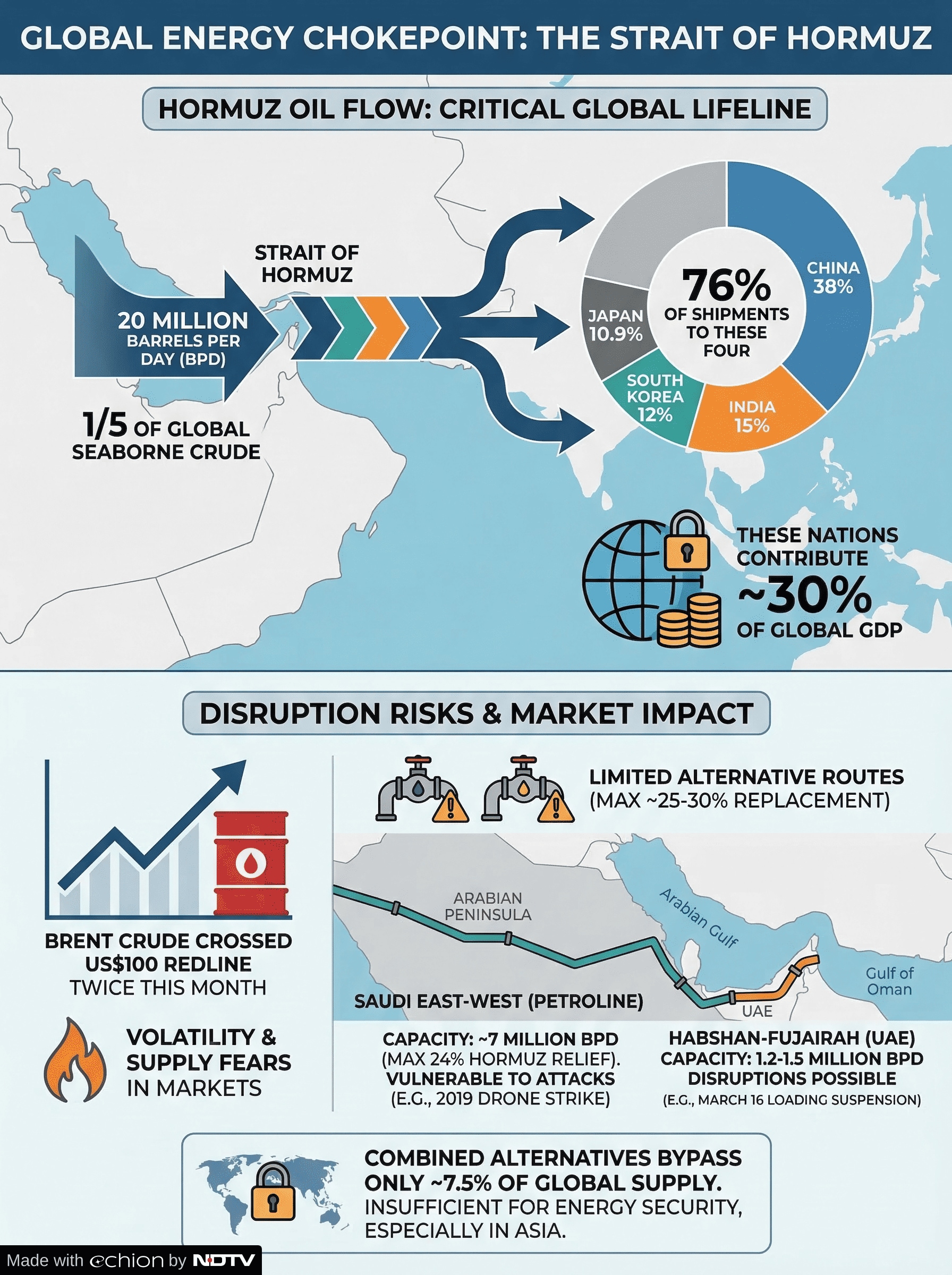
Saudi and UAE pipelines offer marginal relief for Hormuz oil chokehold.
In addition, India also imports - from Qatar, again, and Iran via the Hormuz - large quantities of LPG, or liquified petroleum gas, that is used by over 33 crore households.
This degree of heavy reliance led to worries about critical oil and gas shortages in the country as a result of the Iran war. However, the government has stressed there is no immediate danger.
On Thursday the government reiterated its position and said India had about 60 days of oil stock cover and 30 days of LPG cylinder supply. Reports of shortages were slammed as a "deliberate misinformation campaign" to trigger panic buying.
Industry sources told NDTV the government had fast-tracked the signing of contracts to diversify crude and LPG imports.
RECAP | India Speeds Up Oil, LPG Import Deals Amid Middle East Supply Shock
Meanwhile, junior Petroleum Minister Suresh Gopi told Parliament this week that India's three strategic reserves currently hold an estimated 3.372 million tons - or two-third its maximum capacity.
RECAP | How Much Crude Oil Reserve Does India Have? What Union Minister Said
In addition, current total reserves - i.e., SPRs, which hold unrefined or crude oil, and ready-to-use fuel - are at 74 days, Gopi said, "... which includes stores with oil marketing companies".
RECAP | LPG Production Up 25%, Government Says Amid Shortage Reports
On the supply of LPG, i.e., liquified petroleum gas used to cook food by over 33 crore Indian households, the government said early March it had ordered a 25 per cent increase in domestic production and that there is no need for panic buying.
Track Latest News Live on NDTV.com and get news updates from India and around the world

