





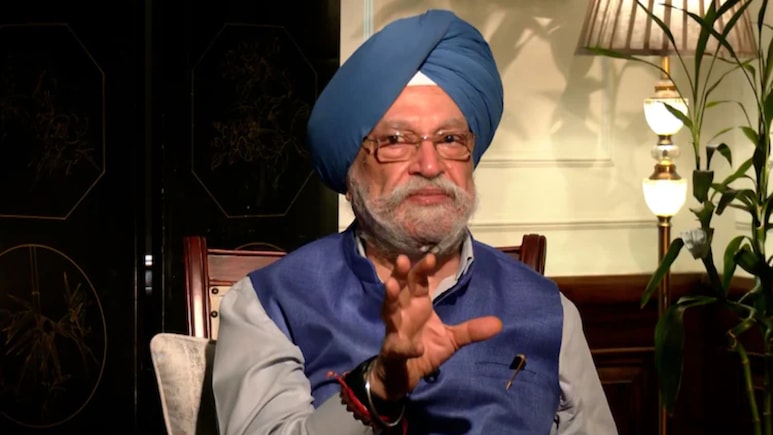
- Petroleum Minister Puri called the E20 petrol controversy a manufactured issue like LPG scare earlier
- India achieved 20% ethanol blending in petrol by early 2025, five years ahead of schedule
- Complaints rose only after June 5 launch of E85 flex-fuel vehicles by major manufacturers
Petroleum Minister Hardeep Singh Puri has dismissed the sudden furore over India's E20 ethanol-blended petrol as a manufactured controversy, drawing a direct parallel with what he called a similarly engineered scare over LPG cylinder shortages just weeks earlier.
The row has erupted around a programme with a much longer history. India's ethanol blending push was first envisioned in 2005, and reached its 20% blending target in early 2025 - five years ahead of the original 2030 deadline. E20 has been sold quietly since, Puri insists complaints over engine wear, gaskets and mileage surfaced only after the June 5 launch of E85 flex-fuel vehicles by Hero, Suzuki and Toyota, prompting opposition allegations of an unconsented "experiment" on consumers and renewed calls for pump-level choice, modelled on Brazil.
In a wide-ranging conversation with NDTV, Puri questioned the timing of the backlash rather than its substance. The June 5 launch, he noted, fell on World Environment Day, and he believes it unsettled interests opposed to India's flex-fuel and EV transition - hence the sudden burst of complaints on a policy that had drawn none for nearly two years.
#NDTVExclusive | 'Ethanol Controversy Is Fear-Mongering': Hardeep Puri Speaks to NDTV @HardeepSPuri | @GaurieD pic.twitter.com/mj37eGvo9J
— NDTV (@ndtv) July 8, 2026
Puri pushed back hard against opposition claims - describing the programme as "an experiment on 3.6 crore Indians" - arguing the blending policy dates back to a 2005 parliamentary commitment, long before the current government, and that a Supreme Court reference to "experiment" concerned procurement quantities in a Karnataka case, not the blending mandate itself.
On the technical complaints - gasket wear and reduced mileage in older, pre-2023 vehicles - the minister conceded some basis but framed them as manageable and driving-dependent. He cited manufacturer data showing 1.5 crore vehicles serviced without complaint, and pointed to ethanol's higher octane count (108 versus roughly 84 for petrol) as the reason for marginal mileage trade-offs.
On the demand for consumer choice at the pump, Puri was unambiguous: logistics make separate ethanol grades impractical, given shared underground tank infrastructure at fuel stations that cannot support multiple blends simultaneously.
The minister drew a wider strategic argument: that ethanol blending is now central to India's energy security calculus, especially with over 85% of crude imported and supply routes through the Strait of Hormuz vulnerable to geopolitical disruption. He credited the programme with saving Rs 1.9 lakh crore in foreign exchange, and linked it to the broader "atmanirbhar" push in energy, alongside enhanced production incentives for domestic oil and gas exploration.
On pricing, Puri maintained that India, alongside Japan, has shielded consumers better than most nations from global crude volatility, citing three rounds of excise duty cuts - in November 2021, May 2022 and March this year - that kept retail fuel prices lower than four years ago despite market pressures.
The larger message from the minister was that India's energy and biofuel strategy, he argued, is being tested - and targeted - precisely because it is working.
Track Latest News Live on NDTV.com and get news updates from India and around the world

