





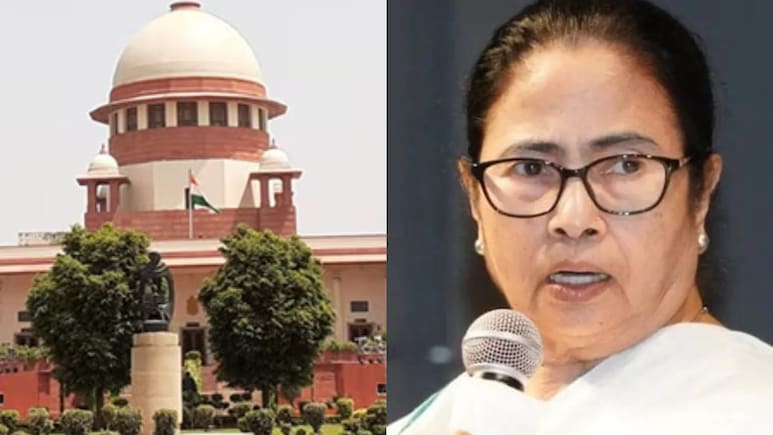
What if your government is in power at the Centre and some other political party does the same at the state level, the Supreme Court posed this counter question to the Mamata Banerjee government during a hearing on the Bengal Chief Minister's alleged interference in the search operations conducted against political consultancy firm I-PAC.
The Enforcement Directorate, or ED, has accused Bengal Chief Minister Mamata Banerjee and state officials of interfering with its investigation and searches at the offices of political consultancy firm Indian Political Action Committee, or I-PAC, which works with the Trinamool. The raids happened in early January as part of a money laundering investigation.
The top court questioned the objections raised over maintainability of the plea moved under Article 32 by Enforcement Directorate (ED) against Mamata Banerjee's alleged interference in the raids against I-PAC.
A bench of Justices PK Mishra and NV Anjaria said that some officers of the ED, which investigates financial crimes, have also petitioned it in their individual capacity.
The court asked the counsel opposing the ED plea to answer whether the agency's officers cease to become citizens of India merely because they are officers of ED.
"Please concentrate on the fundamental right of the officers of the ED against whom the offence has been committed. Otherwise you will miss the point," Justice Mishra remarked.
"You can't forget the second petition which is preferred by individual officers who are the victims of the offence. You will be in difficulty, I am telling you. Don't just say ED, ED, ED," Justice Mishra added.
The court made the observation after senior lawyer Kapil Sibal, representing West Bengal, argued that the ED cannot file a petition under Article 32 when a remedy to approach the police is available to it.
"Any obstruction in performance of a statutory duty is not in violation of a fundamental right. If someone obstructs a police officer, he can't file a petition under Article 32. There is a statutory remedy. Otherwise every police officer will file a petition under Article 32. We can't interpret a law in the context of a particular situation and then open a Pandora's box inconsistent with the basic features of criminal law," Sibal argued.
Sibal also said that a person doesn't have a "fundamental right" to investigate a case.
"He (ED officer) only has a right under a statute to investigate. And violation of that right is not a violation of fundamental right," the senior counsel said.
The lawer added that the ED's own case is that they were exercising their statutory powers which were frustrated.
"There's no question of fundamental rights," Sibal said.
The court also strongly rebuffed suggestions to postpone the hearing of the case due to the upcoming Bengal Assembly elections.
"We don't want to be party to election, we don't want to be party to any crime also. We know the timing of the court. We know the timing of the decision," Justice Mishra said.
The court's comments came after senior lawyer Kalyan Bandopadhyay, representing Mamata Banerjee, referred to an earlier instance when a judge had decided not to hear a case citing elections.
However, the court asked him not to make such a suggestion before it.
Track Latest News Live on NDTV.com and get news updates from India and around the world

