





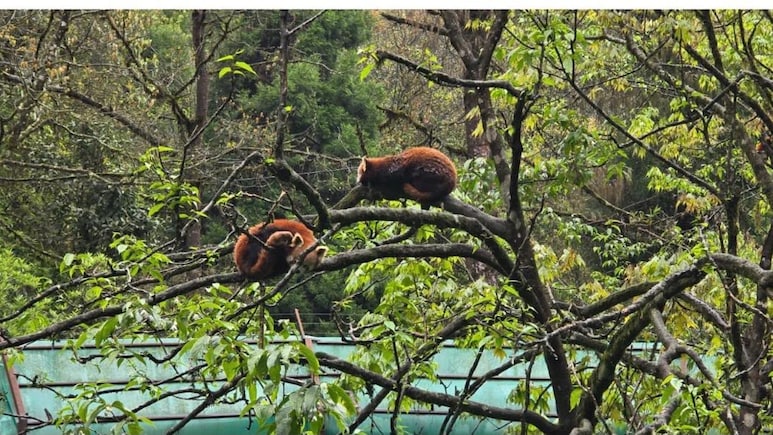
Sikkim is celebrating the progress of its Red Panda conservation and breeding programme, as Nuba and Numa, born last year, are now thriving and showing signs of becoming independent under watchful eyes of park authorities.
Himalayan Zoological Park authorities told NDTV that allowing public viewing may also be considered soon, but it would only happen after authorities are confident that a sterile environment is mentioned to ensure there is no outbreak of life-threatening diseases like canine distemper.
The captive Red Panda population at the Himalayan Zoological Park near Gangtok was nearly decimated by two outbreaks of canine distemper, a highly contagious and potentially fatal viral disease, but the birth of red panda cubs after seven years had given a fresh lease of life to the conservation programme at the Himalayan Zoological Park near Sikkim's capital, Gangtok.
Nuba and Numa, a male and female cub, were born on June 15, 2025, to Lucky (II) and Mirak. They now weigh between 3 and 3.5 kg each and have shown a good appetite and steady growth.
Their birth came after a difficult seven-year period in the history of the Red Panda Conservation Programme, initiated in 1997. There were no successful births in these seven years due to challenges such as two outbreaks of canine distemper that nearly decimated the captive red panda population.
The Himalayan Zoological Park's red panda (Ailurus fulgens) breeding programme began with Preeti, a female from Rotterdam Zoo in the Netherlands, and Jugal from Darjeeling's Padmaja Naidu Himalayan Zoological Park.
According to the World Wildlife Fund (WWF), almost 50% of the red panda's habitat is in the Eastern Himalayas. They use their long, bushy tails for balance and to cover themselves in winter, presumably for warmth. Primarily an herbivore, the name panda is said to come from the Nepali word 'ponya', which means bamboo or plant eating animal.
"Their successful breeding laid the foundation for a thriving genetic lineage. In 2005, the programme was further strengthened with the inclusion of a wild-origin pair, Lucky and Ram, helping expand and diversify the genetic pool of the red panda population at the park," an official said.
All red pandas born under this programme are tracked through national and international studbooks to ensure healthy genetic variability and global breeding cooperation, park authorities said.
Red pandas typically breed in the winter months between November and January. After a gestation period of about five months, females give birth between June and August in warm, hidden nests. In this case, park officials said that Mirak was observed participating in nest-building with Lucky-II, which marked a rare instance of male involvement in an activity like nest-building. Red panda males generally do not engage in cub-rearing.
The public will still have to wait for a while to see the two new Red Pandas, as the cubs were being raised away from the public eye until they turned old enough for viewing, officials said.
"These new cubs will stay with their mother for over a year, reaching full size by 12 months and becoming sexually mature by 18 months. Their health and compatibility will then be assessed as part of future breeding strategies for the endangered species," park authorities had said last year after their birth.
The birth of Nuba and Numa was also very significant for HZP's participation in the Red Panda Conservation Breeding Programme under the Central Zoo Authority's endangered species breeding initiatives, and their survival is also something that authorities are now confident about. Nuba and Numa are continuing to grow, climb and adapt to their surroundings - offering a positive sign for red panda conservation and breeding at the park.
According to the WWF, Red pandas are currently listed as endangered species by the IUCN, and their numbers are believed to be less than 10,000 individuals in the wild. However, the exact figure remains unknown.
Located at Bulbuley, 3 km from Gangtok, the 205-hectare Himalayan Zoological Park is at an average elevation of 1,780 metres. Apart from the red panda, the park houses the snow leopard, Himalayan palm civet, monal (pheasant), Himalayan black bear, and crimson-horned pheasant.
The Himalayan Zoological Park is currently focused on maintaining a healthy founder stock for future breeding. A dedicated Red Panda Conservation Breeding Centre has also been proposed outside the main park complex, with plans to combine breeding with research and support for in-situ conservation.
The Red Panda has a special place in Sikkim, where it is the official state animal. The baby Red Pandas are also open for adoption under 'My Child From Wild', a community campaign to support zoo animal welfare and conservation education.
With Inputs From Pankaj Dhungel
Track Latest News Live on NDTV.com and get news updates from India and around the world

