





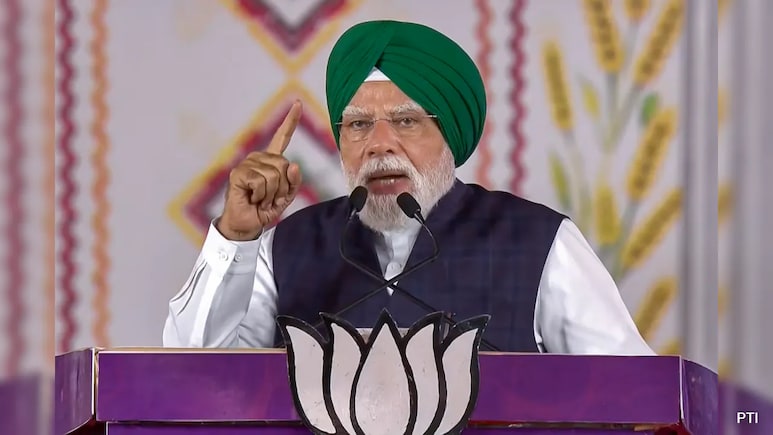
- Prime Minister Narendra Modi's visit to Punjab appeared to mark the beginning of a political reset for the BJP
- That narrative has been disrupted by the farmers' agitation against the proposed India-US trade deal
- Punjab is witnessing scenes that evoke memories of 2020-21 farm laws protest and 2024 farmers' agitation
Just days ago, Prime Minister Narendra Modi's visit to Punjab appeared to mark the beginning of a political reset for the BJP in a state where the party has struggled to overcome the legacy of the 2020-21 farm laws agitation. The focus was firmly on development, infrastructure and investment. PM Modi's decision to wear a green turban, a colour closely associated with Punjab's farming community, was widely seen as a symbolic outreach to rural voters.
The message was unmistakable: the BJP wanted Punjab's politics to move beyond the farm laws and towards development as it prepared for Assembly elections due in about six months.
That narrative, however, has been disrupted by the farmers' agitation against the proposed India-US trade deal.
With thousands of farmers gathering at the Shambhu border and Haryana Police once again stopping them from marching towards Delhi, Punjab is witnessing scenes that evoke memories of both the 2020-21 farm laws protest and the 2024 farmers' agitation. For the BJP, it is an uncomfortable case of political deja vu.
The similarities extend beyond the visuals of barricades, protest camps and security deployments.
When the Centre introduced the three farm laws through ordinances in 2020, the BJP repeatedly argued that farmers had misunderstood the reforms and should first understand the legislation before opposing it. Senior leaders assured farmers that the Minimum Support Price (MSP) regime would continue and that mandis would not be dismantled. Those assurances failed to convince Punjab's farmers, culminating in one of the largest protest movements in independent India before the laws were eventually repealed.
A similar argument is now emerging over the proposed India-US trade agreement.
Punjab BJP president Kewal Singh Dhillon has urged farmers not to jump to conclusions, saying no final agreement has been signed and that there will be "no compromise on the interests of farmers and livestock rearers". He has also said Prime Minister Narendra Modi has assured that Punjab's farmers will not be adversely affected.
Farmer organisations remain unconvinced. They fear lower import duties could allow heavily subsidised American agricultural and dairy products to enter the Indian market, depressing prices and reducing farm incomes. They argue that waiting until the agreement is finalised would leave little scope to protect farmers' interests.
The issue has rapidly become a political flashpoint.
The Congress has launched a campaign against the proposed trade agreement, alleging it would hurt Punjab's agriculture and dairy sectors. The Aam Aadmi Party has described the proposed pact as the "biggest betrayal of farmers" and demanded that the Centre make the draft agreement public. The Shiromani Akali Dal has also backed the agitation, accusing the Centre of ignoring the concerns of Punjab's farmers.
For the BJP, the timing is particularly difficult.
The party has been trying to expand beyond its traditional urban support base and make inroads into Punjab's rural belt ahead of the Assembly elections. PM Modi's recent visit was widely interpreted as the start of that outreach. Another farmers' movement centred on Punjab, however, risks reviving memories of the farm laws agitation that severely damaged the BJP's standing among the state's farming community.
Unlike the 2020 agitation, which was directed against domestic agricultural reforms, the present mobilisation is centred on an international trade agreement. If it gathers momentum, it could become India's first large-scale farmers' movement against a foreign trade pact, forcing political parties to articulate how they intend to balance global trade ambitions with the interests of domestic agriculture.
With elections approaching, the protests have the potential to once again make farmers' issues the defining theme of Punjab's political discourse. For the BJP, which hoped to contest the election on development and governance, the return of farmers to the Shambhu border threatens to reopen a chapter it has spent years trying to close.
Track Latest News Live on NDTV.com and get news updates from India and around the world

