





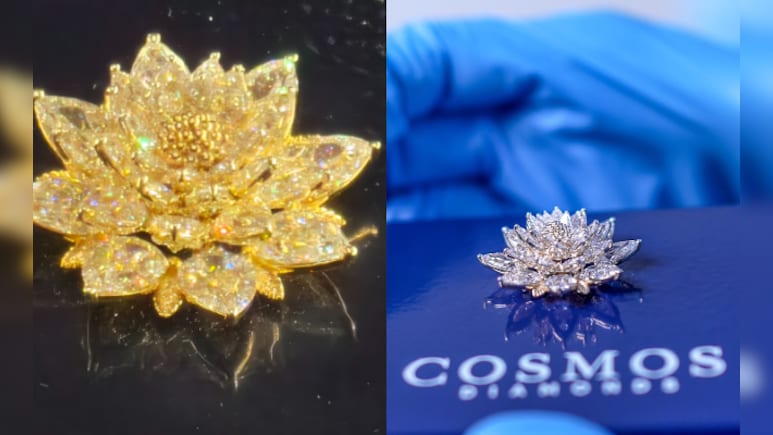
A childhood nursery rhyme that generations of children have sung before bedtime has found a remarkable new realistic expression in space.
"Twinkle, Twinkle, Little Star, Like a Diamond in the Sky" is no longer just a line from a poem. Thanks to a collaboration between Bengaluru based Cosmos Diamonds and Hyderabad headquartered Skyroot Aerospace, there is literally now a lotus diamond inspired by that very idea orbiting Earth.
The diamond, called Cosmic Bloom, is a lotus shaped creation conceived by entrepreneur and National Institute of Design (NID) trained jewellery designer Sanjana T., founder of Cosmos Diamonds, Bengaluru. A replica of the unique diamond was launched aboard Skyroot Aerospace's historic Vikram 1 mission, turning a childhood imagination into a technological and cultural milestone.
A week since launch… and I still can't stop watching this on loop. ❤️🚀
— Pawan (@PawanKChandana) July 25, 2026
What are the odds that Vikram-1's very first sunrise in orbit makes its grand entrance through the diamond on board?
Some moments can't be engineered.
That perfect sun angle happened only because of the… pic.twitter.com/KftlA2X8eJ
For Sanjana, the experience was almost impossible to describe. "It is beyond my wildest dreams that this has actually happened," she told NDTV. "It all started from that little nursery rhyme that we all know, Twinkle-Twinkle Little Star. How I wonder what you are, up above the world so high, like a diamond in the sky. And now it gives me so much pride to tell you that now there is actually a diamond in the sky."
The story behind Cosmic Bloom is as fascinating as the object itself.
The collaboration began almost by chance. Sanjana met Skyroot Aerospace, Co-Founder Pawan Chandana at a business gathering nearly a year before the mission. During their discussions, they discovered a unique connection between their aspirations. Cosmos Diamonds represented innovation in sustainable lab grown gems while Skyroot was preparing to make history with India's private orbital launch ambitions.
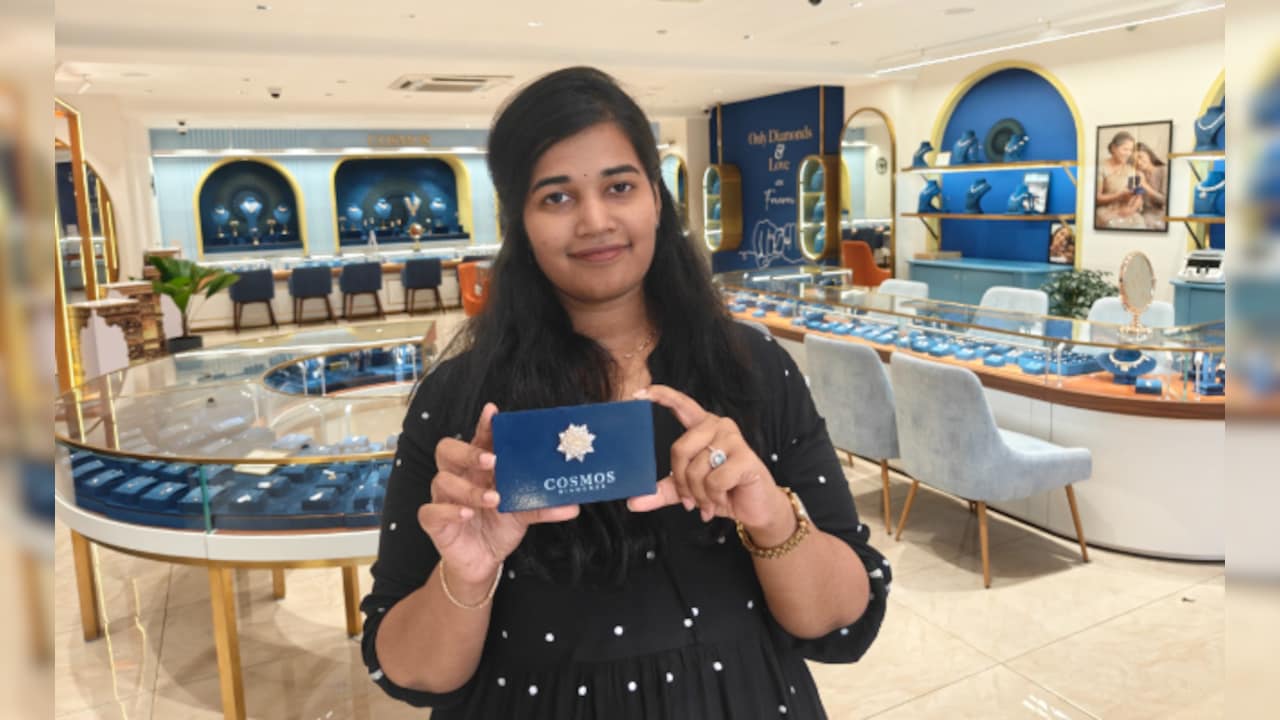
Sanjana explained her vision of creating environmentally friendly diamonds through advanced technology and how they represented the aspirations of a new GenZ India. Chandana was intrigued.
According to Sanjana, both soon found themselves discussing a simple childhood rhyme known to every Indian child.
"We both bonded over the fact that this nursery rhyme that everyone knows. Do you think we can make it true?" she recalled. That question would eventually lead to a diamond motif finding its place in orbit.
The choice of design was equally deliberate.
Months were spent debating what symbol should accompany the historic mission. Sanjana and her team believed that whatever travelled aboard the rocket would effectively become a message from India to the world. On July 18, a brave new world was opened by 28 year old's, who toiled day and night to reach this new peak in innovation.
The answer emerged from India's own cultural heritage.
The lotus, India's national flower, became the obvious choice.
"Anything we put on that rocket is a message from India to the world," Sanjana said. "We wanted to represent ancient Indian wisdom and culture and heritage."
The lotus occupies a unique place in Indian civilization. Found in temple carvings, paintings, literature and spiritual traditions, it is recognized across regions, religions and communities. The flower is associated with purity, wisdom, resilience and divinity. "If you see our Gods, whether it is Buddha, whether it is Lakshmi, whether it is Saraswati, whether it is Brahma, almost everyone is usually seen with a lotus," Sanjana explained.
The design also offered a practical advantage.
A lotus remains visually elegant from every direction.
"We do not know where the camera is in space and how it is going to be shot," she said. "This is the only design which looks great from any angle."
The resulting creation was named Cosmic Bloom, symbolising both the blossoming lotus and humanity's quest to explore the cosmos.
For an entrepreneur whose company is called Cosmos Diamonds, seeing her creation carried into the real cosmos felt almost destined.
"It is actually a very divine coincidence that our brand name is Cosmos and now I get to see my diamond in the backdrop of the real Cosmos," she said. "It is a feeling I cannot even begin to explain."
What makes the story even more remarkable is that the diamond was conceived, designed and crafted in Bengaluru and Surat. Sanjana, trained at the National Institute of Design, belongs to a new generation of Indian designers who are combining art, technology and sustainability.
Unlike traditional mined diamonds, Cosmos Diamonds specializes in lab grown diamonds. These diamonds possess the same physical and optical characteristics as natural diamonds while being produced through advanced scientific processes. In India most lab grown diamonds are grown in Surat, the diamond capital of India and possibly the world now.
In many ways, the mission represented the convergence of two major trends shaping modern India. One was the rise of private space exploration represented by Skyroot Aerospace. The other was the emergence of technology driven, environmentally conscious entrepreneurship represented by Cosmos Diamonds.
The emotional peak came after launch.
As the spacecraft travelled through orbit, cameras captured sunlight illuminating the lotus diamond.
For anyone connected with diamonds, light is everything.
"There were tears in my eyes," Sanjana said. "Diamonds are all about light. I was thinking if only there was some light."
Then came the moment she will never forget. "The first rays of sunlight actually hit it from the side view and for a moment you could see as if it is really blooming and there was starlight everywhere."
The image of sunlight streaming through the lotus shaped diamond transformed Cosmic Bloom from a payload into a cosmic karmic eternal symbol of hope crafted by Indian youth. Sanjana says it is a memory she expects to carry throughout her life.
"I think that is a moment I am never going to get over. It is a very cool story I will be telling my grandkids one day."
For Skyroot Aerospace, the diamond represented something much larger than a decorative object.
Skyroot Aerospace Co-Founder Pawan Chandana often spoke about making the dream of "a diamond in the sky" a reality through the collaboration. The mission showcased how private Indian companies can merge science, culture and imagination into a single story capable of inspiring millions.
Today, the original Cosmic Bloom is circling the Earth four hundred and fifty kilometres above the planet. Travelling at orbital velocity of twenty eight thousand kilometres per hour, it is far removed from the workshops where it was designed and crafted. Today the Cosmic Bloom sees 16 sunsets and sunrises every 24 hours.
Yet its significance extends beyond engineering or jewellery.
It connects a nursery rhyme sung by children, a lotus revered in Indian culture, a designer's imagination, and a rocket built by Indian engineers.
In an age when space missions often focus on technology, Cosmic Bloom adds a deeply human dimension. It is a story about imagination becoming reality. It is about India's cultural heritage finding a place in orbit. It is about a young NID trained designer whose dream reached space. And above all, it is about a childhood line that finally came true.
A diamond is forever. But Cosmic Bloom has become something even rarer. It is truly a diamond in the sky.
Track Latest News Live on NDTV.com and get news updates from India and around the world

