





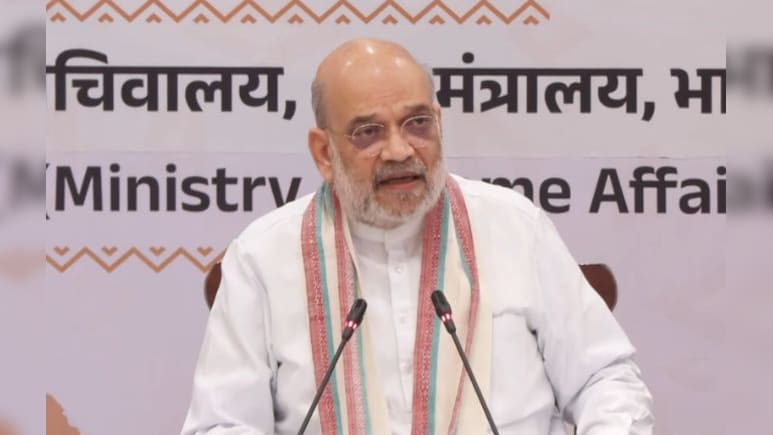
Union Home Minister Amit Shah on Tuesday declared Bastar completely free from Naxalism, calling it a historic turning point in India's decades long battle against Left Wing Extremism.
Chairing the 26th Central Zonal Council meeting in Bastar, the Home Minister said the success marked the beginning of a new phase focused on development, justice delivery and governance in former insurgency hit regions.
“It is a matter of great satisfaction that this meeting is being held in Bastar and even before the meeting, the entire Bastar region has become Naxal free,” Mr Shah said while congratulating Prime Minister Narendra Modi on what he described as the achievement of a “Naxal-free India”.
The high level meeting was attended by Vishnu Deo Sai, Mohan Yadav, Yogi Adityanath and Pushkar Singh Dhami along with senior officials from the Centre and participating states.
Giving credit to security forces, intelligence agencies and coordinated action between states and the Centre, Mr Shah said the operation against Naxalism succeeded because of a “whole of government approach” under which development and security moved together.
But the Home Minister also cautioned that the battle is not fully over yet. “For nearly five decades, these regions remained behind in the race of development. Our fight will continue till these areas stand at par with the rest of the country,” he said.
In a strong political and administrative message, Shah said the entire Central Zone comprising Chhattisgarh, Madhya Pradesh, Uttar Pradesh and Uttarakhand is now free not just from Naxal violence but also from pending inter-state disputes.
Calling it a major achievement of cooperative federalism, he said the Modi government has transformed Zonal Council meetings into a result oriented mechanism.
Amit Shah highlighted that between 2004 and 2014 only 11 Zonal Council meetings were held, while the number rose to 32 between 2014 and 2026. Discussions on issues increased from 569 to 1,729 during the same period, with around 80 per cent of them resolved.
The Home Minister also used the platform to push states on governance and law enforcement priorities. He urged Chief Ministers to intensify efforts against malnutrition, improve school education, reduce dropout rates and strengthen rural development schemes.
On crimes against women and children, Mr Shah said timely DNA testing in POCSO and rape cases can significantly improve conviction rates and stressed the need for special courts to fast track cases pending for over five years.
He also directed states to upgrade cyber fraud helpline 1930 call centres according to Union Home Ministry standards.
In one of the strongest messages of the meeting, Mr Shah set an ambitious target for the justice system, saying India should aim to dispose of every criminal case from trial courts to the Supreme Court within three years before 2029.
“Just as we freed the country from Naxalism, we must now ensure speedy justice for every citizen,” he said.
Track Latest News Live on NDTV.com and get news updates from India and around the world

